

What Is Sales Prospecting? Definition, Steps, Best Practices
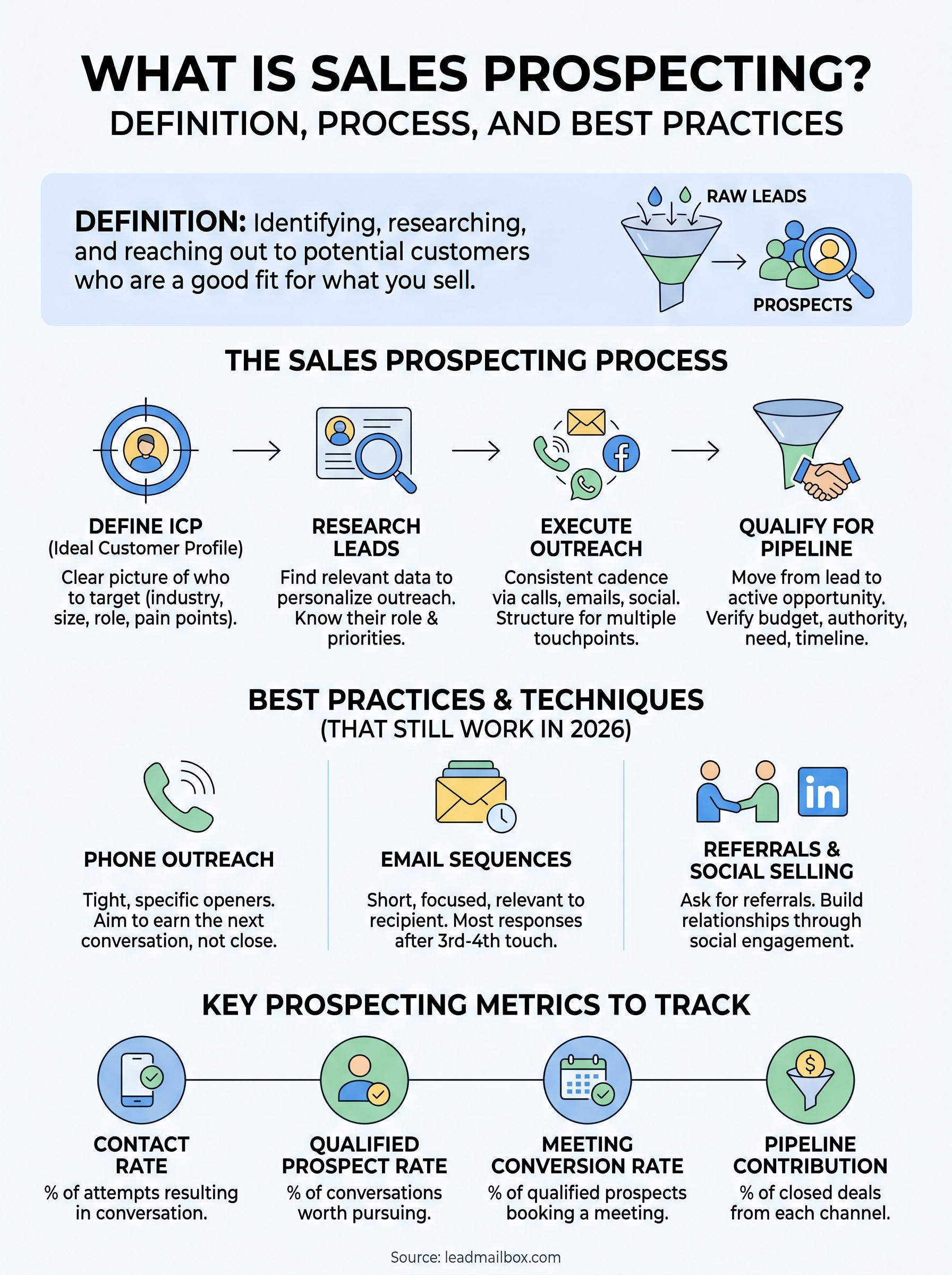
Every closed deal starts with a conversation, but before that conversation happens, someone has to figure out who's worth talking to. That's exactly what sales prospecting is: the process of identifying, researching, and reaching out to potential customers who are a good fit for what you sell.
Without a solid prospecting process, sales teams burn hours chasing leads that were never going to convert. Pipeline dries up, deals stall, and revenue targets slip. With a structured approach, reps spend their time on the right people, using the right message, at the right moment, which is exactly why we built LeadMailbox to help teams aggregate, organize, and act on leads from hundreds of sources in one place.
This guide breaks down the full sales prospecting process from start to finish. You'll learn what it actually involves, the steps that make it work, and the best practices that separate reps who hit quota from those who don't. Whether you're new to outbound sales or tightening up an existing workflow, everything here is built to be actionable, not theoretical.
Why sales prospecting matters
Sales prospecting is the engine that keeps a revenue operation running. Without a consistent flow of qualified potential buyers entering your pipeline, even the best closers on your team have nothing to work with. When you understand what is sales prospecting and why it matters, it becomes clear that prospecting isn't optional. It's the foundational activity that everything else in the sales process depends on, and the teams that treat it that way consistently outperform the teams that don't.
A full pipeline doesn't happen by accident
Most sales reps focus on the deals already in front of them and push prospecting to the back burner. That behavior creates a feast-or-famine cycle: you close a batch of deals, your pipeline empties, and then you scramble to fill it back up. The reps who consistently hit their numbers treat prospecting as a daily, non-negotiable habit, not something they do when things slow down.
Keeping your pipeline full requires deliberate, repeatable effort at the top of the funnel. When you prospect on a regular cadence, you build a continuous stream of opportunities so your future revenue isn't entirely dependent on the handful of deals you're trying to close right now.
A full pipeline is the difference between a team choosing their best opportunities and a team taking whatever they can get.
Better prospects mean better close rates
Prospecting isn't just about quantity. It's about targeting the right people so the conversations you have are worth having. When you rush through prospecting or skip the research phase, you end up booking calls with contacts who don't have the budget, the authority, or the need for what you're selling. That wastes time on both sides and inflates your activity numbers while dragging down your actual win rate.
Spending time upfront to verify that a potential customer matches your ideal customer profile changes the dynamic entirely. You're not trying to convince someone to care. You're connecting with someone who already has a reason to listen. A rep who books 10 well-qualified calls will almost always outperform a rep who books 30 unqualified ones, even though the second rep looks busier on paper.
Prospecting creates predictable revenue
For sales leaders and business owners, predictable revenue is what separates a scalable operation from a chaotic one. If prospecting happens in bursts rather than consistently, the deals that close come in unpredictable waves, which makes it nearly impossible to forecast accurately or plan for growth.
When your team prospects on a structured, consistent schedule, the data starts working in your favor. You learn how many outreach attempts it takes to book a meeting, how many meetings convert to proposals, and how many proposals close. That ratio becomes a reliable model you can use to set realistic targets, hire at the right time, and identify exactly where your process is breaking down before it costs you a quarter.
Prospecting also surfaces market intelligence that you won't find in a dashboard. When reps are regularly talking to potential buyers, they pick up on shifting objections and emerging competitor activity that feeds directly back into how you position your offer. That feedback loop is one of the most underrated benefits of building a disciplined prospecting process, and it only works if the prospecting is actually happening at consistent volume.
Leads vs prospects vs lead generation
These three terms get mixed up constantly, and the confusion costs sales teams real time and money. When you understand what each term actually means, you can build a process where the right people get the right level of attention instead of treating every name in your database the same way.

The difference between a lead and a prospect
A lead is anyone who has shown some form of interest in your product or fits a general profile that suggests they might. They filled out a form, downloaded something, or showed up in a list you purchased. A prospect, on the other hand, is a lead you've already evaluated and confirmed is a realistic potential customer based on specific criteria like budget, industry, company size, or role.
The gap between a lead and a prospect is where a lot of reps lose efficiency. They skip the evaluation step entirely and treat every lead as if it's worth the same effort, which floods their schedule with calls that go nowhere. Part of understanding what is sales prospecting is recognizing that prospecting is specifically the work of moving a lead through that evaluation and deciding whether they deserve a spot in your active pipeline.
The moment you qualify a lead and confirm it fits your criteria, it becomes a prospect. Everything before that is just a name.
How lead generation connects to prospecting
Lead generation is the upstream activity that fills the top of your funnel with raw leads. It includes paid ads, content marketing, referrals, trade shows, and any other mechanism that brings potential buyers into your orbit. Prospecting is what happens after that, when a rep takes those raw leads and does the work to figure out which ones are actually worth pursuing.
Think of lead generation as filling a bucket and prospecting as examining what's inside. You still need a steady flow of leads coming in, but without a structured prospecting process to filter them, volume becomes noise rather than opportunity. The two activities work together, but they serve different functions and require different skills.
Why the distinction matters for your team
Treating leads and prospects as the same thing creates two predictable problems: reps waste time on contacts that were never going to convert, and genuinely strong leads get buried under the noise of unqualified ones. When your team applies a consistent filter before moving a lead to active outreach, close rates improve and forecasting becomes more reliable because your pipeline reflects real opportunities, not wishful thinking.
Where prospecting fits in the sales process
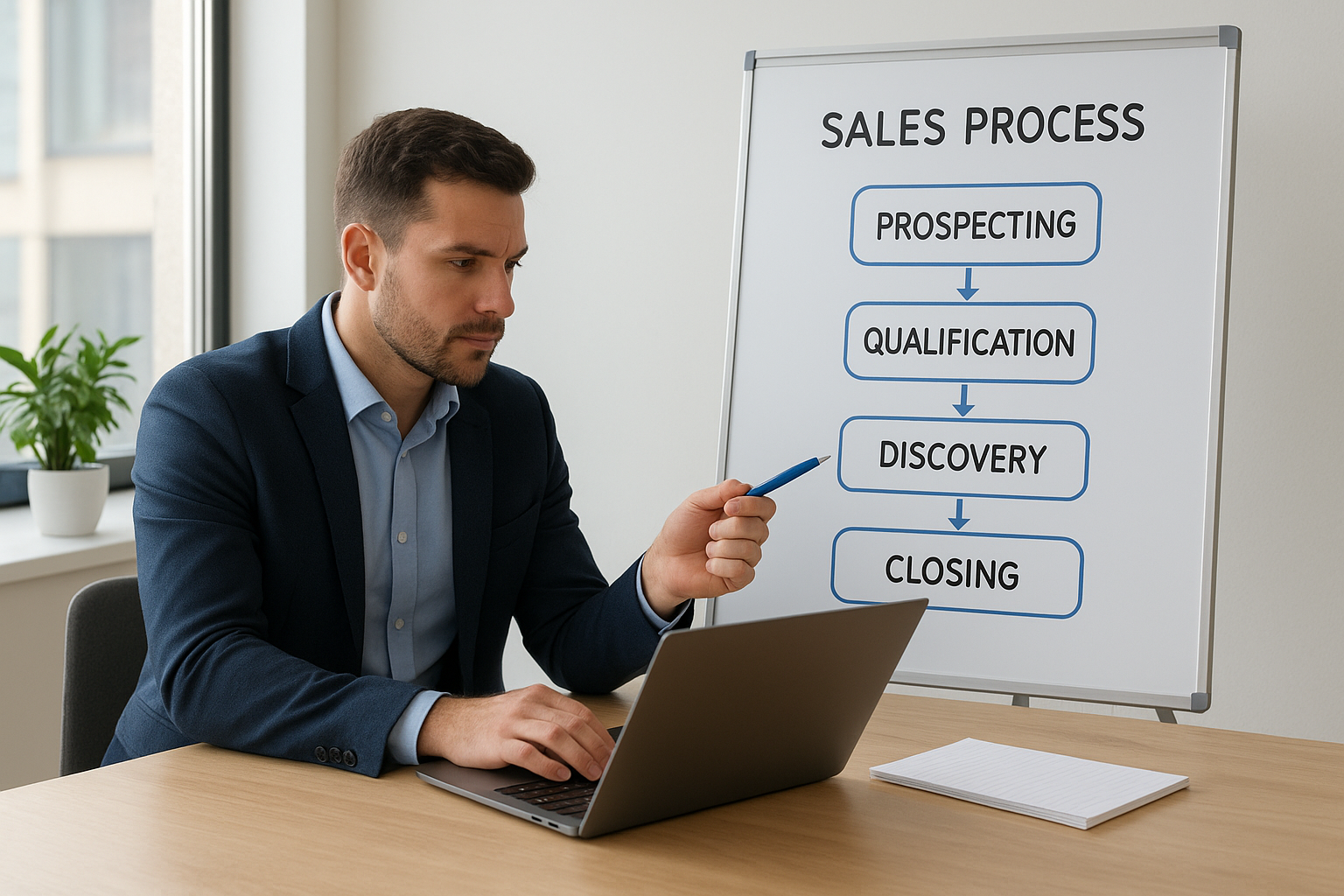
Sales prospecting sits at the very beginning of your pipeline, before discovery calls, before demos, and long before any proposal goes out. It's the first stage in a sequence that only moves forward when you've identified someone who is worth your time and confirmed that they fit the criteria you've set. When you understand what is sales prospecting and where it lives in the overall process, you stop treating it as a side task and start treating it as the foundation everything else is built on.
Prospecting comes before everything else
Every stage in your sales process depends on what happens before it. Qualification depends on having someone to qualify. Discovery depends on having a conversation booked. Closing depends on working with a prospect who has already been vetted. Prospecting is the step that supplies all of it. When prospecting is weak or inconsistent, every downstream stage suffers because you're either working with too few opportunities or the wrong ones.
The sequence typically looks like this: you identify a potential buyer, research whether they fit your profile, make contact, and then move them to the qualification stage if the response is positive. Prospecting ends the moment someone agrees to a conversation. Everything after that belongs to a different part of the process, and conflating the two causes reps to rush the front end and waste effort on the back end.
Skipping or shortchanging the prospecting stage is the most common reason sales teams have active pipelines that never actually close.
How prospecting connects to qualification
Prospecting and qualification are closely related but they serve different purposes at different points in the funnel. Prospecting determines whether a lead is worth reaching out to at all, based on external signals like industry, company size, or role. Qualification happens after you've made contact and can ask direct questions to confirm whether the person has the budget, authority, need, and timeline to move forward.
Treating these as the same step is where a lot of teams make mistakes. When reps skip proper prospecting and jump straight to outreach, they spend their qualification conversations discovering what good prospecting would have told them upfront. That shift costs time and lowers the quality of your entire pipeline. Keeping the two stages separate makes your process cleaner and your results more predictable.
How the sales prospecting process works
Understanding what is sales prospecting at a conceptual level is useful, but the real value comes from knowing the specific steps that turn a cold list into a conversation. The prospecting process isn't one single action. It's a sequence of decisions and activities that, when done in order, consistently move the right people toward your pipeline.
Define your ideal customer profile first
Before you reach out to anyone, you need a clear picture of who you're targeting. Your ideal customer profile (ICP) describes the type of company or person most likely to buy from you and get real value from your product. This means getting specific about industry, company size, geography, role, and common pain points so you're not guessing when you evaluate whether a lead is worth pursuing.
Without a defined ICP, your outreach becomes scattershot. Every rep on your team ends up making different judgment calls about who qualifies, which means your pipeline fills with inconsistent quality and your results become hard to reproduce. A written ICP solves that by giving everyone the same filter to work from.
Research your leads before you reach out
Once you have your ICP, the next step is sourcing leads that match it and doing enough targeted research to personalize your outreach. This doesn't mean spending 45 minutes on every contact. It means knowing the person's role, understanding their likely priorities, and identifying a credible reason to reach out before you write a single word.
Personalization based on real research will always outperform volume-based outreach that ignores who the person actually is.
Skipping this step is what makes prospecting feel like cold calling at its worst. When your message shows genuine relevance to the person's situation, your response rate climbs because recipients can tell you actually know something about them rather than blasting a generic template to a list.
Execute outreach on a consistent cadence
Reaching out once and moving on is one of the most common prospecting mistakes sales reps make. Most responses come after multiple touchpoints across different channels. Build a structured sequence that includes calls, emails, and where appropriate, direct messages, spaced out over several days or weeks so you stay visible without becoming a nuisance.
Track every attempt so you know exactly where each lead stands and what your next scheduled action should be. This keeps contacts from slipping through the cracks and gives you data to sharpen your approach over time.
Prospecting techniques that still work in 2026
Part of understanding what is sales prospecting is recognizing that the specific tactics you use matter as much as the process itself. Some techniques that worked ten years ago have lost their edge, but several core methods still produce strong results in 2026 when you apply them with discipline and genuine personalization.
Phone outreach still converts
Cold calling is not dead. What stopped working was cold calling done badly, with no research, no relevance, and no clear reason for the person on the other end to stay on the line. When you do the upfront work to understand your prospect's role and likely priorities, a direct phone call remains one of the fastest ways to qualify someone or surface interest that email alone never would.
A 90-second phone call can tell you more about a prospect's fit than a week of email back-and-forth.
Keep your opener tight and specific to their situation. Reference something real, ask one focused question, and let them respond. The goal of the first call is not to close anything. It is to earn the next conversation.
Email sequences with real personalization
Generic bulk email produces generic results. What still works in 2026 is a short, focused sequence built around something specific to the recipient, their industry, a trigger event like a hire or funding round, or a problem you can address directly. Sequences work because most responses come after the third or fourth touchpoint, and a structured sequence keeps you consistent without requiring you to manually track every follow-up.
Keep each email short. Three to four sentences is enough. State why you are reaching out, connect it to something relevant to them, and make one clear ask.
Referrals and social selling
A direct referral from someone the prospect already trusts compresses the entire early stage of the sales process. When you close a deal, ask your new customer if they know two or three other people who face the same problem. Most reps skip this step entirely, which means they leave some of the highest-conversion leads sitting unused.
Social selling through platforms like LinkedIn works when you treat it as relationship-building rather than broadcasting. Comment on relevant posts, share useful perspectives, and start conversations before you ever send a connection request with a pitch attached. Warm familiarity built over weeks converts far better than a cold message that leads with an offer.
Prospecting frameworks and metrics to track
Understanding what is sales prospecting at a process level is useful, but having a structured framework to guide your daily decisions and clear metrics to measure results is what separates teams that improve over time from teams that repeat the same mistakes at higher volume.
Use a framework to guide your outreach decisions
A framework gives your team a shared decision structure so every rep approaches prospecting consistently rather than improvising on their own judgment. One practical starting point is the ICP-plus-trigger model: you define your ideal customer profile, then layer in trigger events like new funding rounds, leadership changes, or product launches that signal a prospect is likely in buying mode right now.
Many teams also work with a three-part filter: Does the company match your profile? Does the contact have the authority and realistic budget to buy? Is there a credible, specific reason to reach out today? If the answer to all three is yes, the lead earns a spot in your active outreach sequence. If it fails any of the three, you park it for later or remove it entirely rather than letting it dilute your pipeline.
A framework does not slow you down. It stops you from wasting time on contacts that were never going to convert.
Track the metrics that expose where your process breaks
Most reps track activity volume like calls made and emails sent, but ignore the numbers that actually reveal whether their prospecting is working. The four metrics worth monitoring closely are:
- Contact rate: What percentage of your outreach attempts result in an actual two-way conversation
- Qualified prospect rate: How many conversations produce a lead worth moving to the next stage
- Meeting conversion rate: How many qualified prospects agree to a discovery call or demo
- Pipeline contribution: What percentage of closed deals originated from each prospecting channel
Watching these four numbers gives you a diagnostic view of your entire prospecting operation. If your contact rate is strong but your qualified prospect rate is low, your targeting needs work. If your qualified prospect rate is solid but meeting conversion is low, your opener or messaging needs adjustment. The numbers tell you exactly where to fix the process rather than leaving you guessing about why results are inconsistent.
Next steps
Now that you have a clear picture of what is sales prospecting and how each piece fits together, the next move is turning that understanding into a repeatable daily habit. Start by defining or tightening your ideal customer profile so every rep on your team works from the same filter. Then audit your current outreach sequences to confirm they run long enough and include enough touchpoints to produce real responses. Pick the two or three metrics from the framework section and start tracking them this week, not next quarter.
The reps and teams that consistently hit their numbers do not prospect harder. They prospect smarter, with better targeting, structured sequences, and tools that eliminate the manual work that slows everything down. If you are ready to build a prospecting operation that keeps your pipeline full without wasting your team's time, see what LeadMailbox can do for your sales process and put the whole system to work.