

What Is Sales Pipeline Management? Stages & Best Practices
Every deal your team is working sits somewhere between "first contact" and "closed." The structure you build around that progression, and how actively you manage it, determines whether revenue shows up consistently or only by accident. That's exactly what sales pipeline management is: a repeatable system for tracking where each deal stands, what needs to happen next, and where opportunities are stalling out before they slip away.
Without that visibility, sales teams end up guessing. Reps chase the wrong leads, managers can't forecast accurately, and deals quietly die in the middle stages because nobody noticed they stopped moving. A well-managed pipeline fixes all of that by giving your team a clear, shared view of the entire sales process.
At LeadMailbox, we've spent over 20 years helping sales teams organize leads from multiple sources and convert them into closed deals. Pipeline management is central to everything our platform does, from lead aggregation to AI-powered outreach, because no tool matters if your pipeline is a mess.
This article breaks down the core stages of a sales pipeline, explains why active management makes a measurable difference, and walks through best practices you can apply right away to keep deals flowing. Whether you're building your first pipeline or tightening up an existing one, you'll leave with a practical framework to work from.
Sales pipeline vs sales process vs sales funnel
These three terms show up constantly in sales conversations, and people use them interchangeably all the time. That's a problem, because each one describes something distinct, and confusing them leads to sloppy thinking about where your revenue problems actually live. Understanding what separates them gives you a much clearer starting point for building something that works.

The sales pipeline
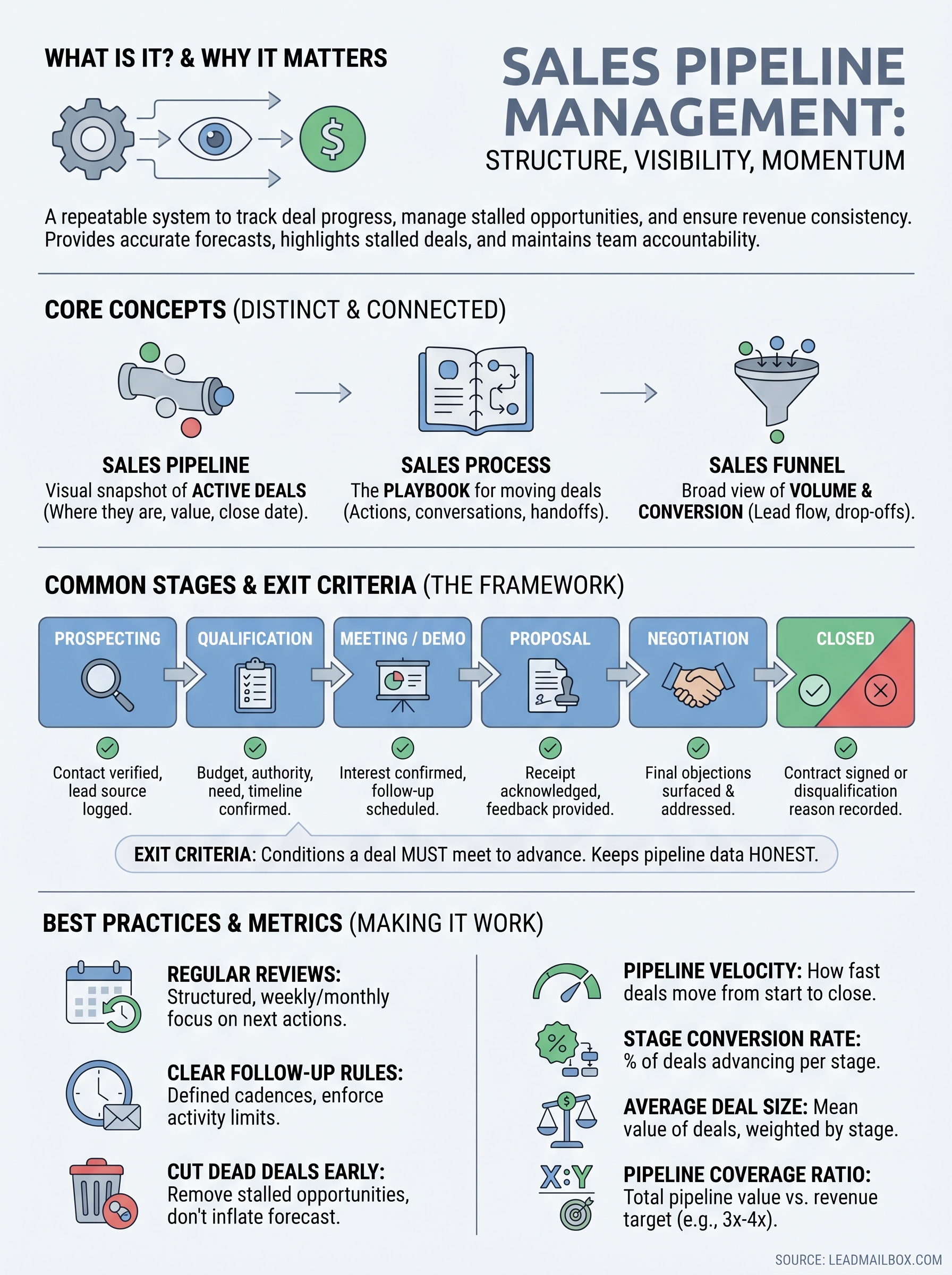
The sales pipeline is a visual representation of every active deal your team is working, organized by where each deal currently sits in your process. Think of it as a snapshot of work in progress. When you ask what is sales pipeline management, you're really asking how to actively oversee that snapshot so deals don't stall, disappear, or get misread as more valuable than they actually are.
Each deal in your pipeline carries a stage, an associated dollar value, and an expected close date. Your pipeline view lets you see all of that at once, which is what makes it useful for both day-to-day rep activity and longer-term forecasting. The pipeline is about the deals themselves, not the steps your team follows to work them.
The sales process
Your sales process is the playbook your team follows to move a deal from one stage to the next. It covers the specific actions, conversations, and handoffs that happen at each step. Where the pipeline shows you where deals are, the process defines how your team moves them forward.
A strong sales process gives every rep the same map, so the outcome of a deal depends less on individual style and more on consistent, repeatable execution.
Without clear process documentation, your pipeline fills up with deals that look healthy on paper but have no real momentum behind them. A well-documented sales process answers questions like: What does a rep do after an initial call? When does a deal qualify for a proposal? Who owns follow-up after a demo? Each of those answers removes a potential stall point.
The sales funnel
The sales funnel takes a broader, population-level view. It tracks how many leads enter the top of your process and what percentage convert at each stage, all the way down to closed deals at the bottom. Marketers tend to live in the funnel because it measures volume, conversion rates, and where the biggest drop-offs happen across your entire prospect pool.
Your funnel and your pipeline are looking at the same underlying activity from different angles. The funnel asks "how many?" while the pipeline asks "which ones, and where are they right now?" Both perspectives matter, but they answer different questions. Sales managers rely on the pipeline for deal-level visibility, while marketing and leadership use the funnel to evaluate overall program performance and spot systemic leaks.
Keeping these three concepts separate helps you diagnose problems more precisely. If your win rate is low, that's a process issue. If deals are stalling mid-stage, that's a pipeline management issue. If your lead volume is dropping, that's a funnel issue. Each problem has a different fix, and mixing up the terms makes it harder to find the right one.
Why sales pipeline management matters
A pipeline full of deals looks great until you realize half of them haven't moved in three weeks. Active pipeline management is what separates a realistic revenue forecast from wishful thinking. When you understand what is sales pipeline management at a practical level, you see that it's not just about tracking deals; it's about maintaining the momentum that turns tracked deals into actual closed revenue.
It gives you accurate revenue forecasts
Most revenue shortfalls don't come from a lack of leads. They come from overestimating deal quality without the data to back it up. When you manage your pipeline actively, you attach real probabilities to each stage, weight them against your close dates, and produce a forecast grounded in actual deal behavior rather than optimism. That accuracy matters when you're staffing a team, planning a campaign budget, or reporting to leadership.
Forecasting without pipeline data is guessing with extra steps.
Teams that review their pipeline regularly catch the gap between what reps say will close and what the data actually supports before the end of the quarter, not after. That kind of early warning changes how you respond, because you still have time to act.
It shows you where deals stall
Every pipeline has a stage where deals slow down and quietly die. Without clear visibility, those deals sit in your forecast, inflate your numbers, and distort every decision you make downstream. Active pipeline management forces you to assign defined next actions and deadlines to each deal, so stalls become visible while you can still do something about them.
When you spot that a deal has been in the proposal stage for four weeks with no activity, you can act: send a follow-up, re-engage the contact, or remove the deal entirely. Letting stale deals linger is how pipelines turn into fiction, and how forecasts miss every single quarter.
It keeps your team accountable
Pipeline reviews give managers and reps a shared, objective view of what's happening with each deal. Instead of relying on verbal updates that are hard to verify, you work from deal-level data that shows stage, value, activity history, and next steps. That transparency holds reps accountable without micromanaging them, and gives managers the context they need to coach at the right moments.
Sales pipeline stages and exit criteria
Understanding what is sales pipeline management in practice means knowing what each stage in your pipeline actually represents, and more importantly, what conditions a deal must meet before it advances to the next one. Those conditions are called exit criteria, and they're what keep your pipeline data honest. Without them, reps push deals forward based on optimism rather than actual progress, and your forecast reflects what people hope will happen rather than what the data supports.
Common pipeline stages
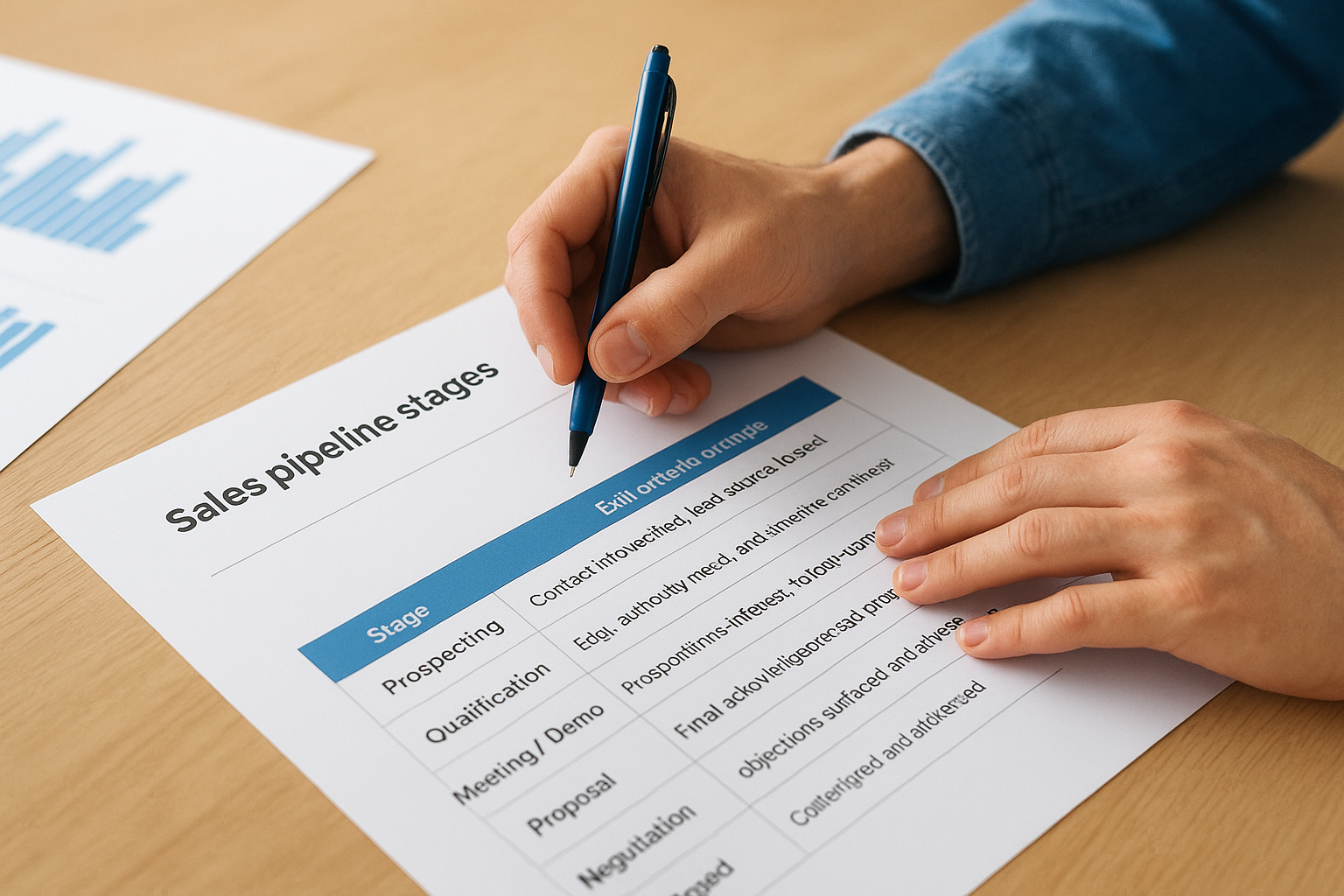
Most sales teams work with six core stages, though your specific business may need to adjust based on cycle length and deal complexity. The table below shows a standard structure with example exit criteria for each stage:
| Stage | What it covers | Exit criteria example |
|---|---|---|
| Prospecting | Lead identified, no contact yet | Contact info verified, lead source logged |
| Qualification | Initial contact made, needs assessed | Budget, authority, need, and timeline confirmed |
| Meeting / Demo | Product or service introduced | Prospect confirms interest, follow-up scheduled |
| Proposal | Formal offer delivered | Prospect acknowledges receipt and provides feedback |
| Negotiation | Terms actively discussed | Final objections surfaced and addressed |
| Closed | Deal won or lost | Contract signed or disqualification reason recorded |
Each stage should have a defined entry point and a specific action that signals a deal is genuinely ready to move forward. Without that structure, your pipeline becomes a collection of guesses dressed up as data.
Why exit criteria matter
Exit criteria are the mechanism that keeps your pipeline grounded in reality. When a rep can advance a deal to "Proposal" simply by firing off an email, your stage-level data loses meaning, and every forecast you build on top of it inherits that noise. Requiring reps to confirm that actual buyer behavior has occurred before a deal advances filters out the noise before it compounds.
Deals that advance without exit criteria don't move your revenue forward; they just move your problem out of sight.
Build your exit criteria with input from your whole team so everyone shares the same definition of what progress looks like. When reps, managers, and leadership operate from identical standards, your pipeline stops being a source of debate and starts being a reliable tool for decision-making.
How to manage and improve your pipeline
Knowing what is sales pipeline management is useful, but applying it consistently is what actually moves revenue. The difference between a pipeline that produces predictable results and one that creates constant confusion usually comes down to three operational habits: regular reviews, defined follow-up rules, and a willingness to remove deals that have no real chance of closing.
Run structured pipeline reviews
Pipeline reviews should happen on a fixed schedule, not just when a quarter is ending and leadership wants answers. Weekly reviews with individual reps give managers visibility into deal activity before problems compound, while a broader team review each month surfaces patterns across the whole pipeline, like a stage where everyone stalls or a common objection nobody is handling well. Keep reviews focused on next actions rather than status updates. Ask what has changed, what the rep needs to advance the deal, and whether the close date still reflects reality.
A pipeline review that only confirms what you already know is not a review; it is a report.
Set clear follow-up rules
Most deals do not die from bad pitches. They die from inconsistent follow-up. Reps get busy, leads go cold, and deals that had real potential end up lost to a competitor who simply stayed in contact. Set a follow-up cadence for each stage of your pipeline, something like a maximum number of days a deal can sit without recorded activity before it gets flagged. When your system enforces those rules automatically, nothing slips through because a rep forgot or assumed someone else was handling it.
Cut dead deals early
One of the most counterintuitive improvements you can make to your pipeline is removing deals from it. Stale opportunities inflate your forecast, waste rep time, and make it harder to identify where your real bottlenecks are. Build a disqualification process that lets reps close out dead deals cleanly, log the reason, and move on. That data does not disappear; it feeds back into your qualification criteria so your team gets better at spotting low-probability deals before they consume weeks of pipeline capacity.
Metrics and tools to keep it predictable
Understanding what is sales pipeline management gives you the framework, but tracking the right numbers is what tells you whether that framework is actually working. Without specific metrics tied to each stage, you are left interpreting gut feelings instead of data, and gut feelings do not scale. Choose a small set of numbers to watch consistently, and your pipeline shifts from a visual exercise to a genuine forecasting engine.
Pipeline metrics worth tracking
Four numbers do most of the heavy lifting when it comes to pipeline health:
- Pipeline velocity: how fast deals move through your stages from first contact to close
- Stage conversion rate: the percentage of deals that advance from one stage to the next
- Average deal size: the mean value of deals in your pipeline, weighted by stage
- Pipeline coverage ratio: how much total pipeline value you carry relative to your revenue target, typically 3x to 4x
When your stage conversion rate drops at a specific point, that tells you exactly where your process is breaking down. When your pipeline coverage ratio falls below target, you know you need to generate more opportunities before the next close period, not after it.
Tracking these numbers weekly gives you enough lead time to course-correct before a bad quarter becomes a confirmed one.
What to look for in a pipeline tool
Your pipeline tool should do more than store deal information. The right platform aggregates leads from multiple sources into a single view, logs communication activity automatically, and surfaces deals that have gone quiet before your team notices. Manual data entry creates gaps in your records, and gaps in your records create blind spots in your forecast.
Look for a platform that combines lead management, communication tracking, and follow-up automation in one place rather than forcing your team to reconcile data across separate systems. When your dialer, email, SMS, and pipeline view all live together, every interaction gets logged without extra work from your reps. That means your pipeline data stays current, your metrics reflect what is actually happening, and your forecasts stop requiring manual cleanup before anyone can trust them.
Next steps
Sales pipeline management is a discipline that compounds over time. The teams that get the most out of it are not the ones with the most sophisticated tools; they are the ones who review their pipeline consistently, enforce exit criteria honestly, and cut dead deals before they distort the forecast. Now you have a clear picture of what is sales pipeline management, how to structure the stages, and which metrics actually tell you whether your pipeline is healthy.
Your next move is straightforward: audit your current pipeline against the stage definitions and exit criteria covered in this article. Find where deals are sitting longest without recorded activity, set a defined follow-up rule for those stages, and build the review cadence that keeps your team accountable week over week.
If you want a platform that brings lead aggregation, communication tracking, and pipeline visibility into one place, explore what LeadMailbox can do for your sales team.