

What Is a Sales Enablement Platform? Features & Benefits
Your sales team is juggling lead lists, phone calls, emails, and follow-ups across a dozen different tabs. Sound familiar? If you've been searching for what is a sales enablement platform, you're likely trying to figure out whether one tool can actually pull all of that chaos together, and whether it's worth the investment.
The short answer: yes, and it probably should have happened yesterday. A sales enablement platform gives your team a centralized system for managing content, communication, and lead engagement so reps spend less time toggling between apps and more time closing deals. But not every platform works the same way, and the features that matter most depend on how your team actually sells.
At LeadMailbox, we've spent over 20 years building exactly this kind of system, a platform that combines lead aggregation, telephony, AI-powered outreach, and campaign tools into one place. So we know firsthand what separates a useful sales enablement platform from one that just adds complexity. This article breaks down the core features, real benefits, and top solutions available right now, so you can make a confident decision about what your team actually needs.
What a sales enablement platform is
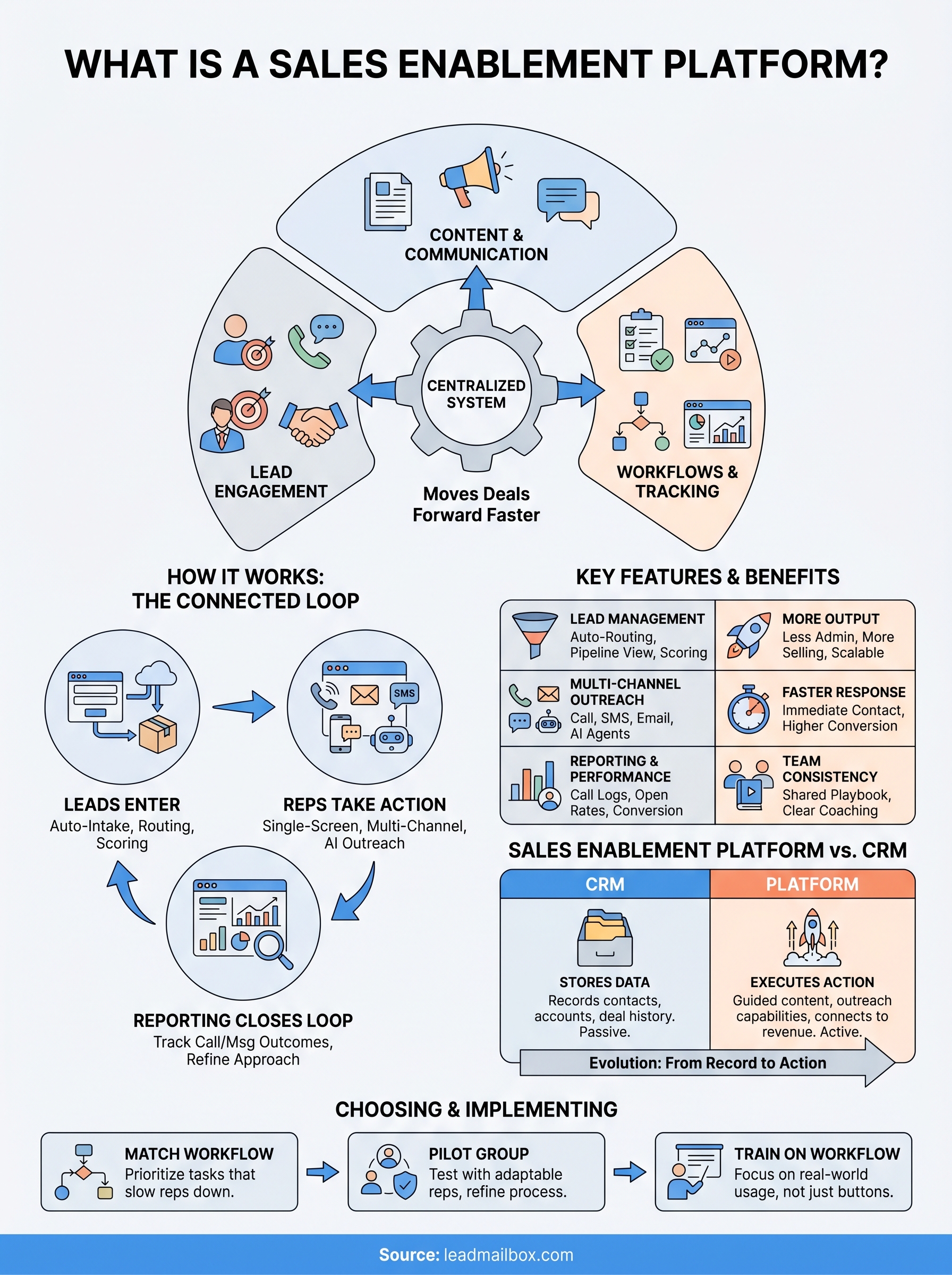
A sales enablement platform is software that gives your sales team the resources, workflows, and communication tools they need to engage buyers more effectively and move deals forward faster. When people ask what is a sales enablement platform, they're usually trying to understand how it differs from a basic CRM or a simple contact list. The distinction matters: a CRM stores information about your leads and customers, while a sales enablement platform actively helps your team act on that information through guided content, outreach capabilities, and performance tracking that connects directly to revenue outcomes.
A sales enablement platform doesn't just store data - it puts that data to work for your team at every stage of the sales process.
The components that make it work
Sales enablement platforms typically combine several functions that sales teams previously had to patch together using separate tools. Content management lets you store and organize sales collateral, call scripts, and outreach templates so reps can pull the right material at exactly the right moment. Communication tools like click-to-call, email automation, and SMS campaigns let reps reach leads directly from the platform without switching between apps, losing context, or burning time on manual setup.
Most platforms also include lead management features that track where each prospect sits in your pipeline and which actions have already been taken. Some go further with AI-powered tools that can respond to inbound messages, handle initial call screening, or draft outreach emails based on lead data. When these components work together inside a single system, your team spends less time managing software and more time having conversations that actually move deals.
How the term is used in practice
The phrase "sales enablement" gets used broadly, and that can create real confusion when you're evaluating options. Some vendors apply it only to content libraries or training and coaching platforms. In practice, the most useful definition is the broadest one: a sales enablement platform is any system that removes friction between your team and the activities that generate revenue.
For small and mid-sized sales teams, this usually means a platform that handles lead intake from multiple sources, organizes contacts into a manageable pipeline, supports outreach across phone, email, and SMS, and gives team leaders clear visibility into what's working. The goal isn't to add complexity.
Why this matters for your team right now
Sales cycles have gotten more fragmented. Buyers expect faster responses, and reps are being asked to handle more touchpoints across more channels than ever before. Without a platform that brings these moving parts together, even experienced reps end up spending significant portions of their day on administrative tasks rather than selling.
A well-chosen sales enablement platform changes that math. Your reps get a single place to see their leads, take action, track responses, and hand off or escalate when the time is right. Managers get reporting that shows which reps, channels, and sequences are producing results. And your entire team operates from the same playbook instead of improvising with whatever tools they each happen to prefer. That consistency is what separates teams that scale from teams that stay stuck.
How sales enablement platforms work
Understanding what is a sales enablement platform becomes clearer when you see the mechanics behind it. At its core, the platform acts as a central hub where leads come in, reps take action, and outcomes get tracked, all without requiring you to jump between disconnected tools. The entire process runs in a connected loop: data flows in, your team acts on it, and results feed back into the system so you can refine what actually works.
How leads enter the system
Most platforms connect directly to the sources where your leads originate, whether that's a web form, a third-party lead vendor, a paid ad campaign, or an inbound call. When a new lead arrives, the platform captures the contact details and automatically routes them to the right rep or queue based on rules you define. This removes the manual work of copying data between spreadsheets or dialing numbers one by one.

Getting leads into your system automatically reduces the gap between a prospect showing interest and your rep making first contact, and that gap directly affects your conversion rate.
With fast-moving industries like insurance or real estate, response speed has a measurable impact on close rates. A platform that automates lead intake and triggers immediate outreach actions gives your team a real edge over competitors still relying on manual handoffs.
How reps take action from one place
Once a lead is in the system, your rep sees the full picture: contact details, lead source, any prior interactions, and suggested next steps. From that same screen, they can place a call, send an SMS, or trigger an email sequence without leaving the platform. This single-screen approach cuts the administrative drag that slows reps down during high-volume days.
Many platforms also include AI-powered tools that handle initial touchpoints automatically. An AI agent might send a personalized text response within seconds of a lead submitting a form, qualify the lead based on their reply, and flag it for a human rep only when the prospect is ready to talk. Your team gets involved at the right moment instead of spending time on every cold contact.
How reporting closes the loop
After your reps take action, the platform records every call, message, and outcome against each lead record. Managers can see which outreach methods are converting, which reps need coaching, and where leads are dropping out of the pipeline. That visibility lets you adjust your approach based on real data rather than guesswork, which is what separates teams that improve consistently from those that repeat the same mistakes.
Core features to look for
When you're evaluating what is a sales enablement platform worth paying for, the feature list is where the real differences show up. Not every platform delivers equally across all areas, and choosing based on a marketing checklist rather than your team's actual workflow is how buyers end up locked into tools that don't fit. Focus on the capabilities that directly reduce friction in your sales process and cut the time between lead intake and first contact.
Lead management and pipeline organization
Your platform needs to do more than store contact information. Effective lead management means capturing leads automatically from every source you use, routing them to the right rep without manual intervention, and giving each rep a clear view of where each prospect stands. Look for platforms that let you set routing rules, apply lead scoring, and track lead age so nothing sits untouched while a competitor follows up first.
The platform that helps your team act on leads within the first few minutes of contact is worth far more than one that simply logs the data.
You also want pipeline views that show the full picture at a glance, so managers can spot bottlenecks and reps can prioritize their day without digging through filters.
Multi-channel outreach capabilities
A strong platform gives your reps the ability to reach leads by phone, SMS, and email from a single interface. Click-to-call, power dialers, and inbound number management handle your phone-based outreach. SMS and email campaign tools cover the follow-up sequences that keep prospects engaged between calls. If the platform also includes AI agents that respond to texts, answer inbound calls, or draft outreach emails, your team can handle higher lead volumes without adding headcount.

Reporting and performance tracking
Without solid reporting, you're making decisions based on assumptions. Call logs, email open rates, SMS response data, and pipeline conversion metrics should all be visible inside the platform, not buried in a separate reporting tool you have to export to manually. Look for dashboards that show rep-level performance alongside campaign-level results so you can see exactly which activities are driving revenue and which ones are wasting your team's time.
Benefits for small and mid-sized teams
Small and mid-sized sales teams face a challenge that larger organizations rarely deal with the same way: every rep has to carry more of the load, and there's usually no budget for a dozen specialized tools to support them. Understanding what is a sales enablement platform helps you see why it fits this reality better than enterprise-level software that assumes you have a dedicated operations team to manage it. The right platform gives your team capabilities that used to require multiple tools, without the overhead of managing multiple vendors, logins, and data silos.
You get more output without hiring more people
When your reps can place calls, send follow-up texts, and trigger email sequences from a single interface, they handle more leads per day than they ever could switching between separate apps. AI-powered tools extend this further. An AI agent that handles the first response to an inbound lead or qualifies a prospect via SMS means your human reps only step in when a contact is actually ready to talk. That shift in how your team spends its time has a direct impact on revenue without adding to your payroll.
A small team using a well-integrated platform can outperform a larger team using disconnected tools, because every minute not spent on administration goes directly into selling.
Your response speed improves right away
Lead response time is one of the clearest predictors of conversion rates, especially in competitive industries like insurance, real estate, or financial services. When leads route automatically into your platform and trigger immediate outreach actions, you cut the gap between a prospect expressing interest and your rep making contact. That speed advantage compounds over time as your competitors still relying on manual processes fall behind on the first follow-up.
Your whole team operates from the same playbook
One underrated benefit for growing teams is consistency. When your content, scripts, and outreach sequences live inside a shared platform, every rep works from the same approved materials instead of improvising with their own versions. Managers get reporting that shows exactly where deals are moving and where they're stalling, which makes coaching conversations specific and productive rather than based on gut feel. That visibility is what lets a team of five perform like a team of ten.
Sales enablement platform vs CRM and other tools
When you're trying to understand what is a sales enablement platform, one of the most useful exercises is comparing it directly to the tools you may already be using. A CRM, a dialer, an email tool, and a sales enablement platform all serve different purposes, and knowing where each one starts and stops helps you figure out what you're actually missing rather than just adding more software to an already crowded stack.
How a CRM differs from a sales enablement platform
A CRM is built around storing and organizing data about your contacts, accounts, and deal history. It answers the question: "What do we know about this prospect?" A sales enablement platform answers a different question: "What should my rep do next, and what tools do they need to do it?" CRMs are records systems. Sales enablement platforms are action systems. Both have value, but only one of them actively helps your team execute outreach, manage sequences, and track which conversations are driving revenue.

Treating your CRM as a sales enablement platform is like using a filing cabinet as a phone. The data is organized, but nothing is actually happening.
Most small and mid-sized teams reach a point where their CRM holds accurate information but their reps still lack the tools to act on it efficiently. They end up bolting on a separate dialer, then a separate email tool, then an SMS platform, and suddenly they're managing four logins, four invoices, and four data sets that never quite sync properly.
Where standalone tools fall short
Separate point solutions each do one thing reasonably well, but they create friction at exactly the moments that matter most. When a rep has to leave one app to place a call, then switch to another to log the outcome, then open a third to send a follow-up text, the administrative overhead compounds quickly across a full day of outreach. Response times slow down, data gets missed, and managers lose visibility into what's actually happening.
A unified sales enablement platform eliminates that fragmentation. Your team works from one interface, all activity logs in one place, and reporting reflects the full picture of every interaction across every channel. For teams focused on converting leads at volume, that integration is not a convenience feature; it is the foundation that everything else runs on.
How to choose the right platform
Choosing the right platform starts with being honest about how your team actually sells, not how you think it should sell. Too many buyers evaluate platforms based on feature lists rather than daily workflow reality, which leads to purchasing tools that check boxes but create friction in practice. Before you look at a single demo or pricing page, write down the three or four activities that slow your reps down the most on a typical day. That list should drive every question you ask.
Start with your team's actual workflow
Understanding what is a sales enablement platform requires you to map it against your current process. If your team spends most of its time on phone outreach, prioritize telephony features like power dialers, click-to-call, and inbound call handling above everything else. If SMS follow-up is where leads respond most, look closely at how the platform handles SMS campaigns and whether AI agents can handle initial responses automatically. A platform that excels at what your team already does will get adopted faster and produce results sooner than one that requires your team to change how it operates.
The best platform for your team is the one your reps will actually use every day, not the one with the longest feature list.
Match features to your lead volume and channels
Your lead volume and the channels you use to generate leads should directly shape your evaluation. If you pull leads from multiple vendors or sources, the platform needs to aggregate those feeds automatically and route them to reps without manual intervention. If you rely on a single channel like paid search or referrals, your requirements may be narrower, but multi-channel outreach capabilities still matter because following up across phone, email, and SMS consistently outperforms single-channel contact attempts regardless of how the lead arrived.
Evaluate total cost and integration requirements
Pricing models vary widely, and the sticker price rarely reflects your true cost. Calculate what you currently spend across every separate tool your team uses, including dialers, email platforms, CRMs, and SMS services, and compare that against the all-in cost of a unified platform. Beyond cost, ask each vendor specifically which integrations they support and whether those connections are native or require third-party middleware. A platform that costs slightly more but eliminates three separate subscriptions and one unreliable data sync is almost always the better financial decision for a small or mid-sized team.
How to roll out a platform successfully
Buying a platform is the easy part. Getting your team to actually use it consistently is where most rollouts fall apart. Understanding what is a sales enablement platform tells you what the software can do, but a successful launch depends on how you introduce it to your team and what you ask them to do differently in the first few weeks. The goal is to build habits fast, not to run a training marathon before anyone makes a single call.
Start with a pilot group before a full launch
Rolling out to your entire team at once almost always creates confusion and resistance. Instead, pick two or three of your most adaptable reps and run a structured pilot for the first two weeks. Have them use the platform for all their lead activity, note what's working, and flag anything that slows them down. Their feedback will surface configuration issues and workflow gaps that you'd otherwise discover only after frustrating your entire team.
A pilot group gives you real-world data on what needs adjusting before you're managing questions and pushback from everyone at once.
Use what you learn from the pilot to tighten your routing rules, adjust your outreach sequences, and set default templates that reflect how your team actually communicates. When you roll out to the rest of the team, you're launching something that already has the rough edges worked out.
Train on the workflow, not just the features
Most platform training covers every button and menu option, which leaves reps knowing where things are but not how to actually use the tool during a live sales day. Build your training around your actual workflow: here is how a new lead comes in, here is what you do first, here is how you log the outcome and trigger the next step. Walk through a real lead from intake to first contact to follow-up so reps can see the full sequence in action.
Short, role-specific training sessions outperform long group demos every time. Phone-focused reps need depth on the dialer and call logging. Reps who rely heavily on email and SMS need fluency in campaign setup and AI agent configuration. Splitting training by function keeps sessions focused and gives each rep exactly what they need to become productive quickly.
Examples of leading platforms in 2026
When you're researching what is a sales enablement platform, seeing how current solutions actually compare helps you move from theory to a real decision. The market in 2026 includes platforms that specialize in content and training, platforms that focus on outreach and communication, and a smaller group that genuinely combines both. Which category fits your team depends entirely on where the biggest friction in your sales process lives.
Platforms built around content and training
Highspot and Seismic both sit at the top of the content-focused segment. They organize sales collateral, enable content search and sharing, and give managers tools to measure whether reps are using approved materials. Seismic in particular has built out strong analytics that show how specific content assets influence deal outcomes. These platforms work well for teams where messaging consistency and large content libraries are the primary challenge, but they typically require a separate CRM and communication stack to handle actual outreach.
If your biggest problem is reps using outdated or off-brand materials, a content-focused platform solves that specific problem well, but it won't dial a single lead for you.
Platforms built around outreach and communication
Outreach and Salesloft dominate the sales engagement space, offering sequence automation, call recording, and detailed rep performance analytics. Both tools have added AI features over the past few years and connect into popular CRMs. They work best for teams that already have a CRM in place and need a dedicated layer for managing outreach cadences and tracking rep activity across email and phone.
Platforms that combine both functions
LeadMailbox sits in a different category from most tools in this list. Rather than specializing in one area, it combines lead aggregation, telephony, SMS campaigns, email tools, and AI agents into a single platform built specifically for small and mid-sized teams that generate and work high volumes of leads. The platform has been running since 2004, which means the core workflows are proven rather than experimental. For teams that currently patch together a dialer, an email tool, and a CRM, switching to a unified system like LeadMailbox removes the data gaps and administrative overhead that come with managing three separate subscriptions and trying to keep them in sync.
Putting it all together
Understanding what is a sales enablement platform gives you the foundation to make a real decision about what your team needs. The right platform doesn't just organize your contacts; it actively reduces the friction between your reps and the actions that produce revenue. Content management, multi-channel outreach, lead routing, and performance reporting all work together inside a single system, so your team operates from one place rather than a dozen disconnected apps.
Your next step is finding a platform that fits how your team actually sells. LeadMailbox combines lead aggregation, telephony, SMS, email campaigns, and AI agents into one system built specifically for small and mid-sized sales teams that want to cut administrative drag and give reps more time selling. If you're ready to see what that looks like in practice, explore what LeadMailbox can do for your team.