

What Does Sales Enablement Include? Strategy, Tools & KPIs
Sales enablement gets thrown around a lot, but most people using the term can't actually list what falls under it. So what does sales enablement include, exactly? It's more than just handing reps a pitch deck and wishing them luck. It covers a specific set of strategies, tools, training programs, and metrics that work together to help your sales team close more deals with less friction.
The problem most small and mid-sized teams run into isn't a lack of effort, it's a lack of structure. Leads come in from multiple sources, reps juggle disconnected tools, and nobody can tell you which activities actually move the needle. A clear sales enablement framework fixes that by aligning your content, technology, coaching, and data under one roof. It's the difference between a team that's busy and a team that's productive.
That's exactly the gap LeadMailbox was built to fill. For over 20 years, we've helped sales teams aggregate leads, manage outreach, and convert pipeline into revenue, all from a single platform. In this guide, we'll break down every component of sales enablement, from strategy and content to tools and KPIs you should actually track, so you can build a system that works for your team.
What sales enablement includes in practice
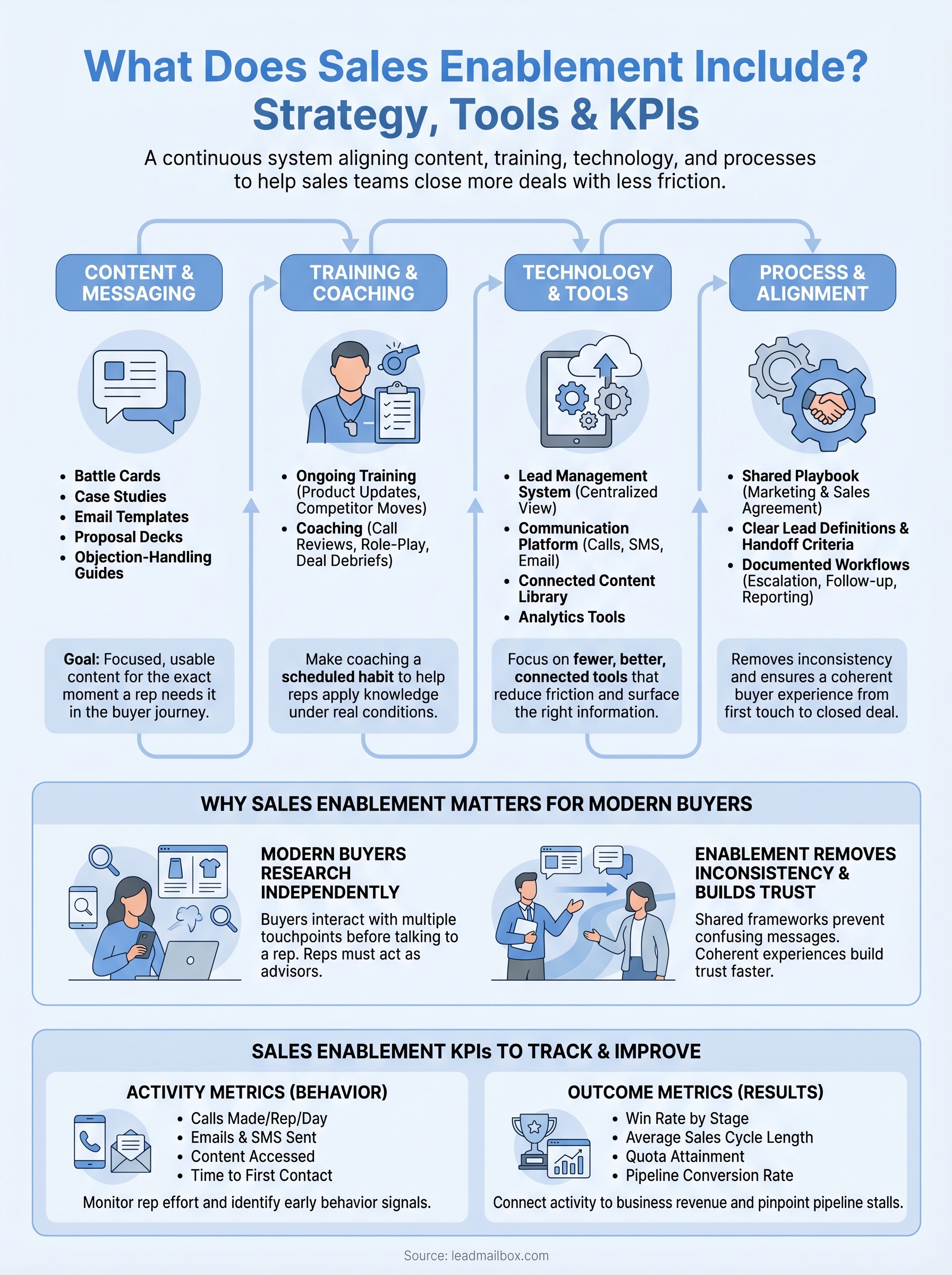
Understanding what does sales enablement include starts with looking at how it actually functions day to day. It's not a single initiative or a one-time training session. Sales enablement is a continuous system built from four interconnected components: content, training and coaching, technology, and process alignment. When all four work together, your reps spend more time selling and less time hunting for the right resource at the wrong moment.
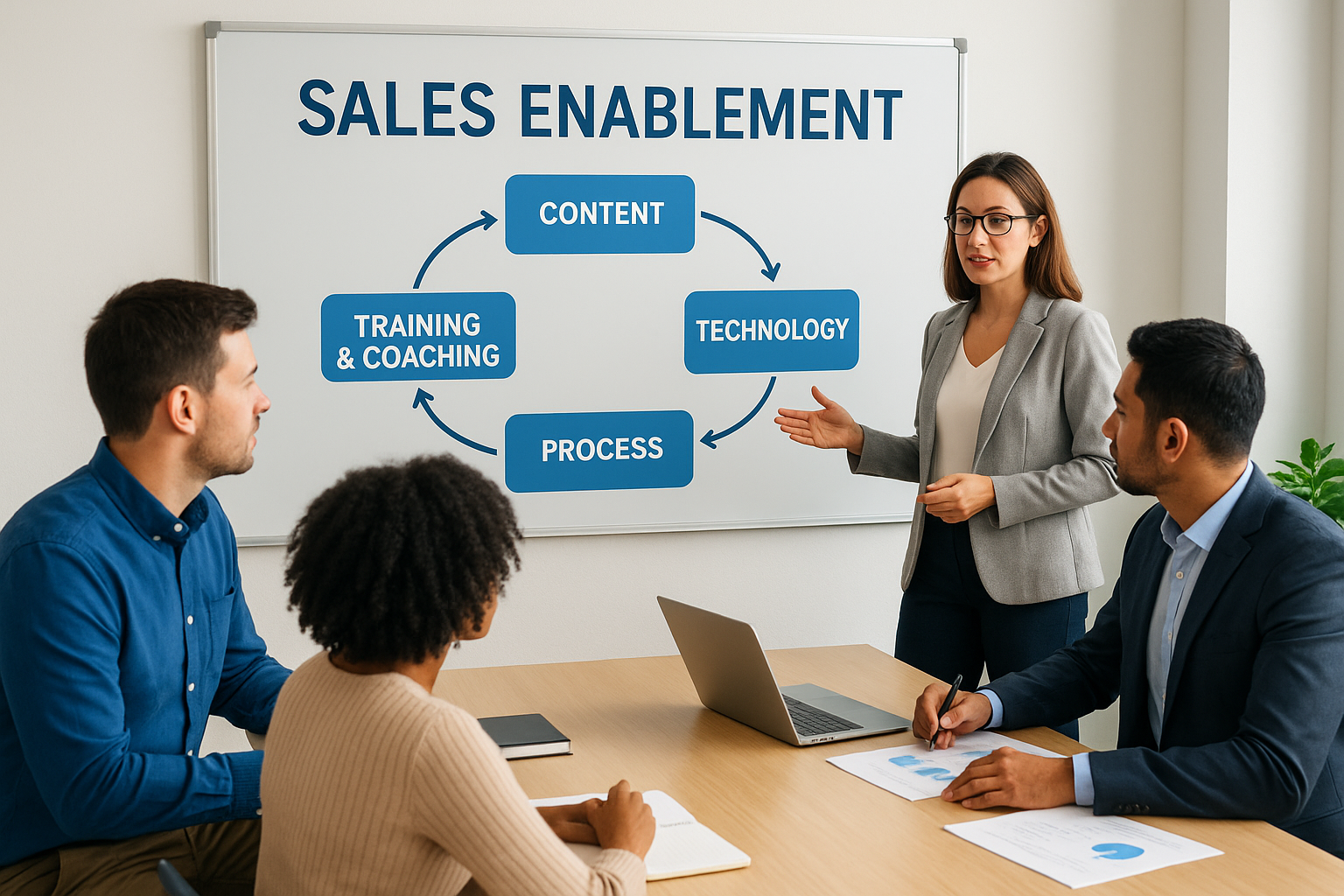
Content and messaging
Your reps need the right material at the right stage of every deal. Sales content covers battle cards, case studies, email templates, proposal decks, and objection-handling guides. Each piece should map directly to a buyer's question or concern at a specific point in the funnel. Without that mapping, content collects dust in a shared drive that nobody opens, and your reps improvise instead.
The goal isn't to produce more content. It's to produce focused, usable content that reps can pull up during a live call or drop into a follow-up email within seconds. A short, accurate objection-handling card beats a 40-page product manual every time.
The best sales content is built for the moment a rep needs it, not the moment someone felt like creating it.
Training and coaching
Onboarding is where most companies put their training energy, but that's only the beginning. Ongoing training keeps reps current on product updates, competitor moves, and new objections that surface over time. Without it, even strong hires drift back to old habits and outdated messaging.
Coaching is different from training. Training delivers knowledge; coaching helps reps apply that knowledge under real conditions. Call reviews, role-play exercises, and deal debriefs all fall under coaching. When managers make coaching a scheduled habit rather than a reactive fix, rep performance improves faster and results become more consistent.
Technology and tools
Technology in sales enablement isn't about loading your team with software. It's about giving reps fewer, better tools that reduce friction and surface the right information at the right time. That typically includes a lead management system, a communication platform covering calls and SMS, and a content library that reps can search quickly.
The tools you choose should connect to each other. A disconnected tech stack creates data gaps, wastes time on manual entry, and makes it nearly impossible to track which activities actually produce revenue. The more your systems share data automatically, the cleaner your pipeline visibility becomes.
Process and alignment
Sales enablement only works when your sales and marketing teams operate from the same playbook. Process alignment means both teams agree on lead definitions, handoff criteria, and the messaging used at each stage of the buyer journey. Without that agreement, leads slip through gaps and reps deliver inconsistent experiences.
Your processes also need to cover how reps escalate deals, follow up on stalled opportunities, and report pipeline status. Documented workflows remove the guesswork and make it easier to identify exactly where deals break down. When you can pinpoint the specific stage where pipeline stalls, you fix the actual problem rather than applying a general fix and hoping something changes.
Why sales enablement matters for modern buyers
The buying process has changed significantly, and most sales teams haven't caught up. Modern buyers complete a large portion of their research independently before they ever speak to a rep. By the time someone reaches out, they've already compared options, read reviews, and formed an opinion. If your team shows up to that conversation without the right context and prepared responses, you're already behind.
Buyers do more research before talking to your reps
According to Google, buyers interact with multiple digital touchpoints before making a purchase decision. That means your reps are no longer the primary source of information for prospects. Instead, your reps need to function as advisors who can add value beyond what a buyer already found on their own. Generic pitches and surface-level product walkthroughs won't cut it when the person on the other end of the call has already done their homework.
This is exactly where what does sales enablement include becomes critical to understand. When your team has well-structured content, accurate competitive positioning, and consistent messaging, they can match the buyer's level of preparation and move the conversation forward rather than back.
Misalignment costs you deals you should win
When your sales and marketing teams operate without a shared framework, buyers experience inconsistency. They see one message in your marketing emails, hear a different story from your reps, and get left wondering which version is accurate. That gap creates doubt, and doubt kills deals.
Structured enablement removes that inconsistency. A shared content library, agreed-upon messaging, and clear handoff criteria keep everyone aligned on what to say and when to say it. Your buyers get a coherent experience from first touch to closed deal, which builds trust faster.
The fastest path to a lost deal is a buyer who leaves a conversation more confused than when they started.
Sales cycles are also getting longer for many businesses, which means buyers need more reasons to stay engaged over time, not just one compelling pitch at the start. Enablement gives your reps the tools to maintain relevance across a longer sales process: relevant follow-up content, timely outreach, and the ability to address new concerns as they surface. Without that structure, deals stall and pipeline accuracy becomes guesswork.
How to build a sales enablement plan step by step
Building a sales enablement plan doesn't require a full restructure of your organization. What it requires is a clear starting point and a sequence you can actually follow. Most teams skip the planning stage entirely and jump straight to buying tools or creating content. That's why their results are inconsistent.
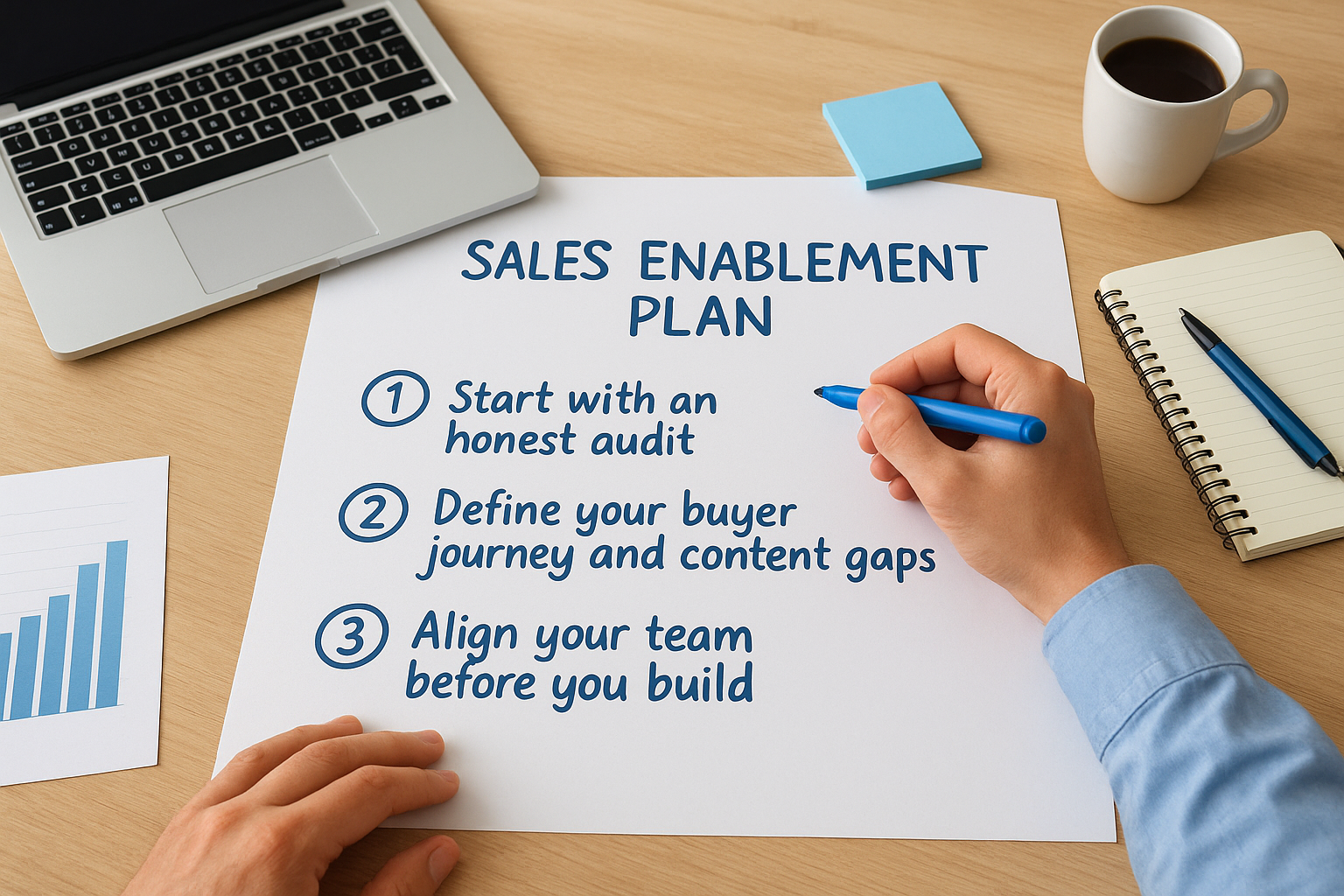
Start with an honest audit
Before you add anything new, take stock of what your team already uses and what's actually working. Pull together your existing content, review your current tools, and ask your reps directly where they lose deals and where they feel underprepared. You'll quickly find patterns: the same objections coming up repeatedly, the same content gaps, the same friction points in the handoff between marketing and sales.
This audit gives you a factual baseline rather than a wishlist. It also helps you prioritize. You don't need to solve every problem at once; you need to identify the two or three gaps that are costing you the most pipeline right now.
Define your buyer journey and content gaps
Once you know where your current system breaks down, map your buyer's journey from first contact to closed deal. At each stage, ask what questions your buyers are asking, what objections your reps encounter, and what content currently exists to address those moments. If the answer to the last question is "nothing" or "something outdated," that's your priority.
A sales enablement plan built around your actual buyer journey will always outperform one built around what felt easiest to create.
Understanding what does sales enablement include becomes much more concrete when you tie each component directly to a stage in the buyer journey. Content, training, and tools all have a specific job to do at a specific point in the process.
Align your team before you build
The most technically complete enablement plan will fail if your sales and marketing teams aren't operating from the same definitions. Before you build anything, get both teams to agree on what a qualified lead looks like, when a lead gets handed off, and what messaging each team uses at each stage.
This alignment step takes a short meeting, but it saves weeks of crossed signals later. Document the agreements, share them with both teams, and revisit them quarterly as your buyer's journey evolves. A plan that lives only in someone's head isn't a plan.
Enablement content, training, and coaching
When you're figuring out what does sales enablement include, the content, training, and coaching layer is where most of the day-to-day impact happens. This is the part of enablement that directly touches your reps during live deals and shapes how they represent your product in every conversation. Get this layer right and your team stops improvising; get it wrong and your best strategy stays stuck on paper.
Build content that reps will actually use
Most sales content fails not because it's poorly written, but because nobody thinks about when a rep will actually pull it up. The moment a rep needs a battle card is during an objection on a live call, not after they finish onboarding. Content built around specific moments in the buyer journey gets used; content built for documentation purposes sits untouched.
Your content library should be organized by use case, not by product category. Group resources by buyer stage, objection type, or deal size they address. When a rep can find what they need in under thirty seconds, they use it. When they have to dig through folders, they improvise instead.
Content that lives in the wrong place is the same as content that doesn't exist.
Design training around real sales situations
Onboarding training gives reps the foundation they need, but ongoing training is what keeps them effective as your product evolves, competitors shift, and new objections surface. Schedule short, focused training sessions tied directly to what's happening in your current pipeline, not a generic curriculum built once and never updated.
Role-play exercises and recorded call reviews are among the most effective training formats available. Both force reps to practice under conditions that mirror actual buyer interactions, which closes the gap between knowing the right answer and delivering it under pressure.
Make coaching a scheduled habit
Coaching works best when managers treat it as a recurring calendar item rather than a fix reserved for struggling reps. Regular deal reviews and call debriefs help your entire team improve, not just the ones who are falling behind. The reps who benefit most from consistent coaching are often your middle performers, since small improvements across that group produce the largest overall revenue gains.
Separate your coaching from your inspection. Pipeline reviews focus on deal status; coaching sessions focus on rep behavior and skill development. Mixing the two turns coaching time into a status update, and your reps stop bringing you their real challenges.
Sales enablement tools and systems to consider
Understanding what does sales enablement include from a technology standpoint means knowing which tools actually support your reps versus which ones add unnecessary complexity. The goal isn't to stack software on top of software. You want a tight, connected set of systems that share data automatically, reduce manual work, and give your team clear visibility into pipeline activity without requiring constant maintenance to stay accurate.

The right tools don't just store information; they surface it at the exact moment your reps need it.
Lead management and communication platforms
Your foundation starts with a lead management system that pulls leads from every source your business uses into one place. When leads scatter across spreadsheets, inboxes, and separate vendor portals, reps waste time locating information instead of using it. A centralized platform gives your team a single view of every contact, their full history, and exactly where each one sits in the pipeline at any given moment.
Communication tools need to live inside that same system. Click-to-call functionality, power dialers, and SMS outreach should connect directly to your lead records so every interaction gets logged automatically. When your reps don't have to switch between five different tabs to make a call and record a note, they move faster and your pipeline data stays reliable.
| Tool Category | Core Function |
|---|---|
| Lead management platform | Centralize leads from multiple sources into one view |
| Power dialer | Increase outbound call volume without manual dialing |
| SMS and email tools | Run personalized follow-up campaigns at scale |
| AI communication agents | Handle inbound responses and routine outreach automatically |
Content and analytics tools
Your reps also need a place to access content quickly and track what's performing. A shared content library organized by buyer stage or objection type lets reps find what they need during a live conversation rather than scrambling after it ends. The library only stays useful if someone maintains it, so assign clear ownership over adding, updating, and retiring outdated material before reps start using stale information in active deals.
Analytics tools close the loop by showing you which content pieces actually get used, which calls convert to meetings, and where deals consistently stall in your pipeline. Without that usage data, you're making decisions based on gut instinct. With it, you can make targeted improvements to the exact touchpoints costing you the most pipeline instead of applying broad fixes that don't address the real problem.
Sales enablement KPIs to track and improve
Knowing what does sales enablement include from a measurement standpoint is just as important as building the right content and tools. Without clear KPIs, you can't tell whether your enablement system is working or simply keeping people busy. The right metrics split into two categories: activity metrics that track rep behavior and outcome metrics that track business results. Both matter, and tracking only one without the other gives you an incomplete picture.
Measuring activity without outcomes tells you how hard your team is working, not whether the work is producing anything.
Activity metrics that show what your reps are doing
Activity metrics help you understand rep behavior patterns and identify where reps are spending their time. These numbers don't tell you whether deals close, but they surface early signals when something is off. If call volume drops without explanation, or follow-up sequences stop going out, your pipeline problems will show up in these metrics before they hit your revenue numbers.
Track these activity metrics consistently:
- Calls made per rep per day to monitor outbound effort
- Emails and SMS messages sent to track follow-up consistency
- Content pieces accessed or shared during active deals
- Time from lead assignment to first contact to catch lag in your response process
Outcome metrics that show what your system produces
Outcome metrics tell you whether your enablement investments are translating into revenue. These numbers connect your activity directly to business results and help you identify which parts of the system are producing and which need adjustment. Review these on a consistent schedule rather than only when pipeline looks thin.
The metrics worth tracking include win rate by deal stage, average sales cycle length, quota attainment by rep, and pipeline conversion rate from each stage to the next. Win rate tells you how often your team closes when they get to a proposal. Sales cycle length tells you whether your content and follow-up process is accelerating deals or letting them sit idle.
Pipeline conversion rate by stage is particularly useful because it shows you the exact point where deals stall most often. Once you know that, you can fix the specific gap: add content, adjust messaging, or increase outreach frequency at that stage rather than guessing at the cause and applying a broad fix that doesn't address the actual problem.
Wrap up and next steps
Now you know what does sales enablement include across every layer: content, training, coaching, technology, and the KPIs that tell you whether the system is actually working. None of these components operate in isolation. Each one depends on the others, and the teams that see the best results treat enablement as an ongoing process rather than a one-time project.
Your next move doesn't need to be complicated. Start with the audit, close the biggest content gap your reps face right now, and make sure your tools share data instead of creating more manual work. Small, targeted improvements at the right friction points compound faster than large overhauls applied to the wrong problems.
If you want a platform that brings lead management, communication, and outreach tools together in one place, see how LeadMailbox supports your sales team and start converting more of your pipeline into closed deals.