

Sales Pipeline vs Sales Funnel: Key Differences Explained
The terms "sales pipeline" and "sales funnel" get tossed around interchangeably in sales meetings, strategy docs, and CRM dashboards. But they're not the same thing, and mixing up sales pipeline vs sales funnel can lead to misread reports, misaligned teams, and missed revenue targets. One tracks what your reps are doing; the other tracks how your buyers are progressing. That distinction matters more than most people realize.
A sales pipeline maps the specific steps and actions your sales team takes to move a deal from first contact to closed-won. A sales funnel, on the other hand, visualizes the buyer's journey, from awareness to purchase, and highlights where prospects drop off along the way. Both give you critical visibility into your sales process, but they answer fundamentally different questions about your business.
At LeadMailbox, we've spent over 20 years helping sales teams organize leads from multiple sources, manage outreach, and convert more deals. That work has shown us firsthand how understanding the pipeline-funnel distinction sharpens decision-making across the board. This article breaks down exactly how these two concepts differ, when to use each one, and how they work together to give you a complete picture of your sales operation.
Why pipeline and funnel both matter
Many sales teams default to one model and treat the other as optional. That habit creates blind spots that cost real revenue. If you focus only on the sales pipeline, you gain clear visibility into where each deal sits and what your reps need to do next, but you lose sight of how efficiently your top-of-funnel efforts are converting interest into qualified opportunities. If you focus only on the sales funnel, you can see conversion rates across each stage of the buyer's journey, but you have no picture of whether your reps are executing the right activities to move those buyers forward. Both models answer questions the other simply cannot.
Understanding the sales pipeline vs sales funnel distinction is not just an academic exercise. It directly shapes which questions you ask in your weekly sales reviews, which metrics you choose to prioritize, and which problems you actually diagnose and fix instead of paper over with optimism.
When you treat the pipeline and funnel as two lenses on the same process, you stop guessing about what is broken and start seeing exactly where to act.
The pipeline keeps your reps accountable
The pipeline is built around sales rep activity. Each stage represents something your team needs to do: qualify a lead, book a discovery call, send a proposal, follow up, close. When you track this model consistently, you can see which reps have healthy deal distribution across stages and which reps have deals stacking at one point because they are not advancing them. That kind of visibility turns a vague "we need to sell more" conversation into a specific coaching conversation about the exact activity gap causing the shortfall.
Without a clear pipeline structure, managers tend to react to end-of-quarter shortfalls rather than catching problems weeks earlier when there is still time to fix them. A well-managed pipeline gives you a forecast you can trust because it reflects real activity and real deal progression, not guesswork. It also gives new reps a repeatable process to follow from day one, so they are not inventing their own approach and hoping it works.
Here is what a pipeline helps you answer:
- Which deals have gone untouched for more than two weeks?
- Which stage is creating the most drag across the entire team?
- Which reps are carrying a healthy distribution of deals versus leaning too hard on one or two large opportunities?
- Is your average deal size increasing or shrinking over time?
The funnel keeps your strategy honest
The funnel is built around buyer behavior. It shows you what percentage of prospects actually move from one stage to the next: from first contact to qualified lead, from qualified lead to proposal, from proposal to closed deal. When your funnel data is accurate, it reveals exactly where your outreach and messaging fail to convert, which is information that no amount of pipeline management can surface on its own.
Your conversion rates at each funnel stage also expose whether a sales volume problem is actually a lead quality problem in disguise. For example, if your reps are running plenty of discovery calls but converting very few into proposals, the issue might not be rep performance at all. It might be that your lead sources are sending unqualified prospects who were never a real fit. The funnel makes that visible immediately. The pipeline alone never would, because the pipeline only tracks what happens to the deals that are already inside it.
Here is what a funnel helps you answer:
- What percentage of leads actually convert to qualified opportunities?
- At which stage do most prospects stop engaging?
- Is a drop in closed revenue caused by fewer leads entering the top, or by worse conversion in the middle?
- How does conversion rate change across different lead sources or campaign types?
Both tools together give your team a complete picture of what is happening and why. That combination is what turns reactive sales management into a process you can actually improve with confidence.
What a sales pipeline is
A sales pipeline is a structured, stage-by-stage view of every active deal your team is working at any given moment. Each stage represents a specific action or milestone your reps need to complete before a deal can advance, from the moment a lead enters your system to the moment they sign. The pipeline is entirely rep-facing and activity-driven, which is what separates it from the funnel side of the sales pipeline vs sales funnel conversation.
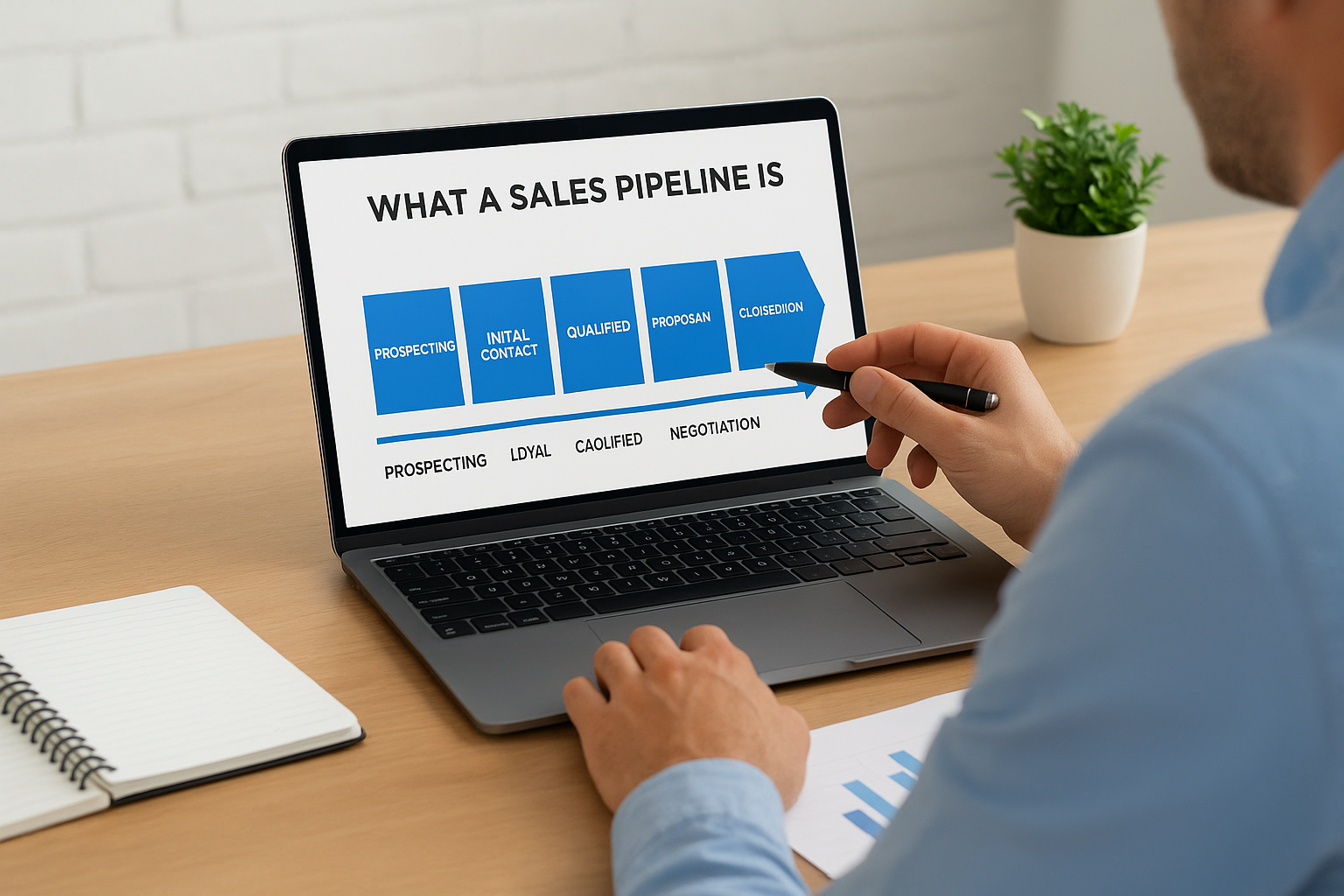
Your pipeline is only as useful as the discipline your team brings to keeping it current.
The stages inside a typical pipeline
Most pipelines run through five to seven defined stages, though the exact labels vary by company and industry. A common structure for a B2B sales team looks like this:
- Prospecting: The lead has been identified and added to the system.
- Initial contact: A rep has reached out by phone, email, or SMS.
- Qualified: The rep has confirmed the prospect fits your ideal customer profile.
- Proposal sent: A formal offer or quote has been delivered to the prospect.
- Negotiation: The prospect is actively engaging on terms, pricing, or scope.
- Closed-won or closed-lost: The deal has reached a final outcome.
Each stage functions as a checkpoint for specific rep action, not just a label to apply and forget. A deal should advance only when the rep has actually completed the work that stage requires. When managers enforce that standard, the pipeline becomes a reliable snapshot of true deal status rather than a collection of optimistic guesses about what might close.
How reps use the pipeline every day
Your reps should review their pipeline at the start of each day to spot which deals need immediate attention. Any deal sitting in the same stage for more than ten consecutive business days is a warning sign that requires action, whether that means advancing the deal, opening a coaching conversation with a manager, or removing the prospect from the active pipeline entirely.
The pipeline also helps reps prioritize their time across a mix of deal sizes, stages, and urgency levels. Without that structure, most reps drift toward the deals they feel most confident about rather than the ones that actually need work. A consistently maintained pipeline removes that bias by making every deal's status transparent to both the rep and their manager, and that shared visibility is what gives the pipeline its practical value on a daily basis.
What a sales funnel is
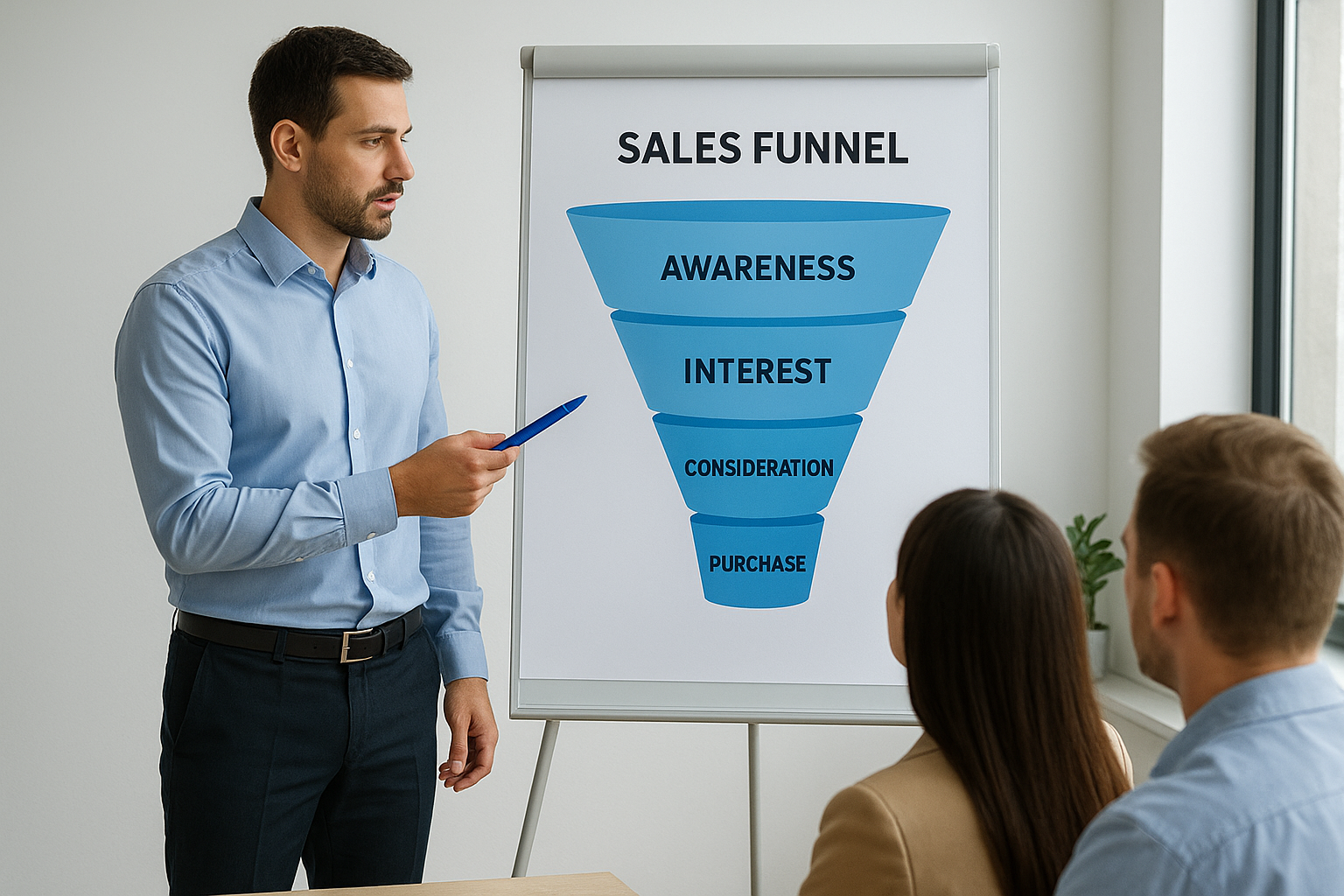
A sales funnel is a visual model of how buyers move through your sales process, from their first awareness of your product or service all the way to a completed purchase. Unlike the pipeline, which tracks what your reps are doing, the funnel tracks what your prospects are experiencing at each phase of their decision-making journey. In the sales pipeline vs sales funnel comparison, this is the core distinction: the funnel is buyer-centered, not rep-centered.
The stages inside a typical funnel
The funnel takes its name from its shape. A large number of prospects enter at the top, and as they move through each stage, some drop off, leaving a smaller group at the bottom that actually converts into paying customers. The stages typically follow this pattern:
- Awareness: The prospect becomes aware that your product or service exists, through an ad, a referral, or an inbound search.
- Interest: The prospect starts engaging with your content, website, or outreach.
- Consideration: The prospect is actively comparing options and evaluating whether your offer fits their need.
- Intent: The prospect signals a genuine desire to buy, such as requesting a demo or asking for pricing.
- Purchase: The prospect converts into a customer.
Each stage represents a conversion point where a percentage of your prospects either advance or fall away. That drop-off data is exactly what makes the funnel useful for diagnosing where your strategy needs work rather than where your reps need to follow up.
When your funnel shows a steep drop between two specific stages, you have a targeted and fixable problem, not a vague "sales is underperforming" conversation.
How marketing and sales teams use funnel data
Marketing teams rely on funnel conversion rates to measure how well their campaigns generate and nurture demand. If a high volume of prospects enters the top of the funnel but very few reach the consideration stage, that signals a messaging or targeting problem that no amount of closing skill will fix on its own. Sales teams use the same data to identify exactly where their follow-up cadence or offer positioning breaks down after a lead becomes an active opportunity.
Funnel data also lets you compare performance across different lead sources to see which channels produce prospects that actually convert. If leads from one source convert at twice the rate of another, you can shift time and budget toward the higher-performing channel rather than treating all incoming leads as equivalent. That analysis turns your funnel into a practical decision-making tool, not just a diagram of a process.
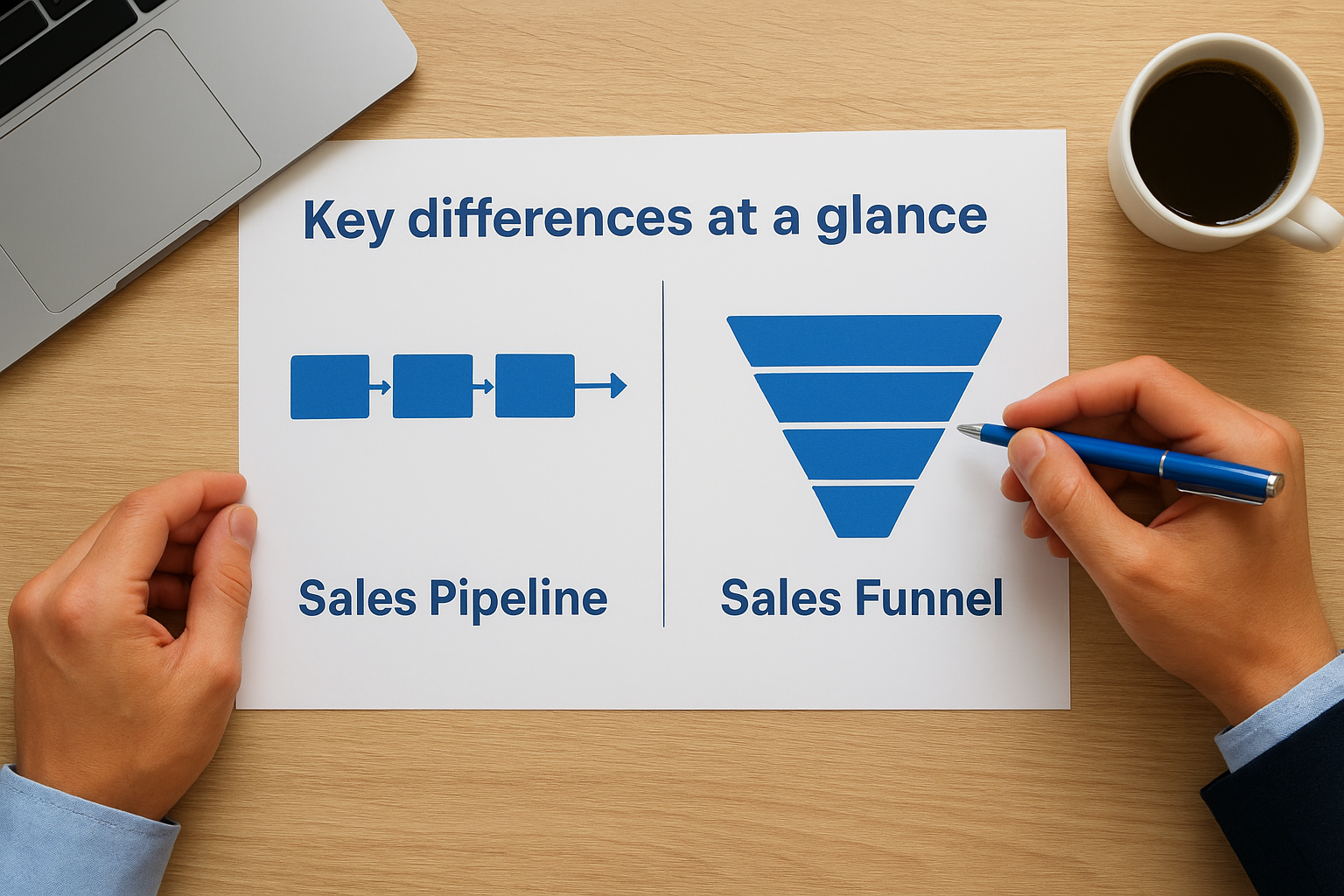
Key differences at a glance
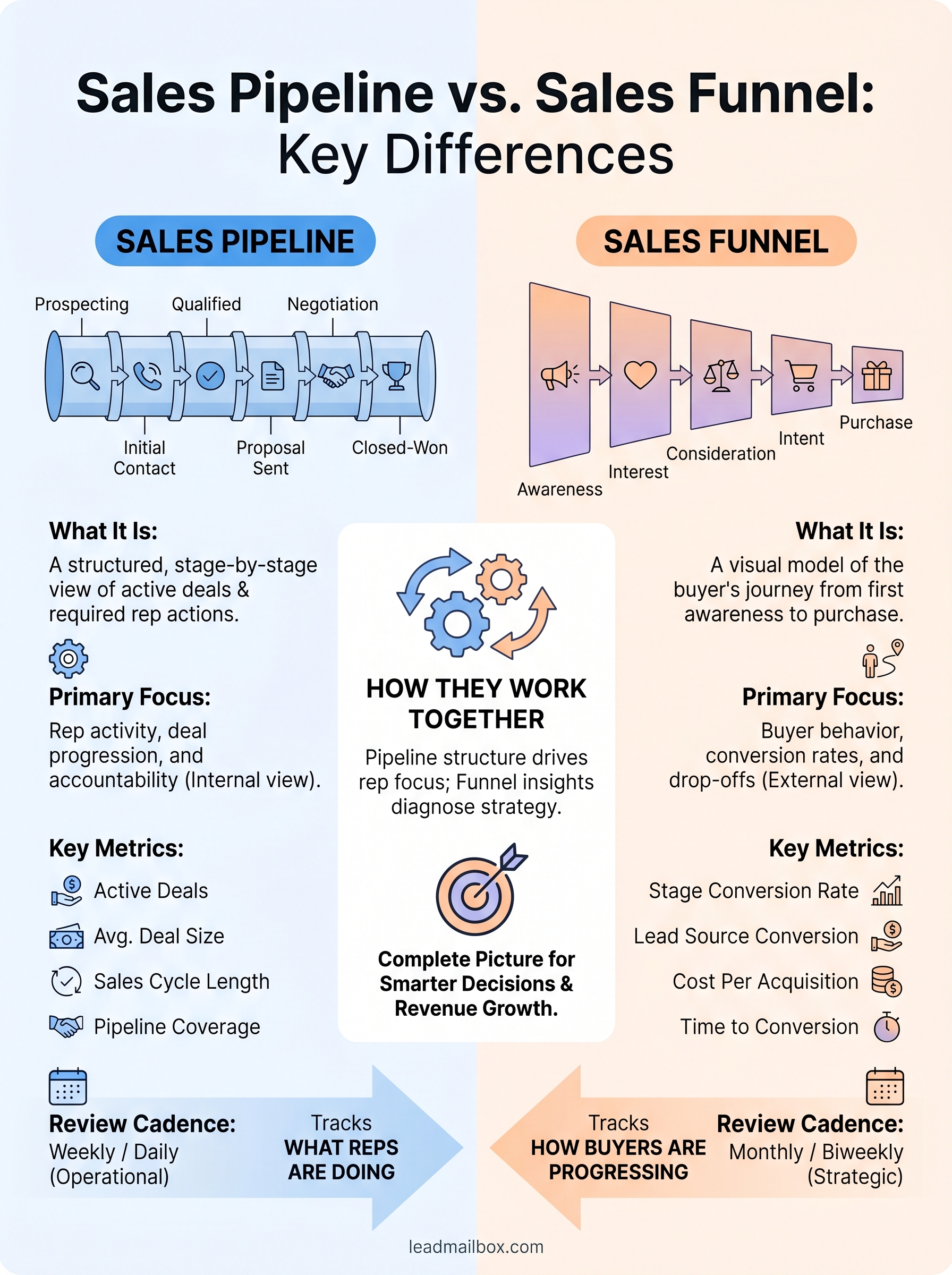
When you line up sales pipeline vs sales funnel side by side, the distinction comes down to perspective. The pipeline looks inward at your sales team's actions and deal progression, while the funnel looks outward at how buyers experience and move through your process. They measure different things, answer different questions, and belong to different conversations, even though they cover the same underlying sales process.
| Dimension | Sales Pipeline | Sales Funnel |
|---|---|---|
| Primary focus | Rep activity and deal status | Buyer journey and conversion rates |
| Who owns it | Sales team | Sales and marketing combined |
| Key question | What does my team need to do next? | Where are prospects dropping off? |
| Shape | Linear stages, deal by deal | Wide at top, narrow at bottom |
| Main output | Forecast and deal health | Conversion rate by stage |
| When to review | Daily or weekly | Weekly or monthly |
Different purposes, different owners
The pipeline belongs to your sales team. Reps and managers use it daily to track deal status, plan follow-ups, and build a reliable forecast. Every stage inside the pipeline points to a specific rep action that needs to happen before the deal advances. That makes it an operational tool, one that drives accountability and surfaces activity gaps before they become revenue problems.
Treating the pipeline and funnel as one tool forces you to answer the wrong questions with the wrong data.
The funnel, by contrast, is a shared tool between sales and marketing. Marketing uses it to assess how well campaigns attract and nurture demand. Sales uses it to identify where conversion breaks down after a prospect enters the process. Because the funnel focuses on buyer behavior rather than rep behavior, it reveals structural problems in your messaging, targeting, or lead quality that pipeline data never surfaces on its own.
When each one applies
You reach for the pipeline when you need to answer deal-level questions: which opportunities are at risk, which reps need coaching, and how likely you are to hit your number this quarter. The pipeline gives you the operational clarity to act on those answers immediately.
You reach for the funnel when you need to answer strategic questions: whether your lead sources are producing quality prospects, where buyer interest consistently stalls, and which campaigns generate revenue rather than just traffic. The funnel gives you the diagnostic data to make smarter decisions about where you invest time and budget across the entire sales process.
Metrics to track for each model
Knowing which numbers matter for each model keeps your team focused on the right problems at the right time. In the sales pipeline vs sales funnel comparison, the metrics are just as different as the models themselves. Pipeline metrics tell you whether your reps are executing, while funnel metrics tell you whether your process is converting. Tracking the wrong set of numbers for the question you are trying to answer wastes time and leads to misdiagnosis.
Pipeline metrics to watch
Your pipeline metrics live at the deal and activity level. These numbers reflect what your sales team is actively doing and how healthy their collective workload looks at any point in the quarter.
- Number of active deals: The total count of open opportunities across all pipeline stages. A sudden drop signals a prospecting problem before it hits your revenue numbers.
- Average deal size: The typical value of deals in your pipeline. If this shrinks over time, your reps may be chasing lower-value prospects or discounting too aggressively.
- Sales cycle length: How many days a deal typically takes to move from first contact to closed-won. Longer cycles often point to a specific stage where deals are stalling.
- Pipeline coverage ratio: The total pipeline value divided by your revenue target. Most teams aim for a 3-to-1 ratio, meaning three dollars of pipeline for every one dollar of target.
- Deal age by stage: How long individual deals have sat in each stage. Deals that age without advancing need immediate attention from either the rep or the manager.
A pipeline metric only drives action when your team reviews it on a regular schedule and ties each number to a specific next step.
Funnel metrics to watch
Your funnel metrics live at the conversion and volume level. These numbers reveal whether your buyers are progressing through each stage efficiently, and where they are falling off in meaningful numbers.
- Stage-by-stage conversion rate: The percentage of prospects that advance from one funnel stage to the next. A sharp drop at any stage marks a specific point of failure in your messaging or outreach.
- Lead source conversion rate: How well prospects from each channel or campaign actually convert to paying customers. This helps you allocate budget toward sources that produce revenue, not just volume.
- Cost per acquired customer: The total spend required to close one new customer. Tracking this by lead source shows you which acquisition channels are genuinely profitable.
- Time to conversion: How long the average prospect takes to move from first awareness to purchase. A rising number often signals a friction point in how you nurture and engage prospects between stages.
How to use pipeline and funnel together
The sales pipeline vs sales funnel distinction only pays off when you actively run both models at the same time rather than choosing one and ignoring the other. Using them together gives your team two different lenses on the same revenue process: one that tells you what your reps need to do right now, and one that reveals whether your underlying strategy is working. Most sales teams already have enough data for both; the gap is usually in how consistently they review and connect the two on a regular schedule.
Set a separate review cadence for each
Pipeline reviews belong in your weekly sales rhythm. Your managers should walk through active deals with each rep every week, checking deal age, stage progression, and whether any opportunity needs a direct intervention before it goes cold. That weekly habit keeps your pipeline accurate and holds your reps accountable to a shared standard of activity across the entire team.
Funnel reviews fit better on a monthly or biweekly schedule, because conversion rates need enough time and volume to surface meaningful patterns rather than short-term noise. Use these sessions to examine whether each stage is converting at the rate you expect, and to identify any structural drop-off that has persisted across multiple consecutive weeks.
When your pipeline review and funnel review surface contradictory signals, that gap is exactly where your next strategic decision lives.
Use funnel insights to improve pipeline structure
If your funnel consistently shows a drop-off at the consideration stage, that tells you something specific about how your reps are positioning your offer after initial contact. You can respond by adjusting the pipeline stage that follows first contact and adding a required step where reps send a targeted resource or address a common objection before moving a deal forward. The funnel identifies the problem; the pipeline gives you a concrete lever to fix it.
Funnel data also helps you set more precise pipeline volume targets for your team. If you know that roughly one in four qualified leads converts to a closed deal, you can work backward from your revenue goal to determine exactly how many qualified opportunities each rep needs in their pipeline at any given time. That connection between funnel conversion rates and pipeline volume transforms both tools from passive reporting views into active planning instruments your team uses to hit their numbers each quarter.
Next steps for your team
You now have a clear picture of the sales pipeline vs sales funnel distinction and how both models work together to drive revenue. The next move is to audit what you already have. Check whether your pipeline stages reflect actual rep actions, not just vague labels, and whether you are tracking conversion rates at each funnel stage consistently enough to spot real patterns over time.
Start small if you need to. Pick one pipeline metric and one funnel metric to review on a set schedule this week, then build from there. Consistent review habits matter far more than having a perfect system on day one. Once you have both models running, the connections between them will surface the specific problems your team can actually fix.
If you want a platform that helps you manage leads, track deal progression, and run outreach in one place, explore what LeadMailbox can do for your sales team.