

10 Sales Pipeline Management Best Practices To Boost Revenue
A leaky pipeline doesn't just slow you down, it costs you deals you've already spent time and money generating. Yet most sales teams operate without a clear system for moving leads from first contact to closed-won. Nailing your sales pipeline management best practices means you stop guessing where deals stand and start making decisions based on real data, which stages convert, which reps need support, and where revenue is getting stuck.
The problem isn't usually a lack of leads. It's what happens after they come in. Leads pile up, follow-ups slip through the cracks, and reps end up chasing prospects who were never going to buy. Without structure, even a full pipeline produces thin results. That's exactly why we built LeadMailbox, to give sales teams a single platform that aggregates leads from multiple sources, organizes them into a workable pipeline, and provides the communication tools (calls, SMS, email, AI agents) to actually move those leads forward.
In this guide, we'll break down 10 practices that separate high-performing pipelines from chaotic ones. Each one is something you can implement right away, whether you're managing a solo book of business or leading a full sales team. Let's get into it.
1. Centralize every lead and conversation in one system
When leads come in from multiple sources and land in different places, your team spends more time hunting for information than actually selling. Scattered data creates duplicates, missed follow-ups, and deals that die quietly because no one knew who owned them. Centralizing every lead and conversation in one system is the first and most critical of all sales pipeline management best practices.
Why this prevents pipeline chaos
A fragmented setup forces reps to context-switch between tools constantly, which means details get missed and response times slow down. Every second a lead sits uncontacted, your chance of converting them drops. When everything lives in one place, your team sees the full picture on every prospect without digging through email threads or spreadsheets.
A lead that doesn't get a fast, informed follow-up is a lead your competitor will close.
How to centralize leads from every source
Start by mapping every channel where leads currently enter: web forms, paid ads, phone calls, referrals, and third-party lead vendors. Connect each source directly to your lead management system through native integrations or webhooks so nothing requires manual import. The goal is zero-touch intake, where leads flow in and surface immediately for your reps.
What to standardize in your intake workflow
Once leads arrive, they need to land in a consistent format your team can act on immediately. Define required fields at intake: name, phone, email, lead source, and date received. Set up automatic lead assignment rules so each new lead routes to the right rep without a manager touching it. Consistency at intake prevents downstream confusion when you review pipeline data later.
What to automate right away
The first automation to build is your speed-to-lead response. The moment a lead enters the system, an SMS or email should go out within seconds. After that, schedule a follow-up task or call for the assigned rep. Automating these first two touches removes the biggest single point of failure in most pipelines: the gap between lead arrival and first contact.
How LeadMailbox supports this best practice
LeadMailbox aggregates leads from hundreds of lead partners and sources directly into one unified inbox. Every call, SMS, and email your team sends lives on the lead record, so any rep can pick up a conversation without losing context. The platform's insta-call and power dialer tools let reps reach new leads within seconds of them coming in, giving you a real competitive edge from the start.
2. Define pipeline stages with clear entry and exit criteria
If your pipeline stages are vague, rep behavior becomes inconsistent and your forecast turns into fiction. Every stage needs a precise entry condition and a precise exit condition so your whole team operates from the same definition of progress.
What a strong stage definition looks like
A strong stage tells a rep exactly two things: what had to happen to enter it and what the buyer must do to exit it. Without both conditions, reps push deals forward based on optimism rather than evidence, which inflates your pipeline and masks real risk.
Example stage flow for SMB and mid-market teams
A practical stage flow for most teams runs: New, Contacted, Qualified, Proposal Sent, Negotiating, Closed. Each name reflects a completed action rather than an intention.
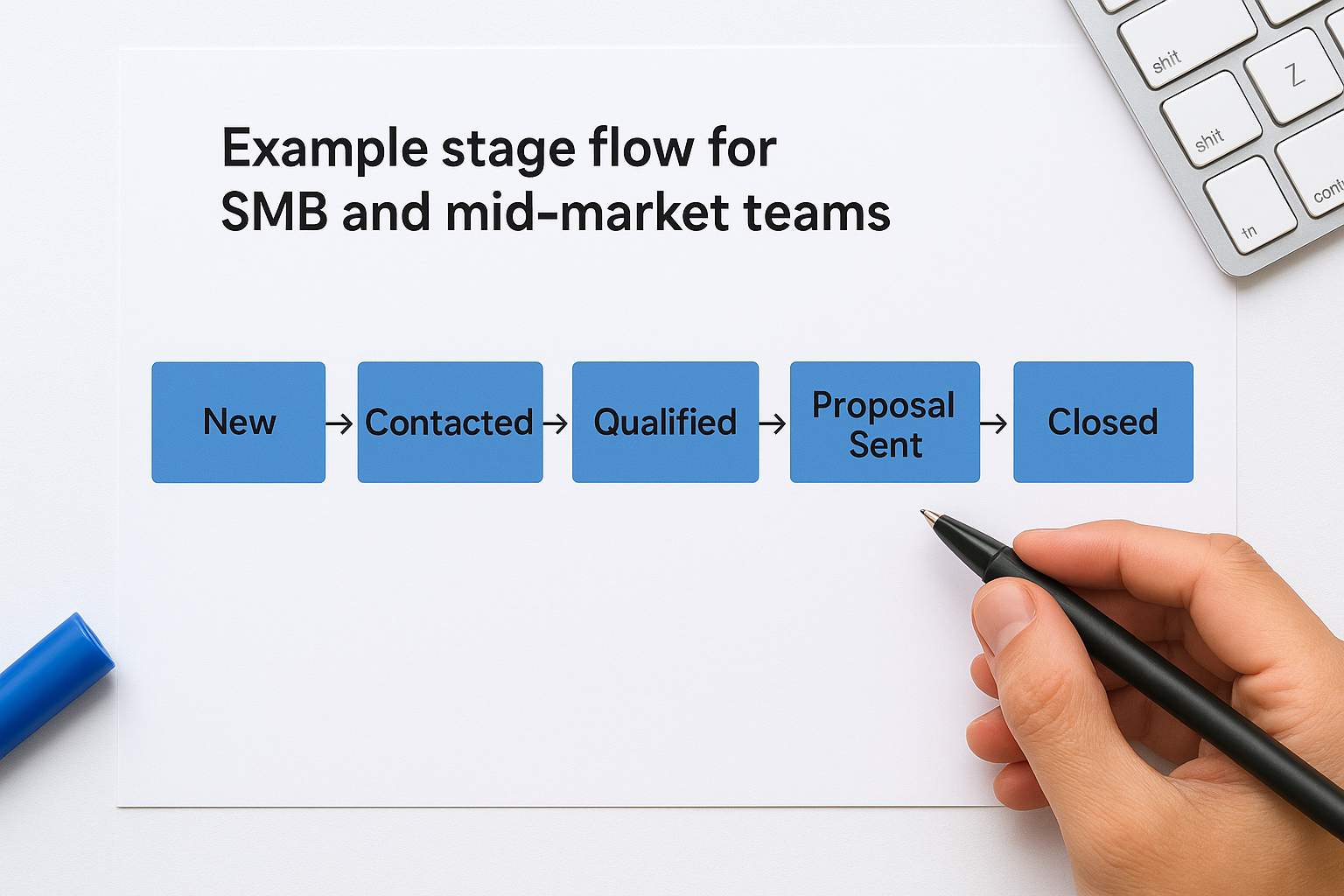
Your pipeline stages should reflect what already happened, not what you hope will happen.
How to write entry and exit criteria that reps follow
Write entry criteria around rep actions ("discovery call completed") and exit criteria around buyer actions ("prospect confirmed budget and timeline"). Tying exit conditions to buyer behavior keeps stage movement objective across every rep on your team.
How to stop stage skipping and "hope-casting"
Reps skip stages when they feel pressure to show movement. Requiring mandatory fields at each stage gate blocks advancement without real evidence and is one of the most impactful sales pipeline management best practices a manager can enforce.
Fields and activities to require at each stage
Require a logged touchpoint (call, email, or meeting note) plus one updated buyer-side field before any deal advances. This gives you reliable data without adding meaningful friction to your reps' workflow.
3. Enforce data hygiene with required fields and rules
Dirty data turns your pipeline into a guessing game, and enforcing data hygiene is one of the most overlooked sales pipeline management best practices. When close dates are wrong and fields are blank, you lose the ability to forecast accurately or coach your reps. Clean data requires deliberate rules built directly into your system.
Which fields you should require on every deal
Every deal record needs five non-negotiable fields at creation: lead source, contact phone, contact email, assigned rep, and deal value. These give you the minimum data to route, contact, and report on any opportunity from day one.
Which fields you should require by stage
As deals advance, stage-specific required fields keep your data rich. Require budget range before moving to Qualified and a confirmed decision date before moving to Proposal Sent. Tying required fields to stage gates prevents reps from advancing deals without real evidence.
A pipeline full of incomplete records is just organized confusion.
How to prevent duplicates and zombie opportunities
Run a duplicate check on phone and email at lead intake to catch overlaps before they multiply. For stale deals, set an automatic flag on any record with no activity in 14 days so managers can review and clean fast.
How to keep close dates realistic without micromanaging
If a deal has slipped its close date more than twice, require the rep to log a buyer-confirmed reason before the date moves again. This one rule keeps close date data honest without turning every pipeline review into a confrontation.
A simple weekly hygiene routine for managers
Spend 15 minutes each Monday running three filters: deals missing required fields, opportunities with no logged activity, and close dates already passed. Clearing these three categories keeps your pipeline data reliable heading into the week.
4. Qualify hard so your pipeline stays small and winnable
A bloated pipeline is not a strong pipeline. When reps hold onto every lead out of fear of losing numbers, your forecast becomes unreliable and your best opportunities get buried under noise. Qualifying hard is one of the most underrated sales pipeline management best practices because it keeps your team focused on deals that can actually close.
What "qualified" means in practical terms
Qualified means a prospect has confirmed need, identified budget, and a decision timeline they have shared with you on the record. Without all three, you have a conversation, not an opportunity. Treat anything short of that as a lead, not a pipeline deal.
Simple qualification frameworks that work for SMB teams
Most SMB teams do well with BANT (Budget, Authority, Need, Timeline) as a baseline. Run through all four criteria in discovery and document the answers directly on the deal record so the qualification is visible to everyone.
A "maybe" with no timeline is a no with extra steps.
Disqualifying fast without burning relationships
Disqualify by redirecting, not rejecting. Tell the prospect you want to reconnect when their timing improves and set a follow-up task for 60 to 90 days out. This keeps the relationship intact without parking a dead deal in your active pipeline.
How to stop reps from "collecting maybes"
Require reps to log a buyer-confirmed next step on every deal within 48 hours of last contact. If they can't get a confirmed next step, the deal moves back to lead status automatically.
How to keep qualification consistent across reps
Build a short qualification checklist with four to five required fields that every rep completes before a lead enters the pipeline. Standardizing the criteria removes ambiguity and gives managers a consistent baseline for coaching conversations.
5. Build a follow-up cadence that reps can execute daily
Most deals don't die because the prospect said no. They die because the rep sent one email, heard nothing, and moved on. A consistent follow-up cadence gives your team a repeatable daily structure so every live opportunity gets the attention it needs.
Why most deals stall after a weak next step
A weak next step is one where only the rep knows what happens next. When a call ends without a confirmed next action, the deal drifts and stalls.
Build the habit of confirming the next step verbally before you end every interaction. This one shift moves more deals forward than any other single technique.
If your rep can't name the buyer's next action, the deal has no momentum.
A baseline multi-touch cadence by channel
Start with six touches over ten business days, spread across multiple channels so you reach prospects in different contexts:

- Day 1: Call
- Day 2: SMS
- Day 4: Email
- Day 6: Call
- Day 8: Email
- Day 10: Final call
How to tie every touch to a specific outcome
Each touch needs one clear objective going in, whether that's booking a meeting or confirming a timeline. Reps who know the goal of each touch before they dial handle objections more naturally and close gaps faster.
When to use phone vs SMS vs email
Use phone calls for first contact and any high-stakes conversation. SMS works well for quick confirmations, and email is best for sending materials or following up in writing.
How to use templates without sounding templated
Templates save time, but personalization keeps them effective. Add one specific detail from your last conversation before you send. This habit is one of the sales pipeline management best practices that directly improves reply rates.
6. Use pipeline metrics that actually drive action
Tracking the wrong numbers gives you false confidence without helping you close more deals. The sales pipeline management best practices that separate good teams from great ones come down to knowing which metrics create decisions and which ones just fill dashboards.
The core metrics every team should track
Every team needs four numbers front and center: pipeline value, pipeline coverage, stage conversion rate, and average sales cycle length. These four tell you whether you have enough deals, where you lose them, and how long closing takes.
How to calculate pipeline coverage and set a target
Pipeline coverage is total pipeline value divided by your revenue target. Most teams aim for a 3x coverage ratio, meaning three dollars of pipeline for every dollar of quota. Below 2x signals a sourcing problem that won't fix itself.
Low pipeline coverage is a revenue problem you can see coming weeks before it hits.
How to track stage conversion and stage duration
Stage conversion shows what percentage of deals advance from one stage to the next. Stage duration shows how long deals sit at each stage. Tracking both together reveals exactly where deals stall and which stages need coaching attention.
How to measure win rate and sales cycle length correctly
Calculate win rate against deals that reached a final decision, not total leads. Measure sales cycle from qualified to closed, not from first contact, so your data reflects real buying behavior rather than lead volume.
How to turn metrics into weekly priorities
Pull your four core metrics every Monday morning and identify the single biggest gap. Then assign one concrete action to close that gap before your next review.
7. Run pipeline reviews that create movement, not status updates
Pipeline reviews fail when they turn into deal recaps that everyone already knows. The goal of any review is to create clear next actions and surface deals at risk before they slip off your forecast. This is one of the sales pipeline management best practices that directly impacts how much revenue your team closes each quarter.
What to review as a team vs one-on-one
Team reviews work best for pipeline coverage and top opportunities that affect the group's number. One-on-ones are where you go deep on individual rep performance, deal risk, and coaching. Mixing both into one meeting wastes everyone's time and dilutes the focus of each.
The agenda that keeps reviews fast and useful
Open with coverage and close date movement, then work through deals at risk, then assign actions. Keep the total time under 30 minutes by cutting any deal that has no new information to share.
Questions that expose risk and next steps
Ask "What has the buyer done since your last conversation?" rather than "How is this deal going?" Buyer inaction is a clear signal, and surfacing it early gives your team time to respond before the deal quietly dies.
A deal where only the rep is moving is a deal heading toward a no.
How to handle stuck deals and slipping close dates
When a deal slips its close date, require the rep to share a buyer-confirmed reason before updating it. This one rule keeps your forecast honest and forces real conversations with the prospect.
What to change when patterns repeat
If the same stage consistently shows stuck deals, the problem is process, not people. Fix the stage definition, required fields, or the cadence your reps use to advance deals through that point.
8. Prioritize deals by probability and urgency, not gut feel
Gut feel is not a prioritization strategy. When reps rank their deals based on personal optimism, your highest-value opportunities often get less attention than the ones that feel comfortable. One of the most practical sales pipeline management best practices is building a repeatable system for ranking deals so your team consistently focuses where it counts.
How to spot strong deals early
Strong deals show a clear pattern: the buyer takes initiative. They respond quickly, ask specific questions, and loop in colleagues without being prompted. Track these engagement signals on the deal record so every rep can identify which prospects are genuinely moving.
A simple scoring model reps will use
Score each deal across three factors: buyer engagement, confirmed timeline, and budget clarity. Rate each from one to three and total the scores. Deals scoring seven or higher get daily attention; anything below five needs a hard reassessment before it stays in your active pipeline.
A low-scoring deal sitting at the top of a rep's list is a warning sign, not a priority.
How to set and validate next steps with the buyer
Every next step needs a buyer commitment, not just a rep task. Require reps to log the buyer's specific agreed action and date directly on the deal record before closing out any touchpoint.
When to escalate and when to walk away
Escalate when a deal has real value and an identifiable blocker a manager can remove. Walk away when the buyer stops responding and your scoring model drops the deal below threshold for two consecutive weeks.
How to protect time for pipeline creation
Block at least 90 minutes daily for prospecting, separate from active deal follow-up. Reps who skip sourcing to manage existing deals create a future revenue gap that shows up three months later when their pipeline runs dry.
9. Multithread and map stakeholders before you need them
Relying on a single contact to carry your deal through an organization is one of the most common and expensive mistakes in sales. Multithreading, meaning building multiple relationships across the account, is one of the sales pipeline management best practices that protects your deals from stalling when your champion changes roles, goes on leave, or simply loses internal support.
Why single-threaded deals slip at the finish line
When your only contact disappears or loses influence, your deal disappears with them. Single-threaded deals look healthy right up until they collapse, often days before a projected close date. Map at least two to three contacts per account before you reach the proposal stage.
How to build a stakeholder map in discovery
Ask your primary contact directly: "Who else will be involved in evaluating this?" Document every name, title, and role on the deal record so your entire team has visibility into the buying committee.

A stakeholder map built in discovery is worth more than any proposal deck you send later.
How to create internal champions and deal momentum
Send your champion materials they can share internally without needing you on the call. Short summaries, business case templates, and proof points give them a reason to advocate on your behalf between your conversations.
How to handle procurement and legal earlier
Introduce procurement and legal conversations at least one stage before you expect final approval. Waiting until the finish line turns a two-week close into a two-month delay.
Signals you need more contacts in the account
If your champion stops responding or consistently needs to "check with someone" before answering basic questions, you are single-threaded and at risk. Add contacts immediately rather than waiting for the deal to stall.
10. Automate repetitive work so reps sell more hours per week
Repetitive manual tasks eat hours your reps could spend on conversations that actually close deals. Automation handles the routine work so your team focuses on high-value selling activities every single day.
What to automate first for quick wins
Start with lead assignment and initial outreach. The moment a lead enters your system, automation should route it to the right rep and trigger a first-touch message within seconds, with no manual step required. Prioritize these three workflows before anything else:
- Lead routing by source or territory
- First SMS or email on lead arrival
- Follow-up task creation for the assigned rep
Automations that improve speed-to-lead and response time
Speed-to-lead is one of the highest-impact variables in sales. Automating your first contact to fire within 60 seconds of lead arrival dramatically improves connection rates before a competitor reaches the same prospect.
The rep who responds first wins the conversation more often than the rep who responds best.
How to automate call, SMS, and email workflows responsibly
Build multi-step sequences that trigger based on prospect behavior, not just a fixed timer. When a lead replies to an SMS, your system should pause further automation and route the conversation to a live rep immediately.
How to use AI without losing control of your messaging
AI agents work best when they operate within defined guardrails and approved response templates. Review AI-generated messages regularly to ensure they stay on-brand and accurate before you scale any automated conversation.
How LeadMailbox supports automation across channels
LeadMailbox connects call, SMS, and email automation in one platform, covering the sales pipeline management best practices outlined throughout this guide. Your team closes more deals with less manual effort built directly into the same system where leads live.
Next steps
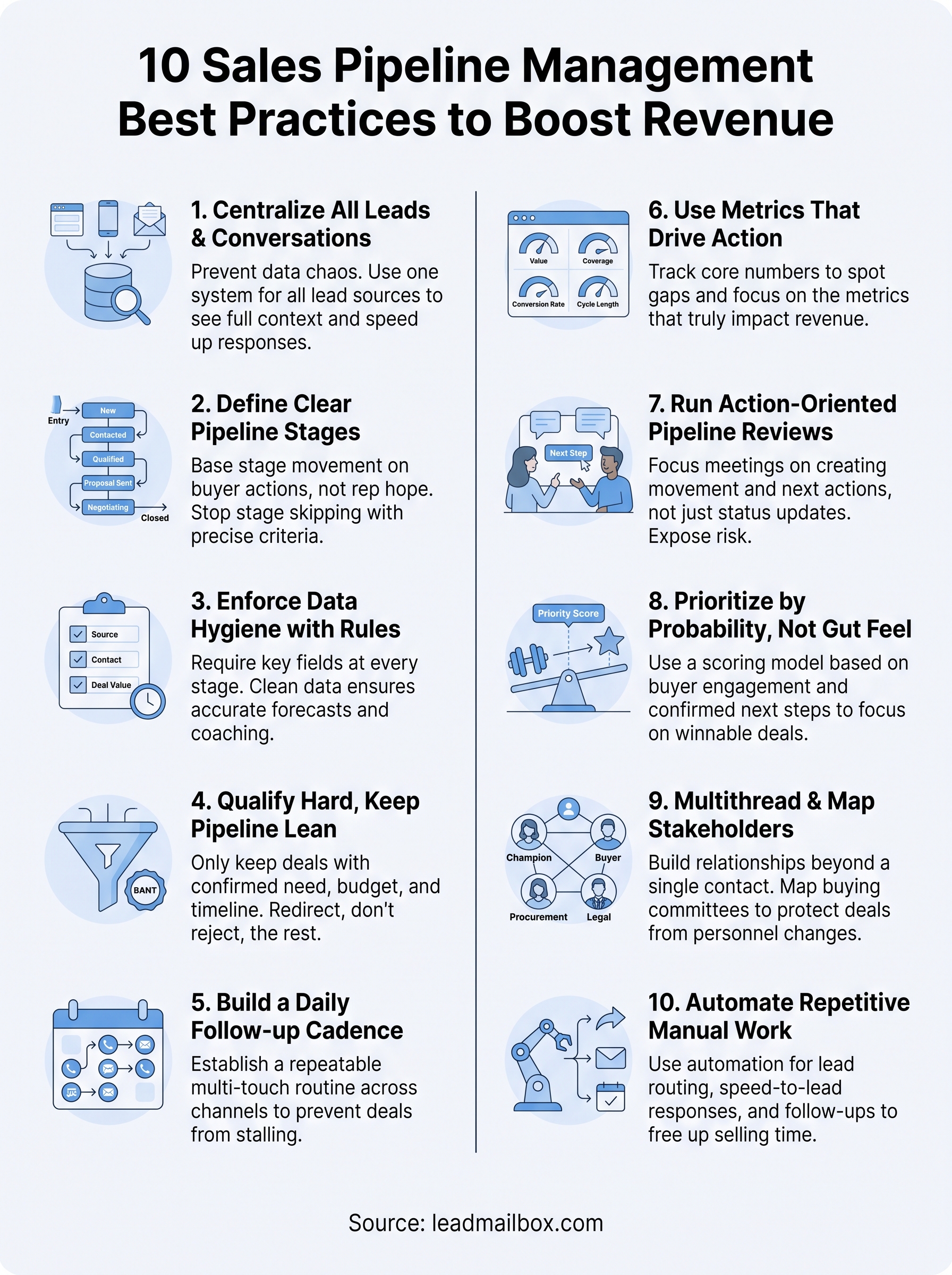
These 10 sales pipeline management best practices give you a clear path from lead chaos to consistent, measurable revenue growth. The difference between a pipeline that converts and one that stalls comes down to consistent execution on the basics: clean data, clear stage criteria, fast follow-up, and automated workflows that keep your team selling instead of administering.
Your next move is simple. Pick the two or three practices that address your biggest current gap and build them into your team's daily routine before layering in more complexity. Small, sustained improvements compound into dramatically better results over a full quarter.
When you're ready for a platform that brings lead aggregation, multi-channel outreach, and pipeline automation together in one place without the enterprise price tag, see what LeadMailbox can do for your sales team. You can stop stitching together separate tools and start closing more deals from a single system built for exactly this.