

Sales Enablement Platform Features—2026 Must-Have Checklist
Picking the wrong sales tool costs more than money, it costs deals, momentum, and your team's patience. The difference between a platform that actually moves the needle and one that collects digital dust comes down to sales enablement platform features that match how your team sells. Not how a vendor thinks you should sell, but how your reps actually work day to day.
The problem is that feature lists across vendors start to blur together. Every platform claims to offer "everything you need," but the gap between a checkbox feature and a genuinely useful one is massive. Some tools nail content management but fall flat on communication. Others handle calls fine but can't aggregate leads from more than a handful of sources. Knowing which capabilities are non-negotiable versus nice-to-have saves you from expensive mistakes, and from duct-taping together five different apps that don't talk to each other. At LeadMailbox, we've spent over 20 years building and refining a platform that combines lead management, telephony, AI-powered outreach, and multi-channel campaigns in one system, so we have a clear perspective on what actually matters.
This checklist breaks down the features you should expect from any serious sales enablement platform in 2026. We'll cover core functionality, communication tools, AI capabilities, and integration requirements, giving you a practical framework to evaluate platforms against your real needs, not marketing promises.
What a sales enablement platform does in 2026
A sales enablement platform gives your sales team the tools, content, and data they need to engage prospects and close deals, all from one place. In 2026, that definition has expanded well beyond what it covered even three years ago. What started as a way to organize sales collateral has grown into an interconnected system covering lead capture, multi-channel outreach, automated follow-up, and real-time performance tracking. The best platforms don't just hold resources; they actively support every stage of your sales process, from the first touchpoint to a signed contract.
From content library to full sales stack
Early sales enablement tools focused almost entirely on content, giving reps a place to store pitch decks, battle cards, and email templates. Today's platforms do far more than that. You need a system that connects content to action, meaning your reps can pull the right asset and send it through the right channel at the right moment, without switching between five different apps. The modern sales enablement platform features that actually drive results are the ones that tie content directly to communication workflows, so context is never lost between systems.
The practical outcome is that your sales stack shrinks. Instead of managing a CRM in one tab, a dialer in another, and an email tool in a third, you work from a single interface. Fewer logins mean fewer dropped leads, which matters significantly when you're managing high-volume pipelines from multiple sources and every delayed follow-up is a potential lost deal.
Lead management as the foundation
Before a rep can enable a sale, they need to know who to contact and when. Lead aggregation, organization, and prioritization sit at the core of what a sales enablement platform does in 2026. Platforms that pull leads from multiple sources, whether paid directories, web forms, or partner integrations, and then route them to the right rep automatically are operating at a different level than those requiring manual imports and constant manager intervention.

Your lead management system is only as strong as its ability to surface the right contact at the right moment, not just store records indefinitely.
Routing rules, lead scoring, and status tracking keep your pipeline moving without requiring a manager to manually check in every time a new lead arrives. You get full visibility into where leads are sitting and how long they've been idle, which makes follow-up faster and more consistent across the entire team.
Where AI fits into the modern platform
AI is no longer an add-on feature in 2026; it's a core expectation. AI agents can now handle inbound calls, respond to text messages, and draft outbound emails, taking on the repetitive communication tasks that used to consume hours of a rep's week. Your team shifts its energy toward qualified conversations instead of grinding through manual outreach on cold contacts.
The important distinction is between AI that assists and AI that replaces sound judgment. The best platforms use AI to extend your reps' capacity, handling routine touchpoints while preserving the human-led conversations that actually close deals. When AI manages the predictable interactions, your reps direct their attention toward the opportunities that genuinely require sales skill.
Why sales enablement platform features matter
The features a platform includes determine what your sales team can actually accomplish each day. A weak feature set forces reps to work around gaps, stitching together manual processes that slow down response times and let warm leads go cold. When the tools match the workflow, your team spends less time managing software and more time having conversations that close deals.
The right platform does not just support your sales process; it removes the friction that quietly kills conversion rates.
The real cost of feature gaps
Missing features rarely show up as a single catastrophic failure. They show up as a rep manually copying contact information between systems, a follow-up that happens three days too late, or a manager who has no clear picture of which leads are active and which ones have aged out. These small inefficiencies compound fast across a team handling hundreds of leads per month, and the cumulative impact appears directly in your close rate.
Choosing a platform with the wrong sales enablement platform features also creates tool sprawl across your operations. Every additional app your team needs to compensate for a capability gap adds another potential failure point, another login, and another monthly cost. The financial drag of a fragmented stack grows steadily as your headcount and lead volume increase, and training time alone becomes a significant drain on your team's productivity.
How features connect to revenue outcomes
Features are not abstract checkboxes. Each capability on a platform maps directly to a step in your sales process, and gaps in that map translate to gaps in revenue. A dialer that integrates with your lead list cuts the time between lead arrival and first contact. Automated follow-up sequences prevent leads from aging out while a rep focuses on a higher-priority conversation.
When you evaluate platforms, you are not just comparing feature lists. You are comparing the outcomes those features produce for a real team under real conditions. Platforms that bring together lead management, communication, and reporting in one place give your team a measurable and consistent advantage over those relying on disconnected tools, and that advantage compounds month over month as your team builds confidence inside a single system.
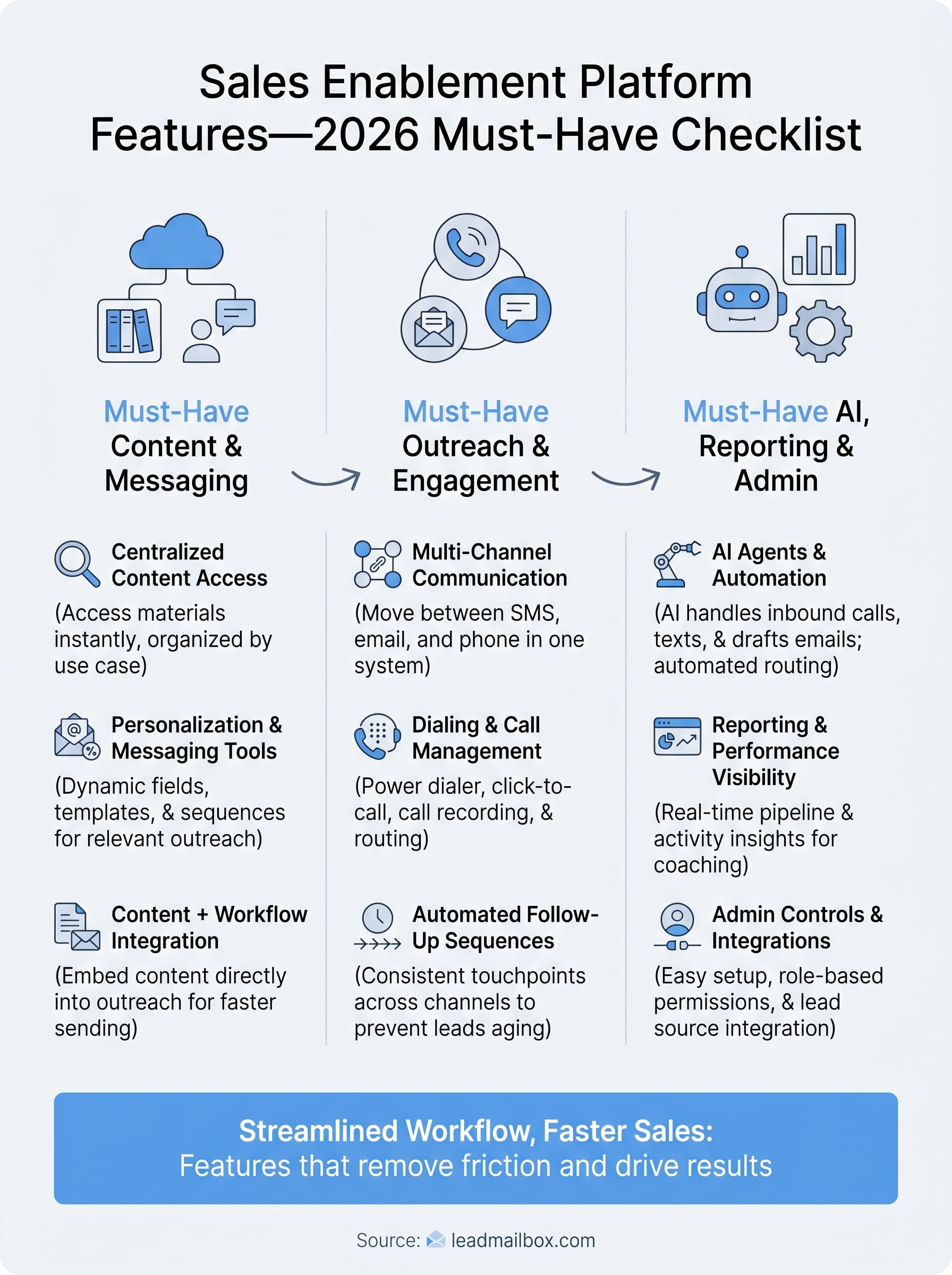
Must-have content and messaging features
Content without reach is just storage, and reach without the right content is noise. The content and messaging layer of your sales enablement platform features determines whether your reps send the right material to the right person at the right moment, or improvise with whatever they can find fastest. Disorganized content kills credibility with prospects, and a platform that doesn't solve for this is one that will slow your team down rather than speed it up.
Centralized content access
Your reps need to find collateral fast, without digging through shared drives or asking a manager where the latest version of a one-pager lives. A centralized content library gives every rep immediate access to approved, up-to-date materials organized by use case, product, or stage in the buying process. When content is searchable and context-tagged, your reps stop wasting time hunting and start using the right assets in live conversations.
A content library is only useful if your reps can reach it without breaking their workflow to open a separate system.
The strongest platforms embed content access directly into the outreach workflow, so a rep composing a follow-up email can attach the right case study without leaving the interface. That integration is not a convenience feature; it is the difference between a rep actually using available content and ignoring it entirely.
Personalization and messaging tools
Generic outreach gets ignored. Prospects respond when the message reflects their situation, their industry, or the specific conversation you had with them last week. Your platform should support dynamic fields, message templates, and customizable sequences that let reps personalize at scale without writing every email from scratch.
Templates should be editable at the rep level so the message sounds like a person, not a mail merge. Personalization tools that pull in contact-specific data automatically reduce the manual work involved in high-volume outreach and keep message quality consistent across your team. When messaging tools and lead data connect in the same system, your reps can send relevant, timely communication without slowing down the pace of their outreach.
Must-have outreach and engagement features
Content sitting in a library does nothing until a rep sends it through the right channel. Outreach and engagement capabilities are where your platform transforms lead data into actual conversations, and the strength of these features determines how fast and how consistently your team reaches prospects. Without reliable communication tools built into the same system, your reps are constantly switching between apps and losing time that should go toward selling.
Multi-channel communication
Prospects don't respond on a single channel, and your platform shouldn't force you to pick just one. SMS, email, and phone outreach all serve different moments in the sales cycle, and the best platforms let your reps move between channels without jumping to a separate tool for each. Keeping all communication history in one place means every rep can see the full context of a prospect interaction before they make the next move.

Automated follow-up sequences that span multiple channels keep leads warm without requiring a rep to manually schedule every touchpoint. A sequence that starts with a call attempt, follows up with an SMS, and closes with a personalized email covers far more ground than single-channel outreach, and it does so consistently regardless of how busy your team gets.
When every channel feeds back into the same lead record, your reps stop guessing and start selling with full context.
Dialing and call management
Phone-based outreach remains one of the highest-conversion channels for sales teams handling large volumes of inbound and outbound lead activity. Your platform should include a full telephony suite covering click-to-call, a power dialer, and inbound call management, not as bolted-on extras but as core sales enablement platform features built directly into your workflow. A power dialer alone can multiply the number of live conversations your reps complete in a single day by eliminating the manual work of dialing each number individually.
Call management tools like inbound number routing and call recording give your managers direct visibility into how conversations are going and where reps need coaching support. That visibility feeds into targeted skill development, which improves close rates over time without requiring you to add headcount to see results.
Must-have AI, reporting, and admin features
AI, reporting, and admin capabilities are the layer of sales enablement platform features that most teams underestimate until something breaks. When your platform lacks real-time reporting, managers make decisions based on outdated information. When AI is absent, reps burn time on tasks a machine could handle in seconds, and that time comes directly out of productive selling hours.
AI agents and automation
AI agents that handle routine communication give your reps back significant portions of their day. An AI that answers inbound calls, responds to incoming SMS messages, and drafts outbound emails removes the volume burden from your team without sacrificing response speed. Your reps stay focused on high-value conversations while the platform manages the predictable touchpoints that would otherwise pile up in a queue.
The fastest follow-up wins most of the time, and AI agents let your team respond instantly even when every rep is already on a call.
Automation rules for lead routing and follow-up triggers reduce the number of decisions your team has to make manually. When a lead hits a certain status or goes a set number of hours without contact, the platform should act rather than wait for someone to notice.
Reporting and performance visibility
Pipeline visibility and activity reporting give managers the information they need to coach reps and adjust strategy without relying on instinct. Your platform should show you which leads are moving, which are stalling, and which reps are hitting their activity targets each day. Granular reporting at the rep, campaign, and source level makes it straightforward to identify where your process is working and where it needs adjustment before small problems compound into significant revenue loss.
Admin controls and integrations
Your admin team needs to set up the platform quickly and maintain it without involving a developer for every configuration change. Role-based permissions and customizable lead routing rules keep your data clean and your workflow consistent as your team scales. Integration with your existing lead sources and partner networks determines how fast new leads enter the system and how much manual work your team absorbs before a rep ever makes contact.
Next steps for your checklist
You now have a clear picture of what separates a platform that delivers results from one that just adds to your software stack. The next move is to take this checklist into your evaluation process and hold every platform you consider accountable to these standards, not just the ones they highlight in their demo.
Start by mapping your current gaps. Identify which sales enablement platform features you're already covering with existing tools and which ones are missing entirely. That gap list becomes your non-negotiable requirements when you speak with vendors.
When you're ready to see what a unified system looks like in practice, explore LeadMailbox. LeadMailbox combines lead management, multi-channel outreach, telephony, and AI agents in a single platform built specifically for sales teams that need to move fast and stay organized without paying enterprise prices.