

9 Sales Enablement Best Practices to Boost Close Rates
Your reps have the leads. They have the pitch deck. They even have the motivation. But if they're missing the right processes, tools, and content at the right moment, deals stall out. That's exactly why sales enablement best practices matter, they bridge the gap between a team that's busy and a team that's actually closing revenue.
The problem isn't usually effort. It's alignment. Marketing creates content that sales never uses. Reps waste hours digging through outdated materials or manually following up with cold leads. Meanwhile, response times slip, and prospects move on. Getting enablement right means removing those friction points so your team spends more time selling and less time searching, something we've spent over 20 years building LeadMailbox to solve, from lead aggregation and AI-powered outreach to integrated calling and SMS tools.
This article breaks down nine practices that directly impact close rates. Whether you're building a sales enablement strategy from scratch or tightening one that already exists, these are the moves that separate high-performing teams from the ones stuck wondering why their pipeline isn't converting.
1. Unify leads, calling, texting, and email in one system
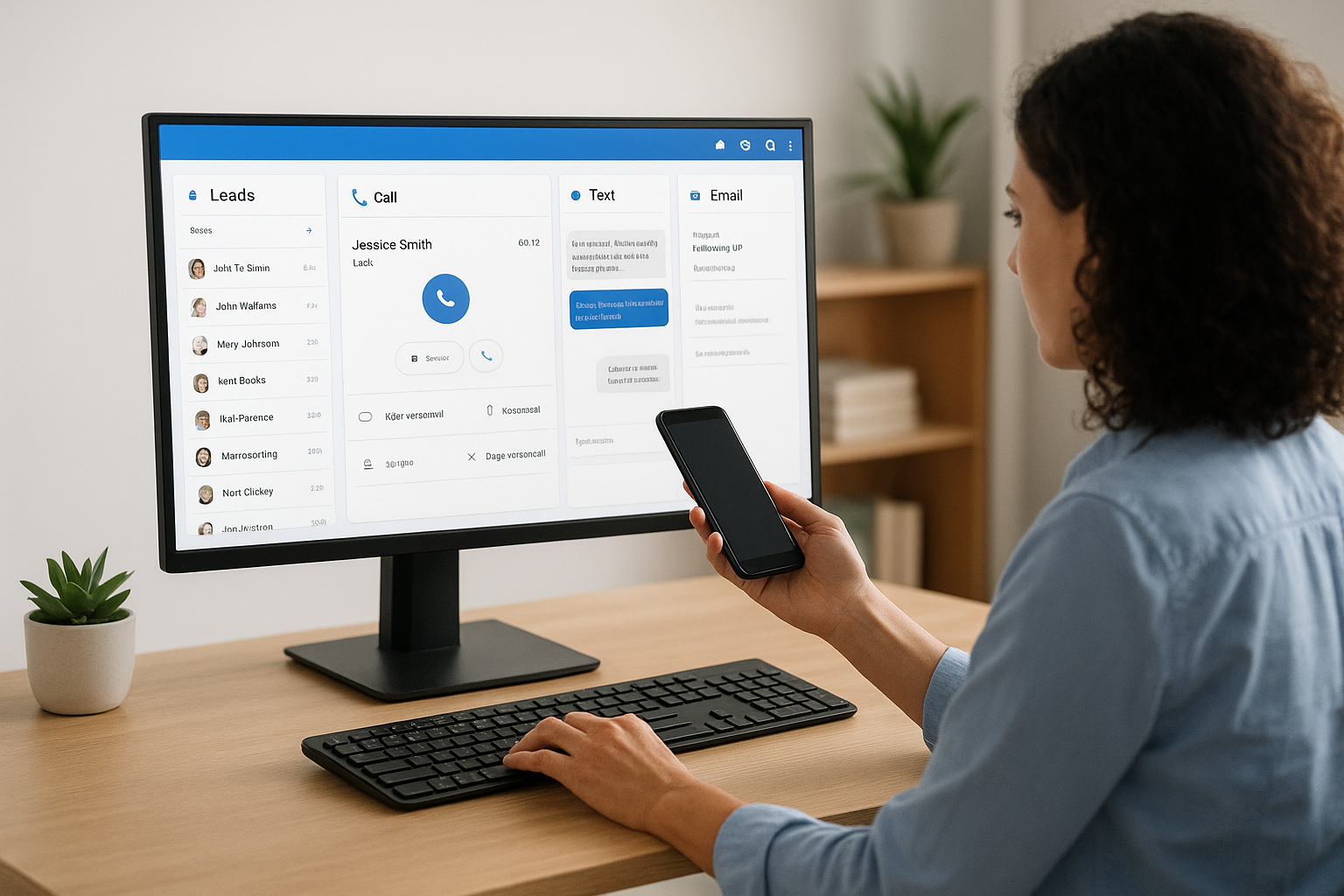
Fragmented tools are one of the biggest obstacles to effective sales enablement best practices. When your leads live in a spreadsheet, your calls happen in one app, texts in another, and emails in a third, reps spend more time context-switching than selling. A unified system fixes this by giving your team a single place to manage every touchpoint from first contact to closed deal.
What it looks like in practice
A rep gets a new lead notification, calls immediately from the same screen, leaves a voicemail drop if no one answers, and triggers an automated SMS follow-up sequence, all without opening a second tab. Every interaction is logged automatically, so the next rep or manager who reviews the record sees the complete picture. No hunting through inboxes or separate CRMs to piece together what happened before the last conversation.
Steps to implement
Start by auditing every tool your team currently uses for lead management and outreach channels. Then identify where data gets siloed or manually transferred between systems. From there:
- Choose a platform that handles leads, calls, SMS, and email natively
- Migrate existing lead data and set up all source integrations before launch
- Build call and message templates your team can use from day one
- Train reps on the unified workflow before fully going live
Establish clear naming conventions and consistent pipeline stages during setup so your data stays clean from the start.
Metrics to watch
Once your system is unified, track contact rate (how often reps actually reach prospects) and average response time per lead. Both will improve when reps no longer need to switch tools to take action. Also monitor channel conversion rates across call, text, and email to identify which outreach method moves deals fastest for your specific audience.
A unified system doesn't just save time. It creates a data trail that makes every future coaching and optimization conversation far more specific and actionable.
Pitfalls to avoid
The most common mistake is partial migration, where some leads stay in old tools while others move to the new system. This creates duplicate records and gaps in follow-up coverage. Commit fully to the new platform and retire legacy tools as soon as your team is trained and workflows are confirmed stable.
2. Tie enablement goals to pipeline math, not activity
Most sales teams measure enablement by activity counts: calls made, emails sent, training sessions completed. Those numbers feel productive, but they don't tell you whether your enablement efforts are actually moving deals forward. Tying your goals to pipeline math means starting with your revenue target and working backward to define exactly what enablement needs to deliver.
What it looks like in practice
If your team needs to close 20 deals this month at a 40% close rate, you need 50 qualified opportunities. That math tells you how many leads to work, how many calls to prioritize, and which content gaps to fill. Sales enablement best practices shift your focus from "did reps complete the training?" to "did conversion rates improve enough to hit the number?"
Steps to implement
Work backward from your monthly revenue goal to set specific conversion benchmarks at each pipeline stage. Then attach enablement activities directly to the gaps those numbers reveal.
If your lead-to-opportunity rate is low, the fix might be better talk tracks, not more calls.
Metrics to watch
Track pipeline conversion rates at each stage, not just overall close rate. Also watch average deal velocity to spot where prospects stall after enablement changes roll out.
Pitfalls to avoid
Avoid setting activity-based quotas as proxies for enablement success. Reps hitting call counts but missing revenue targets signals a process problem, not an effort problem. Fix the process first.
3. Align sales and marketing on handoffs and messaging
Misalignment between sales and marketing is one of the most common reasons good leads go nowhere. Marketing qualifies a lead one way while sales expects something different, and the rep who receives it either ignores it or spends the first call correcting mismatched expectations. Fixing this handoff is a core part of sales enablement best practices that too many teams overlook.
What it looks like in practice
Both teams operate from the same lead qualification criteria and use consistent language at every stage. When marketing passes a lead to sales, the rep already knows the source, the prospect's expressed interest, and the next action to take. No re-explaining, no guesswork, just a clean transition that keeps momentum going.
Steps to implement
Start by documenting exactly what qualifies a lead as sales-ready, then get both teams to sign off on it. From there:
- Define MQL and SQL criteria in writing with input from both sides
- Create shared message templates that reflect agreed-upon positioning
- Schedule a monthly sync to review handoff quality and adjust criteria
Metrics to watch
Track MQL-to-SQL conversion rate and the percentage of passed leads that reps actually work. A low follow-up rate usually means the leads don't meet sales expectations.
If reps are ignoring marketing-sourced leads, the problem is almost always a definition gap, not a motivation problem.
Pitfalls to avoid
Avoid letting one team set the handoff rules without input from the other. Unilateral definitions create resentment and poor follow-through on both sides.
4. Build a speed-to-lead workflow that never breaks
Response time is one of the most overlooked variables in sales enablement best practices. Research consistently shows that leads contacted within the first five minutes convert at dramatically higher rates than those reached an hour later. Building a reliable speed-to-lead workflow means your team reaches prospects while interest is still at its peak, without depending on a rep remembering to check their queue.
What it looks like in practice
A new lead comes in from any source, triggers an automatic call or SMS within seconds, and routes to an available rep instantly. If no rep is available, an AI agent handles the initial contact and captures key information until a human can take over. The prospect never sits in silence waiting.
Steps to implement
Map every lead source you currently use and confirm each one feeds into a centralized system with automatic routing rules. Then set up notification triggers and fallback sequences for off-hours or missed calls.
Speed-to-lead is not about being aggressive. It is about being present before the prospect moves on.
Metrics to watch
Track average time-to-first-contact per lead source and the percentage of leads contacted within five minutes. Both numbers reveal exactly where your workflow breaks down.
Pitfalls to avoid
Avoid building a workflow that depends entirely on manual rep action to start. Any step that requires a human to initiate contact introduces delay. Automate the first touch so speed is consistent regardless of team availability.
5. Standardize follow-up with simple talk tracks and templates
Inconsistent follow-up is where deals quietly die. When every rep invents their own approach from scratch, quality varies wildly and no one knows what's actually working. Standardizing your follow-up with talk tracks and templates removes that inconsistency without turning your team into robots.
What it looks like in practice
Your reps pull up a pre-built call guide or message template, personalize it with one or two details specific to the prospect, and send it in under a minute. The core messaging stays consistent, but the delivery feels human. Every prospect gets a quality touchpoint regardless of which rep handles the follow-up.
Steps to implement
Build your templates by reviewing your best-performing conversations and extracting the language that consistently moves prospects forward. Then:
- Create call guides for the three most common follow-up scenarios
- Build SMS and email templates for each stage of your pipeline
- Review and update templates quarterly based on actual conversion data
Metrics to watch
Track follow-up completion rate and reply rate by template. If one template consistently outperforms others, make it the default and retire the underperformers.
Standardization is not about scripting every word. It is about giving reps a strong starting point so they spend energy selling, not writing.
Pitfalls to avoid
Avoid building overly rigid scripts that leave no room for rep judgment. Templates that sound robotic hurt conversion rates and undermine the sales enablement best practices you are working to build across your team.
6. Coach reps using real conversations and outcomes
Generic coaching feedback rarely changes behavior. When you tell a rep to "listen more" or "handle objections better" without pointing to a specific call, the advice bounces off. One of the most underused sales enablement best practices is grounding every coaching session in real recorded conversations and outcome data rather than general impressions.
What it looks like in practice
Your manager pulls up a recorded call where the rep lost momentum after a price objection and walks through exactly what happened and what a stronger response looks like. The rep hears themselves, sees the outcome in the data, and leaves the session with one specific adjustment to make, not a vague principle to remember.
Steps to implement
Build coaching into your weekly rhythm using data your system already captures. Review calls where deals stalled or closed, then connect the patterns to specific rep behaviors.
- Pull calls tied to lost deals from the last two weeks
- Identify the moment the conversation shifted and why
- Run a 20-minute session focused on one adjustment per rep
Metrics to watch
Track coaching session frequency alongside each rep's stage-to-stage conversion rates. If conversion improves after focused sessions, you are building an effective and repeatable loop.
Coaching without data is guesswork. Coaching with real call recordings and outcomes turns every loss into a repeatable lesson.
Pitfalls to avoid
Avoid coaching only top performers while assuming struggling reps will self-correct. The reps who need the most specific, outcome-based feedback are the ones who rarely receive it.
7. Automate routine outreach without losing personalization
Automation speeds up your outreach, but done poorly, it makes every message feel like a mass blast. The goal of automating routine outreach as part of your sales enablement best practices is to remove repetitive manual work while keeping each touchpoint relevant enough that the prospect feels seen, not processed.
What it looks like in practice
Your system sends a follow-up SMS an hour after a missed call, pulling in the prospect's first name and the specific product they inquired about. The rep never typed that message manually, but the prospect reads something that sounds personal. AI-powered tools handle the timing and delivery while reps focus on the calls that need real conversation.
Steps to implement
Build automation sequences around your most predictable follow-up scenarios. Start with the highest-volume, lowest-complexity touchpoints first.
- Set up post-call SMS sequences that trigger automatically based on call outcome
- Use dynamic fields to pull in lead-specific details like name, source, or interest area
- Cap automated sequences at a set number of touches before routing to a live rep
Metrics to watch
Track reply rate per automated sequence and the percentage of automated leads that convert to live conversations. Low reply rates signal your message content or timing needs adjustment, not necessarily more volume.
Automation works best when it handles the routine so your reps can handle the relationship.
Pitfalls to avoid
Avoid stacking too many automated touches in a short window. Over-messaging burns prospects and damages your reply rates across the entire sequence.
8. Track the right enablement metrics and review weekly
Most teams track too many numbers and act on none of them. Sales enablement best practices require narrowing your metrics to the ones that directly reflect whether your enablement efforts are translating into pipeline movement and closed revenue, not just activity.
What it looks like in practice
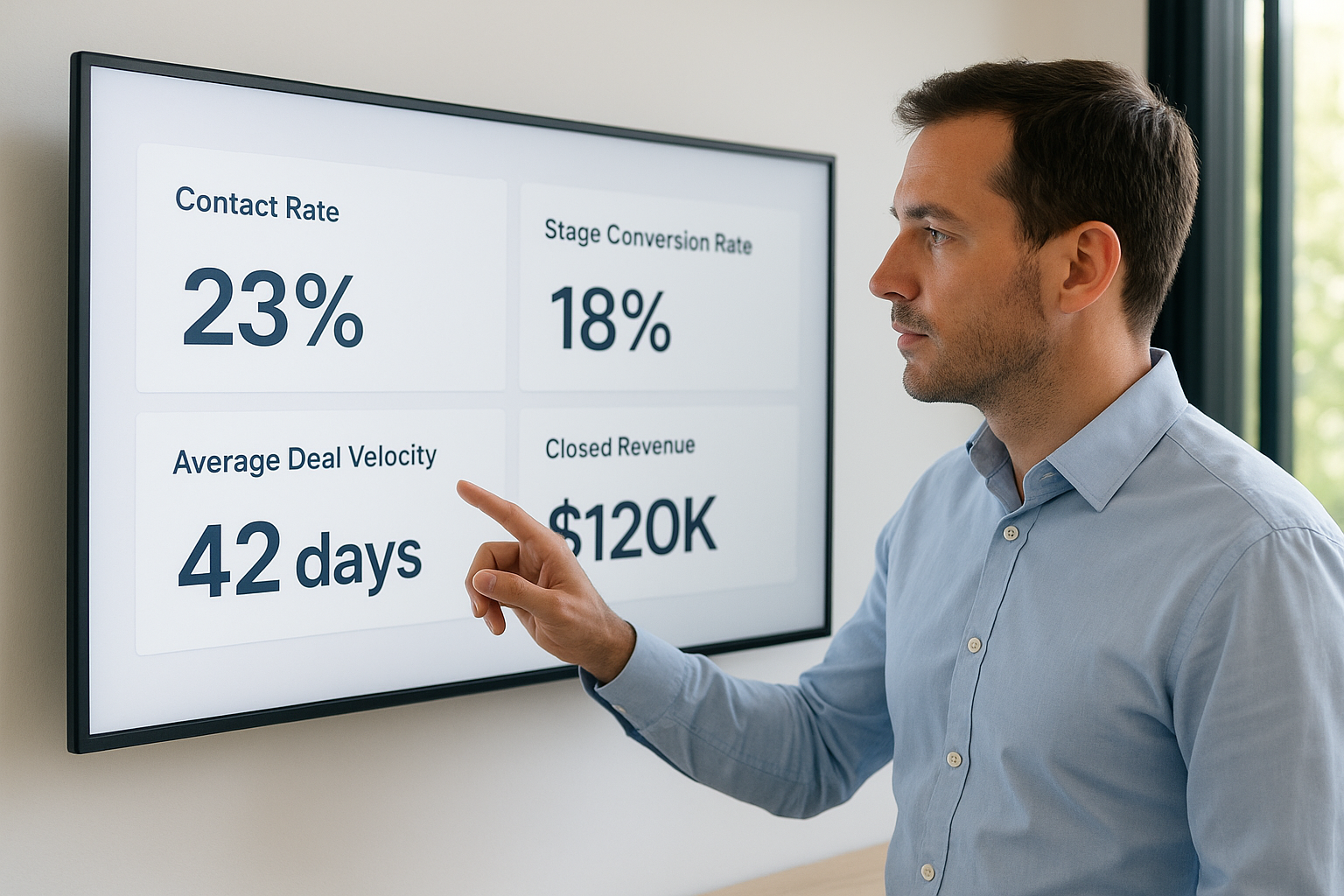
Your sales leader opens a weekly dashboard showing contact rates, stage conversion rates, and average deal velocity side by side. When one number drops, the team knows exactly which part of the process to investigate. No digging through reports or waiting for a monthly review to catch a problem that already cost you two weeks of pipeline.
Steps to implement
Pick five or fewer metrics that connect directly to your revenue target, then review them every week at a set time with your team.
- Track contact rate, lead-to-opportunity rate, and stage-to-close conversion
- Schedule a weekly 30-minute review and protect it from cancellation
- Flag any metric that shifts more than 10% in either direction for immediate discussion
Metrics to watch
Focus on pipeline conversion rates at each stage and average time-to-close. These two numbers tell you whether your enablement changes are actually shortening the path to revenue or just adding noise.
A weekly review turns data into decisions before small drops become expensive trends.
Pitfalls to avoid
Avoid letting your weekly review become a pure reporting session where numbers get read aloud but nothing changes. Every meeting should end with one specific action assigned to a named person with a clear deadline.
9. Keep lead data clean and integrate the tools you keep
Dirty data and disconnected tools quietly drain your team's productivity. When duplicate records pile up, contact details go stale, or your tools don't talk to each other, reps waste time on bad leads and broken workflows instead of closing deals. Keeping your data clean and your integrations tight is one of the most underrated sales enablement best practices on this list.
What it looks like in practice
Your system flags duplicate leads automatically, contact records stay current, and every tool your team uses feeds data into a single source of truth. Reps open one screen and see a complete, accurate picture of every prospect without second-guessing whether a phone number or email is still valid.
Steps to implement
Run a quarterly data audit to catch duplicates and outdated records before they compound. Then:
- Set up automatic deduplication rules in your lead management platform
- Remove any tool that duplicates functionality without adding unique value
- Confirm every active integration writes data back to your primary system
Metrics to watch
Track data accuracy rate (percentage of records with valid contact info) and the number of duplicate leads created per month. Both numbers drop quickly once you establish consistent hygiene habits and automate the most common data quality checks.
Clean data is not a one-time project. It is an ongoing standard that keeps every other part of your sales process working as intended.
Pitfalls to avoid
Avoid keeping tools out of habit rather than necessity. Every disconnected platform you hold onto adds another point where data breaks down and your team loses time recovering it instead of moving leads forward.
Next steps
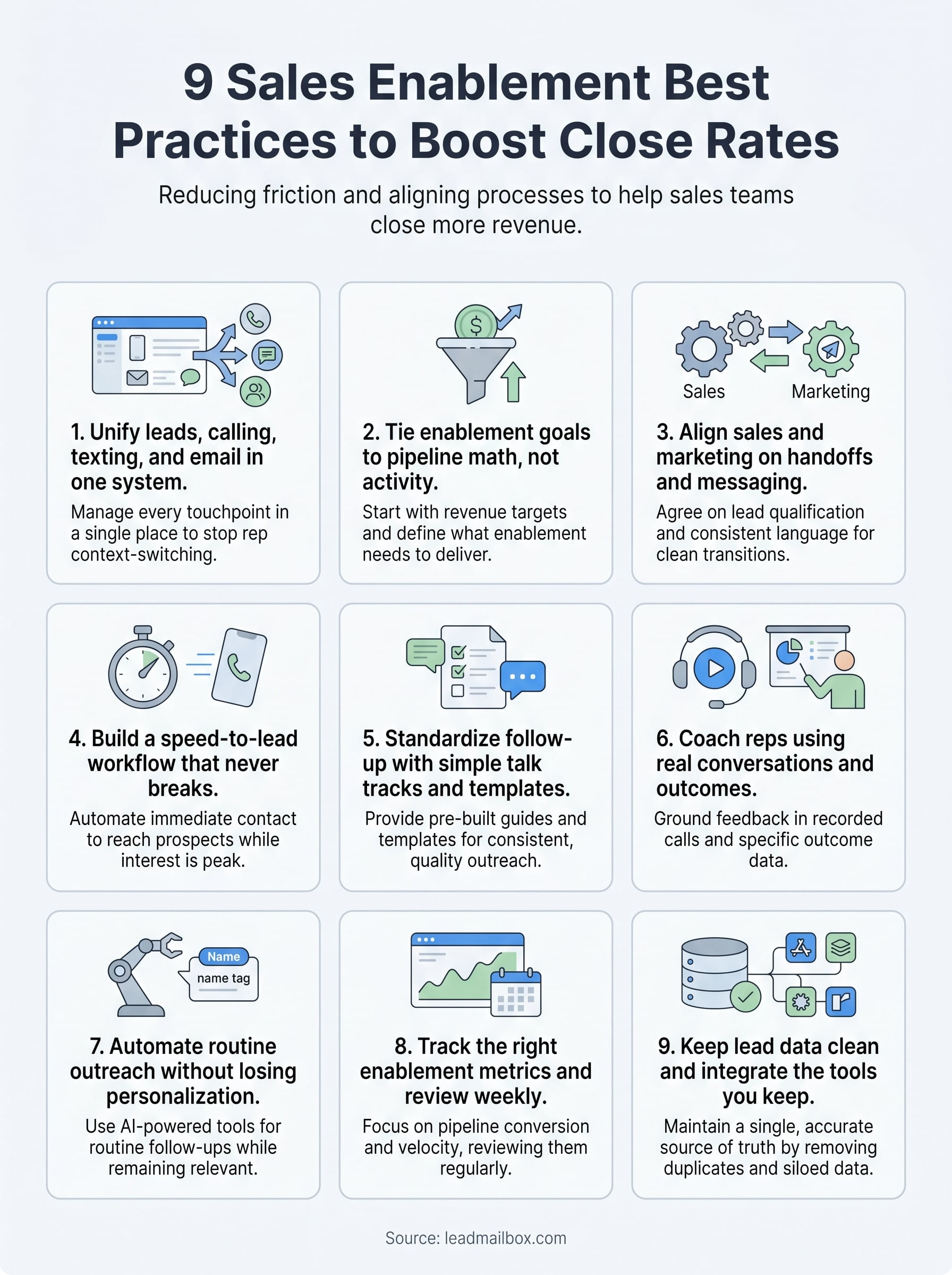
These nine sales enablement best practices share a common thread: every one of them reduces friction between your team and the next closed deal. You don't need to overhaul everything at once. Pick the two or three practices where your current process breaks down most visibly, fix those first, and measure the results before moving to the next set.
The biggest gains typically come from unifying your tools and tightening your speed-to-lead workflow. When your team can call, text, and email from a single platform with automatic routing and follow-up sequences, the rest of the process gets easier to manage. Coaching improves because the data exists. Templates get better because you can see what converts. Clean data becomes easier to maintain because fewer systems are involved.
If you want to see how one platform handles all of this, explore what LeadMailbox can do for your sales team and start closing more of the leads you're already paying for.