

Power Dialer Vs Predictive Dialer: Differences, Pros & Cons
Choosing the right auto-dialer can make or break your team's productivity. The power dialer vs predictive dialer debate comes up constantly in sales circles, and for good reason, each one works fundamentally differently, and picking the wrong type means either wasted agent time or dropped calls and frustrated prospects.
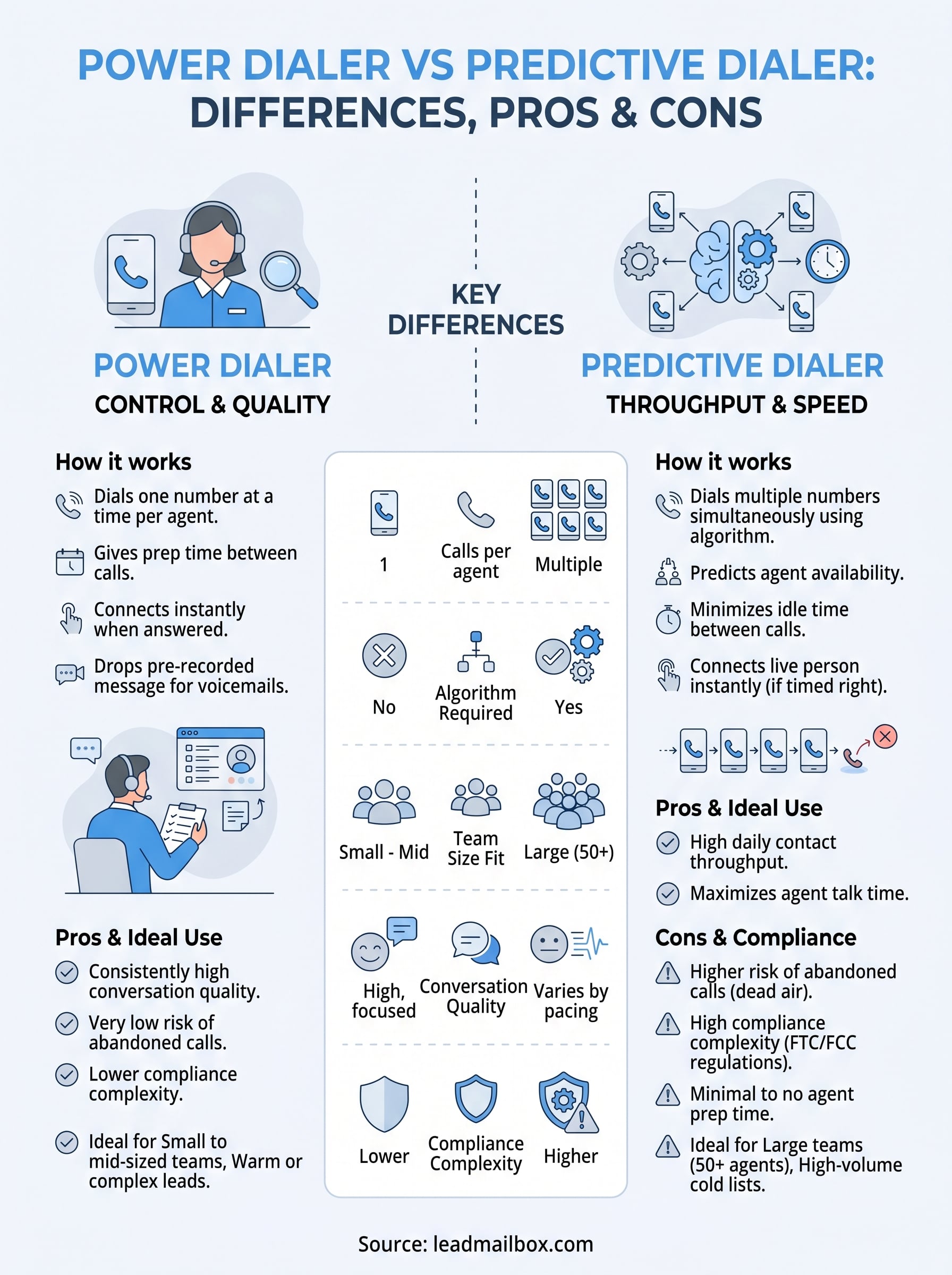
Both dialers automate the process of calling through a lead list, but they take very different approaches to how and when calls get connected. A power dialer calls one number at a time, keeping your reps in full control. A predictive dialer uses algorithms to dial multiple numbers simultaneously, anticipating when an agent will become available. The right choice depends on your team size, call volume, and how much you value conversation quality over raw speed.
In this guide, we break down exactly how each dialer works, their pros and cons, and which scenarios favor one over the other. At LeadMailbox, our telephony suite includes a built-in power dialer alongside click-to-call, insta-call, and other communication tools, so we've spent over 20 years watching how sales teams actually use these systems. That hands-on experience shapes everything we cover below.
Power dialer vs predictive dialer at a glance
When you stack up power dialer vs predictive dialer options, the fundamental divide is control versus raw throughput. Both systems automate outbound calling so your reps stop manually dialing numbers, but they make very different trade-offs between call quality, compliance risk, and agent workload. Understanding those trade-offs upfront saves you from buying a system that works against your team rather than for it.
What a power dialer does
A power dialer moves through your contact list one call at a time per agent. When a rep finishes a conversation, the system automatically dials the next number without the agent lifting a finger. If the call hits voicemail, the dialer can drop a pre-recorded message and skip ahead to the next contact instantly, so your rep never wastes 30 seconds waiting for a beep.
This approach gives agents time to review a lead's details before the next call connects. Because the dialer only fires one call per available agent, the risk of a prospect picking up and hearing dead air is nearly zero. For teams that sell complex products, work warm leads, or need reps to walk in prepared, that moment of context between calls directly impacts conversion rates.
A power dialer is built for quality-focused teams where rep preparation and conversation depth matter more than sheer volume.
What a predictive dialer does
A predictive dialer dials multiple numbers simultaneously using an algorithm that factors in agent availability, average handle time, and historical answer rates. The system's goal is simple: have a live person on the line the instant an agent becomes free. This keeps agents talking almost continuously, which is exactly why large outbound call centers use predictive dialers to drive high daily contact numbers.
The trade-off is that the algorithm occasionally miscalculates agent availability and connects a live prospect before any rep is ready to take the call. The FTC and FCC classify these as abandoned calls, and both agencies set strict limits on how frequently they can occur. Running a predictive dialer at scale means compliance complexity becomes an ongoing operational concern, not just a one-time setup task.
Side-by-side comparison
The table below breaks down the core differences between the two systems so you can spot at a glance which fits your current setup. Pay close attention to the team size and compliance columns, because those two factors alone eliminate one option for most businesses.
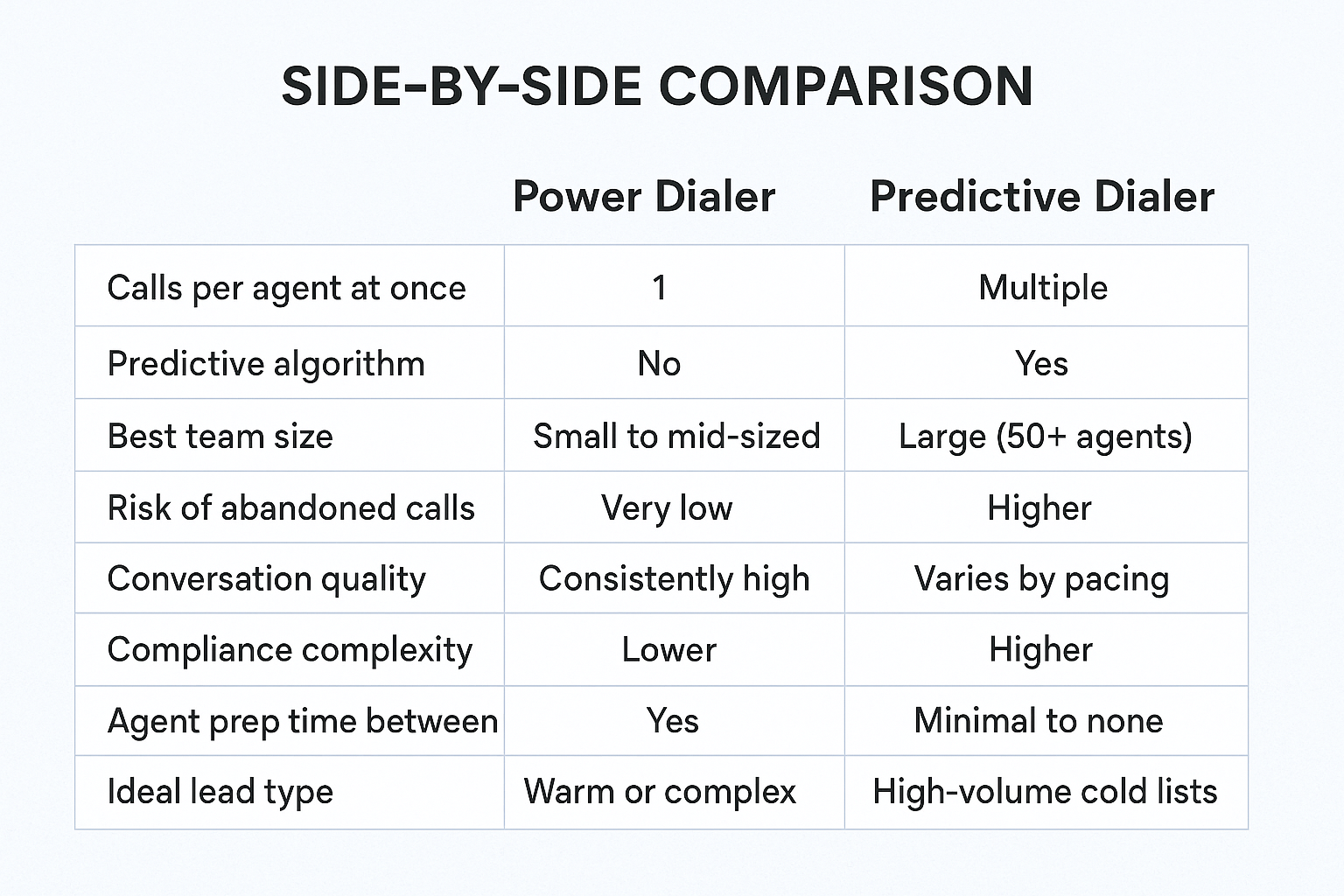
| Feature | Power Dialer | Predictive Dialer |
|---|---|---|
| Calls per agent at once | 1 | Multiple |
| Requires predictive algorithm | No | Yes |
| Best team size | Small to mid-sized | Large (50+ agents) |
| Risk of abandoned calls | Very low | Higher |
| Conversation quality | Consistently high | Varies by pacing |
| Compliance complexity | Lower | Higher |
| Agent prep time between calls | Yes | Minimal to none |
| Ideal lead type | Warm or complex leads | High-volume cold lists |
Your team's size and lead quality typically make the decision straightforward. If you run fewer than 15 to 20 agents and care about warm lead conversion, a power dialer fits the way you actually work. If you manage a large floor of agents burning through cold lists and your compliance infrastructure is solid, a predictive dialer's throughput advantage starts to make sense. The sections below walk through each system in detail so you can match the right tool to your exact situation.
Why dialer choice matters for sales teams
The dialer you pick shapes every outbound call your team makes, not just the speed of dialing. It affects how prepared your reps sound, how many prospects hang up before a rep gets on the line, and whether your business stays on the right side of telemarketing regulations. Most sales leaders treat dialer selection as a tech purchase when it's actually a decision about how your team operates every single day.
The cost of a mismatched dialer
Putting a predictive dialer in front of a small, relationship-driven sales team creates real problems fast. Reps get connected to live prospects without a second to review the lead's background, so conversations start cold even when the lead is warm. That costs you conversions you already paid to generate.
Buying leads is expensive. Fumbling them because your dialer gives reps no prep time is an avoidable way to burn that budget.
On the flip side, giving a large cold-calling floor a power dialer means agents spend significant time sitting idle between calls, which drives up cost-per-contact and makes it harder to justify the team's headcount. Neither scenario fixes itself over time. The mismatch between dialer type and team structure tends to get worse as call volume grows, not better.
How dialer type shapes rep behavior
In the power dialer vs predictive dialer debate, one factor that gets overlooked is what each system does to rep habits over time. A power dialer gives reps a natural rhythm, a brief window between calls where they can review notes, update the CRM, or mentally reset before the next conversation. That rhythm tends to produce reps who stay sharp throughout a long shift rather than burning out by midday.
Predictive dialers push reps in a different direction entirely. Because the system keeps call queues flowing continuously, reps adapt to working on autopilot. That works well for scripted, high-volume outreach where consistency matters more than nuance. For teams selling anything that requires discovery questions or personalized follow-up, the pace a predictive dialer sets can actually lower close rates even as contact volume goes up.
Understanding this behavioral dimension helps you see why dialer choice is not just an IT decision. It sets the tone for how your reps engage with prospects, how your managers coach performance, and ultimately how many leads convert into customers.
How a power dialer works
A power dialer connects to your CRM or lead list and works through contacts automatically, one at a time per agent. When a rep finishes a call, the system dials the next number on the list without any manual input. That simple loop, finish a call, auto-dial the next, is what separates a power dialer from a basic click-to-call setup and explains why teams use it to increase daily contact volume without adding headcount.
The call sequence step by step
The process follows a consistent pattern every time a call cycle begins. Your lead list or CRM feeds contacts into the dialer queue, the dialer places the call on the rep's behalf, and if someone answers, the rep connects immediately with no delay. If the call hits voicemail, the dialer drops a pre-recorded message automatically and moves to the next contact so the rep never sits idle waiting for a beep.

Here is what a typical power dialer sequence looks like in practice:
- Rep finishes or ends a call
- The dialer pulls the next contact from the queue
- The system dials the number automatically
- If answered, the rep connects instantly
- If voicemail, the dialer drops the pre-recorded message and moves on
- The cycle repeats until the queue is empty
That voicemail drop feature alone can save a rep 15 to 20 minutes per hour, time that flows directly into live conversations instead of waiting for beeps.
What happens between calls
One of the most underrated advantages of a power dialer is the brief gap it creates between calls. Unlike a predictive dialer, which aims to keep agents talking with almost no downtime, a power dialer gives your reps a moment to review the next lead's history, update notes, or adjust their approach before the new call connects. That window is usually only 5 to 10 seconds, but it makes a measurable difference in how prepared reps sound when they open a conversation.
In the power dialer vs predictive dialer comparison, this prep window is often what tips the scale for teams managing warm leads. When a rep can glance at a contact's prior conversations or deal stage before saying hello, the conversation starts with context instead of cold introductions. That increases the likelihood of moving the lead forward in the pipeline, and it does so without requiring extra coaching or additional effort from the rep on every single call.
How a predictive dialer works
A predictive dialer uses a statistical algorithm to dial multiple phone numbers at the same time, well before any agent finishes their current call. The system constantly analyzes data points across your entire agent pool to predict when someone will become available, then fires outbound calls timed to land a live answer at exactly that moment. The goal is to eliminate idle time between calls entirely, keeping your agents talking for the maximum possible portion of every shift.
The algorithm behind the dialing
The algorithm pulls from several real-time inputs to calculate its dialing pace. It watches average handle time, current agent availability, historical answer rates, and call abandonment data to decide how aggressively it should dial at any given moment. When those inputs are accurate, the system hands a connected call to an agent the instant they become free, with almost no gap in between.
Here are the core variables a predictive dialer algorithm typically monitors:
- Average handle time: How long calls typically last, which tells the system when agents will free up
- Answer rate: What percentage of numbers in your list actually pick up
- Agent availability: How many reps are currently in an active call versus waiting
- Abandonment rate: How often the dialer connects a live prospect with no agent ready to take it
When these variables are tracked accurately and updated in real time, a predictive dialer can dramatically increase the number of live conversations your team has per hour compared to manual or power dialing.
What happens when the math is off
The algorithm does not always get the timing right, and that gap between prediction and reality creates the biggest operational risk associated with predictive dialers. When the system dials too aggressively, a live prospect picks up the phone and hears silence or dead air because no agent is free yet. That call becomes an abandoned call, which carries regulatory consequences under FTC and FCC guidelines that cap how frequently abandonment can occur.
In the power dialer vs predictive dialer comparison, this is where predictive systems demand the most attention from your operations team. Managing abandonment rates, maintaining scrubbed call lists, and staying within legal thresholds requires ongoing oversight rather than a one-time setup. For large call centers with dedicated compliance staff, that workload is manageable. For smaller teams without that infrastructure, it adds significant operational overhead that can outweigh the throughput advantage the dialer provides.
How to choose the right dialer for your team
The power dialer vs predictive dialer decision comes down to three practical factors: team size, lead quality, and your capacity to manage compliance. None of these factors works in isolation. A large team calling cold contacts with dedicated compliance staff has completely different needs than a six-person team working warm inbound leads. Getting clear on your actual situation before you buy saves you from paying for throughput you cannot use or managing complexity you are not staffed for.
Team size and agent count
Your agent headcount is the fastest filter in this decision. Predictive dialers generate their efficiency gains by dialing across a large pool of agents simultaneously. If your team has fewer than 15 to 20 agents, the algorithm does not have enough data points to pace calls accurately, which means abandoned calls go up while actual efficiency gains stay flat. A power dialer gives smaller teams the productivity boost they need without creating the compliance overhead a predictive system requires at lower agent counts.

If your floor runs 50 or more agents focused purely on outbound volume, the math flips. A predictive dialer's ability to keep agents talking for a higher percentage of each shift becomes a meaningful cost advantage, and the compliance infrastructure becomes worth building out.
Lead type and conversation complexity
Warm leads, referrals, and complex products all favor a power dialer. When a rep needs to review prior conversations, customize their pitch, or build rapport quickly, the brief prep window between calls directly supports those goals. The conversation quality difference shows up in your conversion rate, not just in how it feels to work the phones.
Cold lists and simple, scripted pitches are where a predictive dialer genuinely earns its place. If your reps follow a tight, repeatable approach with minimal variation between calls, the near-continuous pace a predictive dialer sets matches how they actually work and keeps cost-per-contact low.
If your team sells anything that requires discovery or relationship-building, prioritize conversation quality over call volume when making your dialer choice.
Budget and compliance capacity
Predictive dialers carry higher licensing costs and ongoing compliance management requirements that small teams often underestimate. Between maintaining scrubbed calling lists, monitoring abandonment rates, and staying current with FTC and FCC guidelines, the operational overhead is real. A power dialer lets you capture significant productivity gains with far less administrative lift, making it the more cost-effective starting point for most small to mid-sized sales teams.
How to stay compliant and protect caller ID
Compliance is not a background concern you handle after launch. It's a core operational requirement that shapes how you configure your dialer, how you build your call lists, and how you handle every outbound campaign from day one. Both power and predictive dialers fall under federal telemarketing regulations, but the compliance burden each creates is very different in practice, and understanding that difference before you buy protects your business from costly surprises.
Know your regulatory obligations
The FTC and FCC both regulate outbound calling under rules that include the Telephone Consumer Protection Act (TCPA) and the FTC's Telemarketing Sales Rule (TSR). These rules require that you scrub your call lists against the National Do Not Call Registry, maintain your own internal do-not-call list, and identify yourself accurately on every call. Violations carry per-call fines that add up fast, so building these steps into your workflow before you start dialing is far cheaper than dealing with enforcement complaints after the fact.
In the power dialer vs predictive dialer comparison, predictive systems create an additional compliance layer: the FTC caps abandoned calls at no more than 3% of all answered calls over any 30-day period. When your algorithm dials too aggressively and exceeds that threshold, you face regulatory exposure regardless of whether the abandonment was intentional. A power dialer, which connects exactly one call per agent at a time, keeps your abandoned call rate effectively at zero by design.
Building compliance into your dialer configuration from the start protects your business and keeps your contact rates high, since prospects answer numbers they recognize and trust.
Protect your caller ID reputation
Your caller ID health directly affects how many people answer your calls. Carriers and third-party analytics platforms now flag numbers that generate high complaint volumes or show patterns consistent with spam behavior, which means your outbound number can get labeled "Scam Likely" before you even realize there is a problem. Once a number gets flagged, answer rates drop sharply, and no amount of dialing speed compensates for prospects rejecting your calls before they hear your pitch.
Rotating numbers responsibly, monitoring for spam flags, and following the STIR/SHAKEN authentication framework that carriers now use to verify caller identity all reduce your exposure significantly. Register your numbers with major carriers where possible, keep call frequency to individual contacts at a reasonable pace, and respond quickly when a number shows degraded performance by swapping it out before the flag spreads to your other active lines.
Next steps
The power dialer vs predictive dialer decision is clearer than it looks once you know your team size, lead quality, and compliance capacity. Power dialers fit small to mid-sized teams that work warm leads and need reps prepared before each conversation. Predictive dialers make sense for large floors burning through cold lists with dedicated compliance staff in place. Picking the wrong one does not just slow your team down, it costs you money on leads you already paid to generate.
Your next move is to audit your current dialing setup against the criteria in this guide: agent count, lead type, conversation complexity, and your ability to manage abandonment rates. If you are running a small or mid-sized sales team and want a built-in power dialer alongside SMS, email, and AI-powered communication tools in one platform, explore what LeadMailbox offers and see how the full telephony suite fits your workflow.