

Lead Nurturing Vs Lead Generation: Differences & Examples
Most sales teams treat getting leads and keeping them engaged as the same activity. They're not. Lead nurturing vs lead generation are two distinct processes that serve different purposes in your pipeline, and confusing them is one of the fastest ways to waste both time and budget.
Lead generation is about filling your pipeline. Lead nurturing is about making sure those leads don't go cold before they're ready to buy. One without the other leaves money on the table. You can generate thousands of leads a month, but if nobody follows up with the right message at the right time, your conversion rates will reflect it. On the flip side, you can't nurture leads you never captured in the first place.
This article breaks down the core differences between lead generation and lead nurturing, walks through real examples of each, and shows you how they work together to actually close deals. At LeadMailbox, we've spent over 20 years helping sales teams manage leads from the moment they come in, across sources, channels, and stages of the funnel, so this isn't theory. It's what we see work every day with businesses running real pipelines.
Why lead gen and lead nurturing are not the same
Lead generation and lead nurturing target completely different problems in your pipeline. Lead generation is about acquiring new contacts - getting people into your funnel who haven't raised their hand yet. Lead nurturing is about keeping those contacts engaged and moving after they've already entered it. Treating both as the same activity usually means you're doing neither particularly well, and your conversion numbers will tell you that story pretty quickly.
Different goals at different stages
Every stage of your sales funnel has a specific job to do. Top-of-funnel activity is where lead generation lives - it focuses on volume, reach, and attracting the right audience into your pipeline. Your goal at this stage is straightforward: get more qualified people in the door and create visibility for your business.
Lead nurturing sits in the middle and lower funnel, where the goal shifts from attraction to conversion. These are two fundamentally separate objectives, and the mistake most sales teams make is applying lead generation logic - more volume, broader reach - to a part of the funnel that actually requires precision and timing.
When you confuse lead generation with lead nurturing, you end up spending budget on acquisition while letting existing leads go cold.
Think about what a lead actually needs at each stage. A brand-new contact needs basic awareness and context - they're figuring out if you're even worth their time. A lead who requested a demo two weeks ago and hasn't responded to your follow-up needs something completely different: a targeted message that speaks to a specific concern and gives them a clear reason to take the next step. Same funnel, entirely different approach.
Different actions, different timing
The tactics involved in lead nurturing vs lead generation look nothing alike in practice. Lead generation typically includes paid ads, SEO, cold outreach, content marketing, and events - anything designed to bring new contacts into your orbit. These are broad-reach activities where success is measured in volume: clicks, form fills, inbound calls, and new names added to your list.
Lead nurturing requires a much tighter focus. You're working with contacts who already know who you are, and your job is to stay relevant without being repetitive or intrusive. This means sending the right message based on where they are in the buying process, what they've already engaged with, and what objections they likely have. The activities shift toward personalized email sequences, timed follow-up calls, SMS check-ins, and content that addresses their specific situation rather than a general audience.
Timing matters in a way that it simply doesn't during lead generation. You can run a paid ad campaign at any point and capture new leads. Nurturing, however, depends on responding to behavior signals - a lead opening an email, visiting your pricing page, or going quiet after a hot conversation. Missing those windows means losing deals that were already close to the finish line.
One more distinction worth making clear: lead generation is often a marketing-led activity, while nurturing tends to blend marketing and sales responsibilities. The handoff between these two functions is where leads most commonly fall through the cracks. Without a clear process that separates what each function owns and when the baton passes, you end up with leads that nobody is actively working, regardless of how many you generate.
What lead generation is and where it fits in the funnel
Lead generation is the process of identifying and capturing potential buyers who have shown some level of interest in what you offer. It's the mechanism that brings strangers into your pipeline and turns them into trackable contacts with a name, a phone number, or an email address your team can actually work with. Without lead generation, there is no pipeline to manage, and the question of lead nurturing vs lead generation becomes irrelevant because you have nobody to nurture.
What counts as lead generation
Lead generation covers a broad set of tactics, but they all share the same underlying goal: get new contacts into your funnel at scale. The specific channels you use depend on your industry, your budget, and where your buyers spend their time. Common lead generation activities include paid search and social ads, organic content through SEO, cold email outreach, event sponsorships, referral programs, and third-party lead providers who sell contact lists to your team.
Lead generation is not just about volume. Capturing the right leads, people who actually match your buyer profile, saves your team enormous time downstream.
The format of a lead capture also varies widely. A form fill on a landing page, an inbound call to a tracked number, a trade show badge scan, or a booked appointment through a paid ad all represent lead generation activity. What matters is that the contact enters your system in a way you can follow up with.
Where lead generation sits in the funnel
Lead generation is almost entirely a top-of-funnel activity. Your focus at this stage is reach and acquisition. You are not yet trying to close anyone. You are trying to find the right people and give them a reason to raise their hand.
This stage is also where marketing teams typically own most of the work. They run the campaigns, manage the ad spend, produce the content, and set up the infrastructure that captures incoming contacts. Sales may contribute through cold outreach, but the primary responsibility for filling the top of the funnel sits with marketing before the handoff happens.
What lead nurturing is and what it actually includes
Lead nurturing is the process of building and maintaining relationships with leads who are not yet ready to buy. Once a contact enters your pipeline, your job shifts from attracting them to keeping them engaged, informed, and moving toward a decision. Unlike lead generation, nurturing requires you to treat each lead as an individual with specific questions, concerns, and a timeline that may not match yours.
The goal of nurturing
The goal of nurturing is not to pressure leads into a decision. It is to stay present and relevant until they reach the point where buying makes sense for them. Research from Google's Think with Google consistently shows that buyers conduct significant research before engaging with a sales rep, which means most leads need several meaningful touches before they convert. Your nurturing process is what fills that gap between first contact and sales-ready.
If your pipeline has leads that have gone cold, that is almost always a nurturing problem, not a lead generation problem.
What nurturing actually looks like in practice
Nurturing shows up in a range of activities, but the common thread is personalization based on where the lead is in the buying process. A lead who just submitted a form needs a different message than one who attended a product demo three weeks ago and has not responded since. Understanding that distinction is what separates effective nurturing from generic follow-up.
Common nurturing activities include:
- Personalized email sequences timed around lead behavior, such as opening an email or visiting a key page
- Follow-up calls made by a rep with context about what the lead has already engaged with
- SMS check-ins for leads who prefer text over email
- Targeted content sent to address specific objections or questions relevant to that lead's stage
When you think about lead nurturing vs lead generation as separate disciplines, the distinction in tactics becomes clear. Nurturing uses the data your pipeline already has to drive conversations forward, while generation focuses on bringing in new data. Your nurturing process is only as strong as your ability to track lead activity and respond to it in a timely, relevant way.
Lead nurturing vs lead generation: the key differences
When you put lead nurturing vs lead generation side by side, the differences go deeper than just timing. They differ in purpose, ownership, measurement, and the actions required to execute each one well. Understanding where each discipline begins and ends helps you allocate budget correctly and hold the right people accountable for outcomes.
The focus and ownership differ
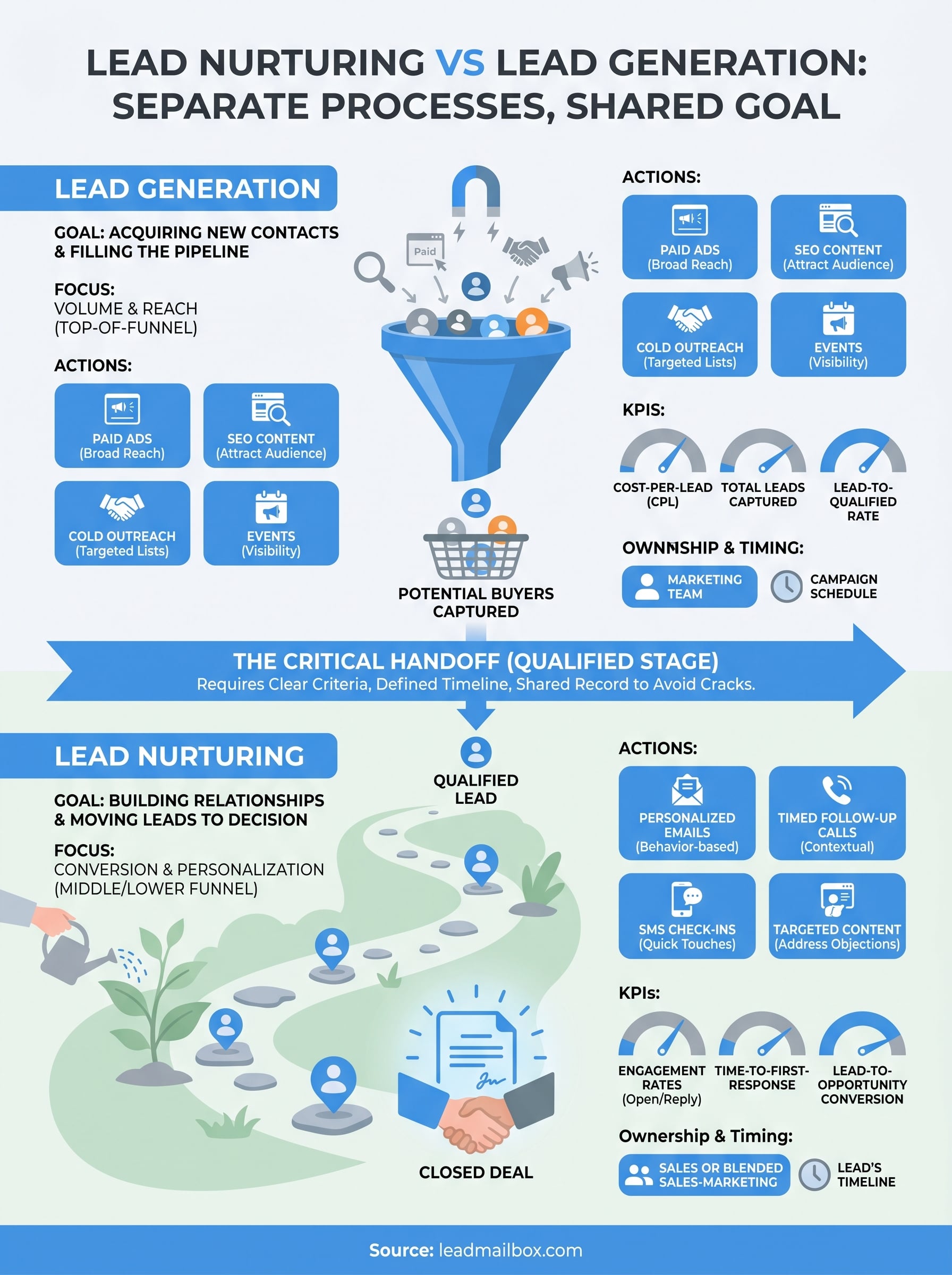
Lead generation focuses on volume and acquisition. Your marketing team runs campaigns, manages ad spend, and optimizes for cost-per-lead. The KPI at this stage is how many qualified new contacts enter your pipeline. Success means your top-of-funnel stays full.
Nurturing focuses on conversion and relationship quality. Your sales team, or a blended sales-marketing function, owns this work. The goal shifts from how many new people you reach to how effectively you move existing contacts toward a decision. This is where personalization and timing determine whether a lead converts or disappears.
The clearest sign of a broken process is when your team generates strong lead volume but closes very few of them. That gap is almost always a nurturing failure.
The tactics look completely different
Lead generation tactics are broad and outward-facing: paid ads, SEO content, cold outreach, and events. These activities introduce your brand to people who do not know you yet. You cast a wide net and capture whoever fits your target profile.
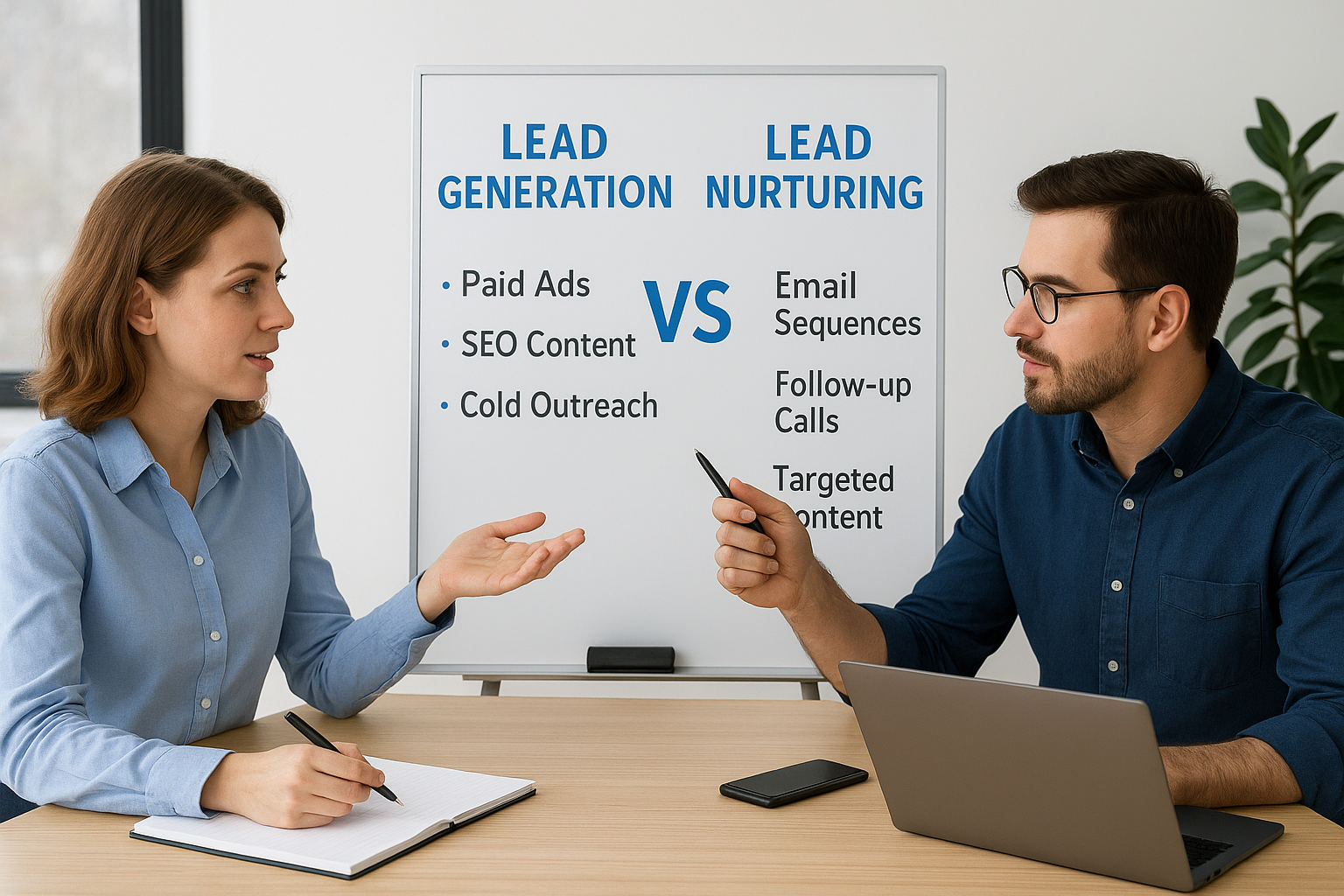
Nurturing tactics are narrow and inward-facing: timed email sequences, follow-up calls based on lead activity, SMS check-ins, and targeted content that addresses specific objections. You already have the contact in your system. Your job now is to use what you know about them to send the right message at the right moment.
The timeline and cadence are different too
Lead generation operates on a campaign schedule that your team controls. You launch an ad, run it for a set period, and measure results. Nurturing operates on the lead's timeline, not yours. A lead might need two touchpoints before they respond. Another might go quiet for 60 days and re-engage unexpectedly. Your nurturing process has to account for both, which means building sequences that stay active long after the initial contact is made.
How lead generation and nurturing work together
Lead generation and nurturing are not competing priorities. They are sequential steps in the same process, and your pipeline only performs when both are working in sync. Generating leads without a nurturing system in place is like filling a bucket with a hole in it. You keep pouring in new contacts, but conversion never improves because nothing is moving those contacts forward after they enter your system.
Lead generation feeds nurturing with the right raw material
The quality of your lead generation directly determines how effective your nurturing can be. When you bring in poorly targeted leads, no amount of follow-up messaging will compensate for the mismatch. Strong lead generation focuses on attracting contacts who match your actual buyer profile, so that when nurturing kicks in, your team is working with people who have a genuine reason to buy rather than contacts who will never convert regardless of how well you follow up.
Your nurturing process is only as strong as the leads feeding into it, which means lead generation quality matters as much as volume.
Every tactic you use to capture a lead should also capture context. What channel did they come from? What offer prompted them to respond? What problem are they trying to solve? That information is what your nurturing sequences run on. Without it, you end up sending generic follow-ups that fail to move anyone closer to a decision.
The handoff is where most pipelines break
When you examine lead nurturing vs lead generation as a combined system, the handoff between the two functions is where deals most often get lost. Marketing generates the contact and sales is supposed to work it, but if the timing, the context, or the assignment is unclear, the lead sits in your pipeline untouched until it goes cold.

A reliable handoff requires clear criteria for when a lead moves from marketing to sales, a defined timeline for first contact after capture, and a shared record of what the lead has already engaged with. When those three elements are in place, your team picks up exactly where lead generation left off, and nurturing has a real chance of converting the pipeline you worked to build.
Examples you can copy for common sales motions
Seeing lead nurturing vs lead generation in action makes the distinction easier to apply to your own pipeline. The examples below reflect two of the most common sales motions: bringing in new contacts through a targeted campaign and re-engaging leads who entered your funnel but stopped responding.
Generating leads through a paid inbound campaign
Say you run a targeted paid search campaign that drives prospects to a landing page with a form offering a free quote or consultation. When someone submits that form, they become a lead. Your lead generation work is done at that point. You captured a name, a phone number, and the context of what prompted them to respond.
The moment a lead enters your pipeline, lead generation ends and nurturing begins.
Your system should immediately log the source, timestamp, and offer associated with that lead so your follow-up has something specific to reference. That context is what turns your first touch from a cold call into a relevant conversation.
Nurturing a lead who went quiet after first contact
This is one of the most common scenarios your team will face. A lead came in, your rep made initial contact, and then the lead stopped responding. Without a nurturing sequence in place, that contact sits in your pipeline until someone manually decides to try again or marks it dead.

A structured nurturing sequence for this situation might look like this:
- Day 1: Automated SMS referencing the specific offer they responded to
- Day 3: Follow-up email with a short case study or relevant example
- Day 7: Phone call from the assigned rep with a clear and direct ask
- Day 14: Final check-in email that gives them an easy way to re-engage or opt out
Each touchpoint uses what you already know about that lead to stay relevant rather than repeating a generic pitch. The sequence stays active without your rep needing to manually track every follow-up. When the lead responds at any point, the sequence stops and your rep takes over with a live conversation based on where the lead is now.
KPIs, lead stages, and clean handoffs to sales
Measuring lead nurturing vs lead generation requires separate scorecards because they serve different purposes. Using the same metrics for both functions gives you a distorted view of where your pipeline is breaking down and makes it nearly impossible to fix the right problem.
KPIs that tell you each function is working
Lead generation success shows up in metrics like cost-per-lead, total leads captured per channel, and lead-to-qualified rate, which tells you whether the contacts coming in actually match your buyer profile. If your cost-per-lead drops but your lead-to-qualified rate drops with it, you are generating volume without value.
Nurturing performance shows up in different numbers entirely. Track email open and reply rates, call connect rates, time-to-first-response, and lead-to-opportunity conversion rate. These metrics reflect whether your follow-up is reaching the right people with the right message at the right time. A low conversion rate from contacted lead to active opportunity almost always points to a gap in your nurturing process, not your lead volume.
Tracking both sets of KPIs separately gives you a clear picture of where your pipeline loses deals and which function needs adjustment.
Lead stages and when handoffs should happen
Clear lead stages prevent leads from sitting in limbo between marketing and sales. A basic staging structure gives everyone on your team a shared definition of what each lead status means and who is responsible for working it at each point.
A simple framework to follow:
- New: Just captured, not yet contacted
- Contacted: First outreach made, awaiting response
- Engaged: Lead has responded and shown interest
- Qualified: Lead meets your buyer criteria and is ready for a sales conversation
- Nurturing: Lead is interested but not yet ready to buy
The handoff to sales should happen at the Qualified stage, not before. Sending unqualified leads to your sales team wastes rep time and trains them to distrust the pipeline. Define your qualification criteria clearly, whether that means a budget confirmed, a timeline established, or a specific action taken, and make sure both marketing and sales agree on that definition before it goes into your workflow.
Next steps
Understanding lead nurturing vs lead generation as two separate disciplines gives you a clearer view of where your pipeline succeeds and where it loses deals. Lead generation fills your funnel with qualified contacts. Nurturing keeps those contacts moving toward a decision through the right message, at the right time, on the right channel. When both functions operate with defined ownership, clean handoffs, and separate KPIs, your team stops guessing and starts closing.
Your next move is to audit your current pipeline and identify which stage is breaking down. If your lead volume is strong but conversion is low, your nurturing process needs work. If your pipeline is thin, lead generation deserves more attention. Most teams need to fix both over time. Start with the gap that costs you the most right now, build the process around it, and measure the results. LeadMailbox gives you the tools to manage both from a single platform.