

12 Lead Nurturing Software Comparison: Pros, Cons & Pricing
Picking the right lead nurturing software can be the difference between a pipeline that converts and one that slowly bleeds out. But with dozens of platforms claiming to do it all, running an honest lead nurturing software comparison takes real effort, effort most sales teams don't have time for.
That's exactly why we put this guide together. At LeadMailbox, we've spent over 20 years helping sales teams manage and convert leads through aggregation, outreach tools, and AI-powered communication, so we know what actually matters in a nurturing platform and what's just noise.
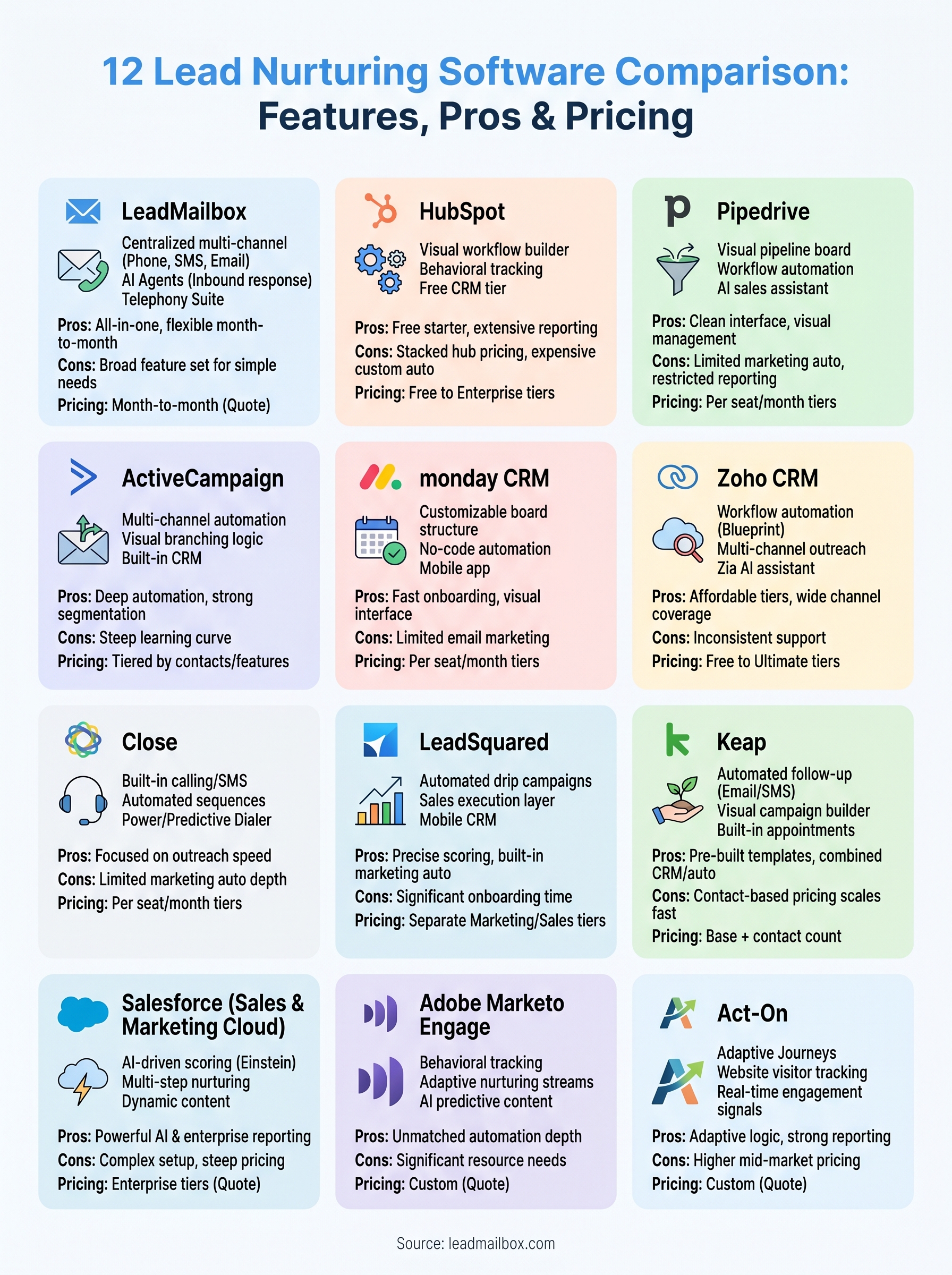
Below, you'll find 12 lead nurturing tools broken down by features, pricing, pros, and cons. Whether you're a solo operator or running a growing sales team, this comparison gives you what you need to make a confident decision without digging through marketing fluff on a dozen different websites.
1. LeadMailbox
LeadMailbox is a lead management and sales enablement platform built specifically for small to mid-sized sales teams that handle high-volume lead intake from multiple sources. With over 20 years in the market since 2004, it combines traditional CRM-style lead management with modern AI-powered communication tools, giving your team a single platform to aggregate, contact, and convert leads without stitching together three or four separate tools.

How it nurtures leads
LeadMailbox nurtures leads by centralizing them from multiple sources and equipping your team with outreach tools across phone, SMS, and email from one dashboard. The platform's AI agents can respond to inbound text messages, answer incoming calls, and draft email replies, keeping leads warm even when your reps are tied up elsewhere. This matters in any serious lead nurturing software comparison because consistent, timely follow-up is one of the most reliable ways to move leads forward, and LeadMailbox automates that follow-up across every channel your leads actually use.
Speed-to-lead is a real factor in conversion rates, and having AI handle the first response means no lead waits hours for a reply while your team is on other calls.
Standout features
LeadMailbox's telephony suite is one of its strongest differentiators in this category. It includes click-to-call, a power dialer, insta-call, and inbound number management, giving your sales reps the infrastructure to run high-volume outbound calls without paying for a separate phone system. Beyond calls, the platform supports personalized SMS and email campaigns, so you can reach leads through whichever channel gets the best response from your specific audience.
Pros
- All-in-one platform covering lead aggregation, telephony, SMS, email, and AI agents in a single system
- Month-to-month pricing with no long-term contracts required, giving your business flexibility
- Stable, proven platform with more than two decades of real-world use behind it
- AI agents reduce manual workload by handling inbound communication automatically
Cons
- The platform's broad feature set may feel like more than very small teams need if they only run simple email sequences
- Pricing is not publicly listed, so you'll need to reach out directly to get a quote
Integrations
LeadMailbox integrates with hundreds of lead partners, making it straightforward to pull leads from the sources your business already works with. The platform is built for multi-source lead aggregation natively, so your team spends less time importing data manually and more time actually working the pipeline.
Pricing
LeadMailbox runs on a month-to-month subscription model, which is a real advantage if your team wants flexibility without committing to a long-term contract upfront. Exact pricing is not publicly available, so you'll want to contact the LeadMailbox team directly for a quote based on your team size and the specific features you need. The flexible billing structure makes it easier to scale your plan as your lead volume and team grow over time.
2. HubSpot
HubSpot is one of the most widely recognized platforms you'll encounter in any lead nurturing software comparison. It combines a free-tier CRM with marketing automation tools that scale up as your business grows, making it a popular starting point for teams that want a single platform for both marketing and sales outreach.

How it nurtures leads
The platform nurtures leads through automated email workflows and behavioral tracking that trigger personalized outreach based on what a contact does on your site. When someone opens an email, visits a pricing page, or submits a form, HubSpot can automatically move them into the right sequence without your team touching it manually.
Behavior-based triggers paired with personalized email sequences make HubSpot a strong fit for marketing-heavy teams that rely on content-driven nurturing rather than high-volume calling.
Standout features
HubSpot's visual workflow builder lets you design multi-step nurturing sequences without writing any code. It also includes lead scoring, contact segmentation, landing page creation tools, and a built-in meeting scheduler, all accessible within the same interface as your contact database.
Pros
- Free CRM tier gives small teams a real starting point without upfront costs
- Extensive reporting shows which sequences and touchpoints actually drive conversions
- Strong email personalization and A/B testing tools built directly into the platform
Cons
- Marketing Hub and Sales Hub carry separate pricing structures, and the costs stack up quickly when your team needs both
- Custom workflow automation is only available on the Professional plan, which starts at $800/month
Integrations
With over 1,700 apps in its marketplace, HubSpot connects with tools like Salesforce, Slack, Zoom, and Google Workspace. Native integrations cover most sales and marketing tools your team likely uses already.
Pricing
Paid tiers for Marketing Hub start at $15/month per seat on the Starter plan, jump to $800/month for Professional, and reach $3,600/month for Enterprise. A free CRM plan is available with limited features.
3. Pipedrive
Pipedrive is a sales-focused CRM built around pipeline visibility first, with lead nurturing layered on top. It earns its place in this lead nurturing software comparison for teams that want a clean, structured workflow without the complexity of a full marketing automation suite.
How it nurtures leads
The platform nurtures leads through automated email sequences and activity reminders that prompt your reps to act at the right moment. Pipedrive uses a visual pipeline board where each lead moves through defined stages, giving your team a clear picture of where every contact sits and what needs to happen next.
When your reps can see exactly what stage each lead is in, follow-up becomes a repeatable process rather than something that falls through the cracks.
Standout features
Pipedrive's LeadBooster add-on includes a chatbot, live chat, and web forms that capture leads directly from your site and drop them into the pipeline automatically. The platform also features AI-powered sales assistance that surfaces next-step suggestions based on deal history, helping your reps prioritize without having to dig through the data themselves.
Pros
Pipedrive keeps things straightforward for sales reps by putting pipeline visibility and workflow automation at the center of the experience.
- Visual pipeline management makes it easy to spot stalled deals and gaps in follow-up
- Workflow automation covers repetitive tasks like sending follow-up emails and updating deal stages
- Clean interface that requires minimal onboarding time
Cons
The platform works well for sales pipelines but has real gaps on the marketing side of nurturing.
- Marketing automation capabilities are limited compared to platforms built for multi-touch nurturing at scale
- Reporting depth on lower-tier plans is restricted, which can limit your visibility into funnel performance
Integrations
Pipedrive connects with Google Workspace, Zoom, Slack, and Microsoft 365, along with hundreds of third-party apps through its marketplace and Zapier.
Pricing
Plans start at $14/month per seat on the Essential plan and reach $99/month per seat on the Enterprise plan, with LeadBooster available as a paid add-on at $32.50/month per company.
4. ActiveCampaign
ActiveCampaign is a marketing automation platform that earns its spot in this lead nurturing software comparison, particularly for teams that run email-heavy sequences and want behavioral triggers to do the heavy lifting between rep touchpoints.

How it nurtures leads
The platform nurtures leads through multi-channel automation that combines email, SMS, and on-site messaging based on how contacts behave across your touchpoints. When a lead clicks a specific link, visits a product page, or hits a lead score threshold, ActiveCampaign automatically routes them into the right sequence without your reps having to intervene manually.
For teams that run complex, behavior-based nurturing campaigns, ActiveCampaign's automation depth is one of the most capable options at this price point.
Standout features
ActiveCampaign's visual automation builder lets you map out branching logic with multiple conditions and outcomes, so your sequences adapt based on what each lead actually does. The platform also includes lead scoring, CRM functionality, and site tracking that feeds contact behavior data directly back into your automation rules.
Pros
- Automation depth rivals platforms that cost significantly more per month
- Lead scoring and segmentation tools give your team precise control over how contacts get prioritized and routed
- Built-in CRM cuts down on the number of tools your team needs when email-led outreach is your primary channel
Cons
- The learning curve is steep, and new users often spend significant time before they get full value out of the platform
- Reporting and analytics feel less intuitive compared to competitors in the same price range
Integrations
ActiveCampaign connects with over 900 apps, including Salesforce, Shopify, WordPress, and Zapier, covering most tools your sales and marketing teams already rely on day to day.
Pricing
Plans start at $15/month for the Starter tier with one user and scale to $145/month for the Plus plan. Enterprise pricing is available on request, and costs increase based on your total contact list size.
5. monday CRM
monday CRM is a flexible sales platform built on top of the monday.com work operating system, giving sales teams a visual, customizable interface for managing leads and deals alongside broader team workflows. It fits into this lead nurturing software comparison as a mid-market option that blends project management simplicity with CRM functionality.
How it nurtures leads
The platform nurtures leads through automated follow-up sequences and pipeline-based reminders that keep your reps on top of every contact without manual tracking. You can set up no-code automation rules that trigger emails or status updates based on deal stage changes or elapsed time, moving leads forward without constant rep intervention.
Combining lead management with broader team workflows in a single platform reduces the context-switching that slows down sales follow-up.
Standout features
monday CRM's fully customizable board structure lets you build your pipeline to match exactly how your team sells, not how the software expects you to. The platform also includes AI-assisted email writing, activity tracking, and a mobile app that gives your reps full pipeline visibility wherever they work.
Pros
The visual interface makes onboarding fast, even for reps who push back on new tools.
- No-code automation handles repetitive tasks across the pipeline with minimal setup time
- Strong team collaboration features built natively into the platform alongside the CRM
- Clean mobile experience for field sales and remote teams
Cons
The platform has real gaps if your team needs deep, multi-touch nurturing capabilities.
- Email marketing automation is limited compared to dedicated platforms built for sequence-heavy outreach
- Native reporting lacks the depth that larger sales teams need for serious pipeline analysis
Integrations
monday CRM connects with Gmail, Outlook, Zoom, and Slack through native integrations, plus hundreds of additional tools via Zapier, covering the core stack most sales teams already use.
Pricing
Plans start at $12/seat per month on the Basic plan and reach $28/seat per month on the Pro plan. A free trial is available, and Enterprise pricing requires direct contact with the monday CRM team.
6. Zoho CRM
Zoho CRM is a full-featured customer relationship management platform that works well for small to mid-sized businesses wanting a capable tool without the enterprise price tag. In this lead nurturing software comparison, Zoho stands out for packing a wide range of automation and outreach features into tiers that remain affordable as your team scales.
How it nurtures leads
Zoho CRM nurtures leads through workflow automation and multi-channel outreach that spans email, phone, social media, and live chat from a single interface. The platform's Blueprint feature lets you define exactly how leads should move through your pipeline by setting rules for each stage transition, keeping your team's follow-up process consistent without relying on individual reps to remember every step.
Consistent, rule-based pipeline movement is one of the clearest signs a nurturing platform will actually hold up under high lead volume.
Standout features
The platform includes Zia, an AI-powered sales assistant, that predicts lead scores, surfaces the best time to contact each lead, and flags deals that are at risk of going cold. Zoho also offers Canvas, a drag-and-drop interface builder, letting your team customize the CRM layout without involving a developer.
Pros
- Affordable pricing tiers make it accessible for smaller teams that still need serious automation capability
- Zia AI surfaces actionable insights that help your reps prioritize outreach without manually sorting through the pipeline
- Wide channel coverage across email, phone, social, and chat built into the same platform
Cons
- Customer support quality is inconsistent, with many users reporting slow response times on lower-tier plans
- Third-party integrations can require more configuration effort compared to platforms with deeper native connections
Integrations
Zoho CRM connects with Google Workspace, Microsoft 365, Zoom, and Slack natively, along with the broader Zoho product ecosystem and Zapier for additional third-party connections.
Pricing
Plans start at $14/user per month on the Standard plan and reach $52/user per month on the Ultimate plan, with a free tier available for up to three users.
7. Close
Close is a sales CRM built specifically for inside sales teams that rely on high-volume phone and email outreach to move leads through the pipeline. It earns its spot in this lead nurturing software comparison as a strong choice for teams where calling drives the majority of conversions and your reps need everything in one place to reach leads without switching between tools.
How it nurtures leads
Close nurtures leads by combining built-in calling, SMS, and automated email sequences into a single interface so your reps spend more time talking to people and less time managing software. The platform runs multi-step follow-up sequences in the background while your team focuses on live conversations, keeping leads engaged between touchpoints without requiring manual intervention at every step.
Close is purpose-built for speed of outreach, which gives it a real edge for teams where phone-based nurturing drives the majority of conversions.
Standout features
Close's Power Dialer and Predictive Dialer let your team work through large call lists efficiently without paying for a separate telephony system. The platform also includes Smart Views, which are saved, filtered contact lists that automatically surface the leads your reps should contact next based on activity history and deal status, removing the guesswork from daily prioritization.
Pros
Close keeps your team focused on outreach rather than administration, which is where most reps lose time.
- Built-in telephony removes the need for an external phone system, simplifying your stack
- Automated sequences handle email and SMS follow-up without a separate automation tool
- Fast, clean interface that minimizes the time between logging in and contacting leads
Cons
The platform has gaps if your nurturing strategy goes beyond outbound calling and basic sequences.
- Marketing automation depth is limited for teams running complex, behavior-triggered nurturing at scale
- Granular pipeline reporting is restricted on lower-tier plans, which can limit your visibility into funnel performance
Integrations
Close connects with Zapier, Slack, and Zoom, along with Google Workspace and various lead generation platforms through its API and app marketplace, covering the core tools your sales team most likely already uses.
Pricing
Plans start at $49/month per seat on the Base plan and reach $149/month per seat on the Enterprise plan, with a 14-day free trial available across all tiers.
8. LeadSquared
LeadSquared is a sales execution and marketing automation platform built for businesses that run high-volume lead intake, particularly in industries like financial services, education, and healthcare. In this lead nurturing software comparison, it stands out for combining a full lead management system with marketing automation tools designed to handle large-scale pipelines without requiring separate platforms for each function.
How it nurtures leads
LeadSquared nurtures leads through automated drip campaigns and activity-based triggers that move contacts through defined nurturing tracks based on their behavior and lead score. The platform tracks every touchpoint your leads have across email, SMS, and landing pages, then automatically adjusts their nurturing path based on what they do, keeping your pipeline moving even when your reps are focused on high-priority conversations.
For industries where lead volume is high and response time matters, LeadSquared's automation-first approach gives your team a real structural advantage over manual follow-up processes.
Standout features
The platform's sales execution layer sets it apart from generic CRMs by giving your reps guided next steps based on lead stage and score, reducing the time your team spends deciding who to contact next. LeadSquared also includes landing page builders and a mobile CRM app that field sales teams use to manage leads and log activity from anywhere.
Pros
- Lead scoring and segmentation tools give your team precise control over outreach prioritization
- Built-in marketing automation reduces reliance on separate third-party tools for drip campaigns
Cons
- Onboarding and initial setup require a significant time investment, particularly for teams without a dedicated operations person
- Pricing scales quickly, and smaller teams can find it difficult to justify the cost as contact volume increases
Integrations
LeadSquared connects with Salesforce, Zapier, and Google Workspace, along with various lead generation platforms commonly used in finance, healthcare, and education.
Pricing
LeadSquared offers separate pricing tiers for marketing automation and sales CRM, with marketing plans starting at $150/month for 1,000 contacts. Sales execution plans are available on request.
9. Keap
Keap, formerly Infusionsoft, is a CRM and marketing automation platform built specifically for small businesses that want to automate follow-up without building out a full marketing team. In this lead nurturing software comparison, it positions itself as an accessible option for solo operators and small teams that need structured automation without the complexity of enterprise-grade tools.
How it nurtures leads
Keap nurtures leads through automated follow-up sequences that trigger based on contact behavior, form submissions, and pipeline stage changes. The platform lets you build personalized email and SMS campaigns that run in the background, keeping your leads engaged without requiring your team to monitor every touchpoint manually.
For small business owners who wear multiple hats, automated follow-up that runs without daily intervention is one of the clearest ways to keep revenue moving.
Standout features
Keap's campaign builder lets you design multi-step automation sequences through a visual, drag-and-drop interface that most users can navigate without technical support. The platform also includes a built-in appointments tool that lets leads book time directly with your team, reducing friction in the handoff from nurturing to a live sales conversation.
Pros
Small teams with limited bandwidth get the most out of Keap's focus on pre-built structure and simplified automation.
- Pre-built automation templates give your team a fast starting point without building sequences from scratch
- Combined CRM and marketing automation in a single platform reduces the number of separate tools your team pays for each month
Cons
The platform's design reflects its small business focus, and that shows when your team's needs start to grow beyond basic sequences.
- Contact-based pricing means costs rise quickly as your list grows, which can become a real strain for businesses running high lead volume
- Automation flexibility is limited compared to platforms built for larger teams running more complex, behavior-triggered nurturing paths
Integrations
Keap connects with Gmail, Outlook, and Zapier, along with e-commerce tools like WooCommerce and payment processors, covering the core stack most small business owners already use.
Pricing
Plans start at $299/month for up to 1,500 contacts and two users, with pricing scaling upward based on your contact count and the number of users you add to your account.
10. Salesforce Sales Cloud and Marketing Cloud Account Engagement
Salesforce combines Sales Cloud, its flagship CRM, with Marketing Cloud Account Engagement (formerly Pardot) to deliver one of the most powerful enterprise-grade lead nurturing setups available. In any serious lead nurturing software comparison, Salesforce earns its reputation through sheer depth: the automation logic, data modeling, and reporting capabilities are difficult to match at any price point.

How it nurtures leads
Salesforce nurtures leads through AI-driven scoring and grading powered by its Einstein AI layer, which ranks contacts based on both their behavior and how closely they match your ideal customer profile. Marketing Cloud Account Engagement handles multi-step email nurturing programs that run automatically based on prospect activity, while Sales Cloud keeps your reps informed on exactly when to step in with a live touchpoint.
When your AI layer handles prioritization and your automation handles follow-up, your reps spend their time on conversations that actually move revenue.
Standout features
The platform's Engagement Studio lets you build complex, branching nurture paths with conditional logic that adapts based on what each prospect does at every step. Salesforce also offers dynamic content personalization, letting your team tailor emails and landing pages based on a contact's industry, stage, or behavior without building separate campaigns for each audience segment.
Pros
- Einstein AI surfaces lead scores and next-best-action suggestions that help your reps prioritize without manually sorting large pipelines
- Enterprise-grade reporting gives your team detailed visibility into every stage of the funnel across both platforms
Cons
- Setup and configuration require significant time investment and often need a dedicated Salesforce admin or outside consultant to implement correctly
- Pricing scales steeply, making it hard for smaller teams to justify the cost compared to more affordable alternatives in this list
Integrations
Salesforce connects with hundreds of tools natively and through its AppExchange marketplace, which includes thousands of pre-built integrations covering virtually every sales, marketing, and operations tool your team already uses.
Pricing
Marketing Cloud Account Engagement plans start at $1,250/month for up to 10,000 contacts, with Sales Cloud plans beginning at $25/user per month on the Starter Suite.
11. Adobe Marketo Engage
Adobe Marketo Engage is an enterprise-level marketing automation platform built for larger B2B organizations that run complex, multi-touch nurturing programs across long sales cycles. In this lead nurturing software comparison, Marketo stands out for its depth of automation logic and its tight integration with the broader Adobe Experience Cloud ecosystem.
How it nurtures leads
Marketo nurtures leads through behavioral tracking and adaptive nurturing streams that adjust automatically based on how each contact interacts with your emails, website, and content. The platform segments your audience and routes contacts into the right nurturing track without manual intervention, keeping your pipeline moving even when your average sales cycle spans several months.
Behavior-driven nurturing tracks that adapt in real time give your team a meaningful edge when closing a deal requires multiple sustained touchpoints over weeks.
Standout features
Marketo's Engagement Engine lets you build adaptive nurturing programs that serve the right content to each contact based on their stage and behavior history. The platform also includes AI-powered predictive content recommendations and audience segmentation, which helps your team personalize outreach at scale without building separate campaigns for every audience segment.
Pros
- Automation depth handles complex, multi-step nurturing programs that few platforms in this list can match
- Advanced analytics give your team clear visibility into campaign performance across the full funnel
Cons
- Implementation and ongoing management require significant technical resources, typically a dedicated marketing operations hire or outside consultant
- Pricing puts it out of reach for small and mid-sized teams that don't need enterprise-grade complexity
Integrations
Marketo connects natively with Salesforce, Microsoft Dynamics, and the Adobe Experience Cloud, along with hundreds of additional tools through its LaunchPoint partner marketplace, covering most enterprise sales and marketing stacks.
Pricing
Adobe Marketo Engage does not publicly list pricing. Plans are customized based on your database size and required features, so you will need to contact Adobe directly for a quote that fits your specific setup.
12. Act-On
Act-On is a B2B marketing automation platform designed for mid-market companies that need serious nurturing capabilities without the complexity of an enterprise-level rollout. In this lead nurturing software comparison, Act-On sits as a middle-ground option between lightweight email tools and platforms like Marketo or Salesforce that require dedicated operations staff to stay functional.
How it nurtures leads
Act-On nurtures leads through adaptive nurturing programs that automatically shift a contact's track based on their real-time engagement signals. When a lead opens a specific email, visits a key page, or hits a defined score threshold, the platform redirects them into the right sequence without requiring your team to manage the routing step by step.
Adaptive nurturing that responds to actual engagement signals keeps your outreach relevant instead of sending every contact the same message on the same fixed schedule.
Standout features
Act-On's Adaptive Journeys feature builds dynamic nurturing paths that respond to each contact's behavior as it happens. The platform also includes website visitor tracking that feeds behavioral data directly back into your automation rules, so your sequences stay informed by what your prospects are doing between emails rather than relying on assumptions about where they are in the buying process.
Pros
The platform works well for mid-market teams that need automation depth without a full enterprise implementation.
- Adaptive nurturing logic adjusts automatically based on contact behavior across email and web
- Strong reporting tools give your team clear visibility into campaign performance across the full funnel
Cons
Act-On has real limitations worth knowing before you commit budget to it.
- Pricing sits higher than many alternatives in this comparison, which strains smaller teams trying to justify the cost
- The user interface feels dated compared to newer platforms competing in the same category
Integrations
Act-On connects with Salesforce, Microsoft Dynamics, and SugarCRM natively, along with Zoom and several webinar platforms, covering the core tools most mid-market sales and marketing teams already have in their stack.
Pricing
Act-On does not publicly list pricing. Plans are scoped based on your contact database size and required features, so you will need to contact Act-On directly for a quote tailored to your team's specific setup.
Next steps
Running a thorough lead nurturing software comparison takes time, but the payoff shows up in your conversion rates once your team stops losing leads to slow or inconsistent follow-up. The right platform depends on your lead volume, your primary outreach channels, and how much automation complexity your team can realistically manage without a dedicated operations hire.
For small to mid-sized sales teams that handle high-volume lead intake across phone, SMS, and email, the best move is a platform that covers all three channels without requiring you to pay for separate tools. Most enterprise options in this list price out smaller teams or demand more technical setup than the results justify.
If you want a platform built specifically for sales-driven lead management with AI-powered follow-up and flexible month-to-month pricing, explore what LeadMailbox offers and see if it fits the way your team actually works leads.