

8 Lead Conversion Best Practices to Close More Deals Today
Most sales teams don't have a lead problem, they have a conversion problem. Leads come in from ads, referrals, partner networks, and web forms, but somewhere between first contact and closed deal, too many slip through the cracks. If you've been searching for lead conversion best practices, you're likely feeling that gap between the volume you're generating and the revenue you're actually capturing.
The fix isn't one silver bullet. It's a combination of speed, process, qualification, and follow-up, executed consistently. Some of these practices are simple adjustments you can make this afternoon. Others require rethinking how your team handles leads from the moment they arrive. Either way, each one directly impacts your close rate and compounds over time when stacked together.
At LeadMailbox, we've spent over 20 years helping sales teams organize, contact, and convert leads through a single platform, from aggregation and AI-powered outreach to built-in dialers and SMS campaigns. The practices below reflect what we've seen work across thousands of users and industries.
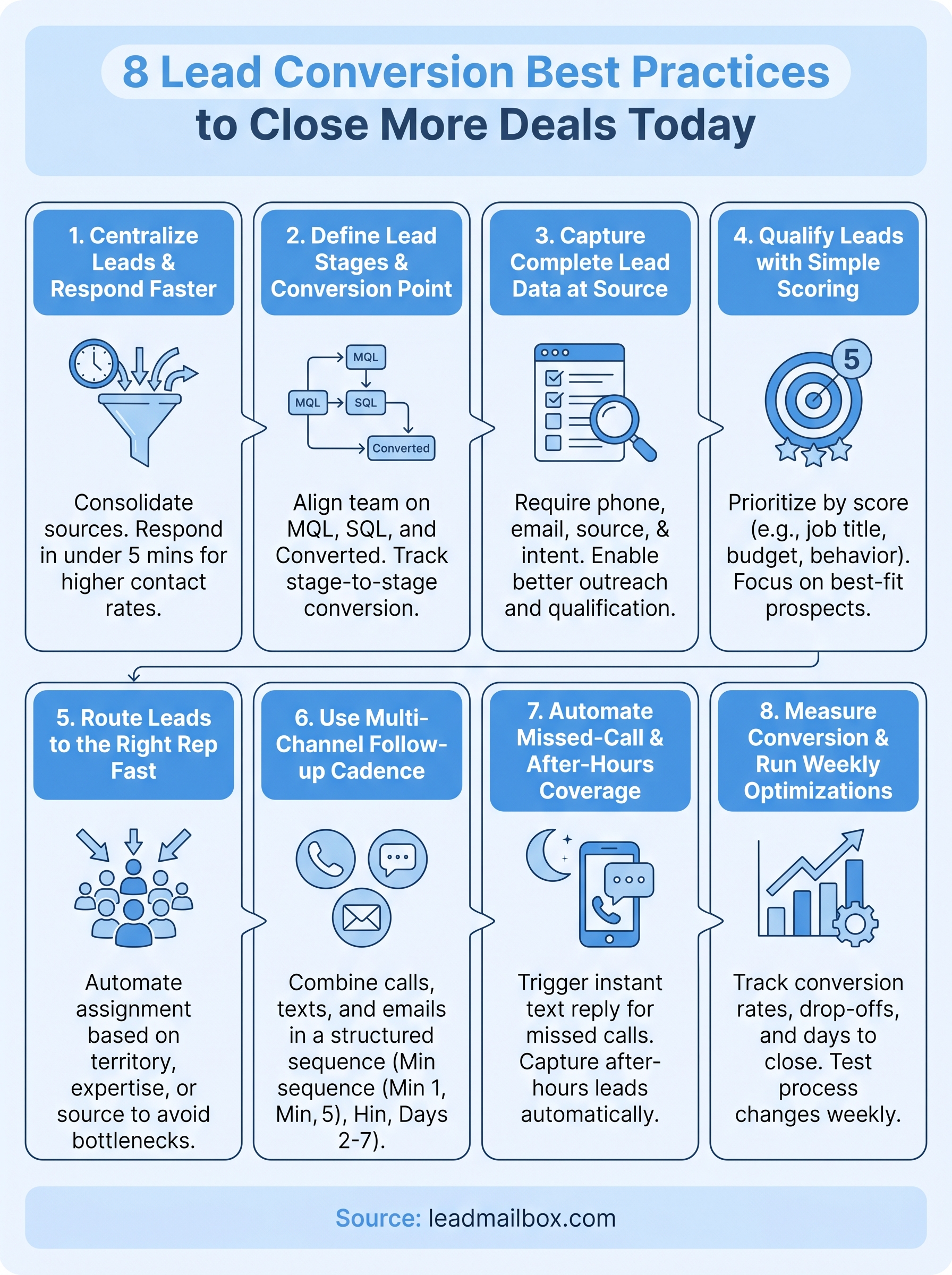
Here are eight lead conversion best practices you can put to work right now to close more deals and stop leaving money in your pipeline.
1. Centralize leads and respond faster with LeadMailbox
Speed and organization both directly affect how many leads you close. When leads arrive from multiple sources and scatter across spreadsheets, inboxes, and partner portals, your team loses time, misses follow-ups, and lets warm prospects go cold. Centralizing every lead into one system is one of the most impactful lead conversion best practices you can apply today.
Why it boosts conversions
The faster you contact a lead, the higher your odds of converting them. Research consistently shows that contacting a lead within five minutes dramatically increases your chances of reaching them compared to waiting even an hour. When leads are fragmented across tools, that response window closes before your rep ever sees the notification.
A fragmented lead inbox is a revenue leak. Centralization turns that leak off at the source.
How to do it in a single workflow
LeadMailbox pulls leads from hundreds of partner integrations directly into one dashboard. When a lead arrives, your rep sees the contact details, source, and lead history in one place and can call, text, or email without switching tools. The workflow is straightforward: lead arrives, rep gets notified, outreach starts within minutes, with no manual sorting required.

What to automate first
Set up these two automations before anything else:
- Instant lead notifications: Alert reps the moment a lead enters the system so no one is waiting on a manual check.
- Automatic first-touch outreach: Trigger a text or email so the lead hears from you even when a rep isn't immediately available.
Both steps together close the response gap that quietly kills most conversions.
Metrics to track
Watch these two numbers on a weekly basis:
- Average lead response time: Aim for under five minutes on the first outreach attempt.
- Contact rate: The percentage of leads you actually reach by phone or message; faster response directly pushes this number up.
If either metric trends in the wrong direction, you have a clear signal that your centralization workflow has a gap that needs fixing.
2. Define lead stages and your conversion point
Without clear lead stages, your team treats every contact the same way, wasting time on bad-fit leads and letting strong prospects slip through gaps in your process. Defining what "converted" means for your business is one of the most overlooked lead conversion best practices you can implement.
Why it boosts conversions
When reps know exactly where each lead stands, they focus on the right contacts at the right time. Undefined stages create confusion about ownership and next steps, which produces inconsistent follow-up and missed deals.
A pipeline without defined stages is just a list. Stages turn that list into a repeatable, scalable process.
How to define MQL, SQL, and converted
Before anyone works the pipeline, align your team on these three definitions to keep lead status consistent across every rep:
- MQL: Shows interest but hasn't passed a sales readiness check
- SQL: Fits your target profile and is actively being worked by a rep
- Converted: Has taken the action your business counts as a closed win
How to keep lead status updates consistent
Require reps to update lead status immediately after every interaction, not at the end of the day. Make it the mandatory final step before closing out a call or message thread.
Stale status data misleads your pipeline view and hides where deals actually stall, so consistency here is non-negotiable.
Metrics to track
Track stage-to-stage conversion rate and average time each lead spends in a given stage.
If contacts consistently pile up between SQL and converted, you've identified exactly where your next process fix needs to happen.
3. Capture complete lead data at the source
When a lead arrives with missing contact details or no context about where they came from, your rep starts every conversation at a disadvantage. Incomplete data slows outreach, reduces personalization, and makes lead qualification far harder than it needs to be. Capturing complete data upfront is one of the most underrated lead conversion best practices you can put in place.
Why it boosts conversions
Complete lead records give your reps the context they need to reach the right person with the right message on the first attempt. When you capture phone number, email, source, and intent signals upfront, you eliminate the guesswork that causes reps to hesitate or skip follow-up entirely.
Bad data at entry compounds into lost revenue downstream, so get it right at the source.
What fields to require and why
Not every field carries equal weight. Require these four as non-negotiable at the point of capture:
- Phone number: Enables immediate call and SMS outreach
- Email address: Powers drip campaigns and async follow-up
- Lead source: Tells you which channels drive your best conversions
- Intent or inquiry type: Helps reps tailor the pitch before the first call
How to reduce form friction without losing signal
Shorter forms convert more visitors, but cutting the wrong fields costs you qualified lead data you can't recover later. Use progressive profiling to collect basic contact details first and gather deeper information through early conversations or automated follow-up sequences.
Metrics to track
Monitor data completeness rate across all incoming leads and contact rate by source. If one channel consistently delivers incomplete records, fix the intake form or partner feed before it pollutes your pipeline further.
4. Qualify leads with a simple scoring model
Not every lead deserves the same attention. Without a scoring model, your reps burn time on contacts who will never buy while the best-fit prospects sit untouched in the queue. Qualifying leads with a clear point system is one of the most practical lead conversion best practices you can build into your process today.
Why it boosts conversions
A scoring model gives your team a shared language for lead quality so every rep makes prioritization decisions based on data, not gut feeling. When reps work the highest-scored leads first, contact attempts land at the right time on the right prospects.
A simple score is more useful than a perfect score your team ignores.
How to build a scoring model your team will use
Start with five to eight criteria that reflect your actual best customers: job title, budget range, lead source, response behavior, and inquiry type all make strong inputs. Assign point values to each, and set a minimum threshold score that separates leads worth immediate outreach from those that need nurturing first. Keep it simple enough that reps can explain it without a manual.
How to handle bad-fit and not-now leads
Low-scoring leads don't belong in the trash. Move bad-fit contacts out of the active pipeline immediately so they don't distort your metrics. Route not-now leads into a long-term nurture sequence so reps can focus on closeable deals without losing future opportunities.
Metrics to track
Watch score-to-close rate by tier to confirm your thresholds are accurate, and review average lead score for closed-won deals monthly. Both numbers will show you quickly where your scoring model needs adjustment.
5. Route leads to the right rep fast
Sending every lead to the same rep or leaving assignment to chance creates bottlenecks that kill deals before they start. When a strong prospect lands in the wrong inbox or waits while someone figures out who should take it, you lose the response window that matters most. Smart lead routing is one of those lead conversion best practices that looks simple on paper but has an outsized impact on close rate.
Why it boosts conversions
The right rep on the right lead converts at a measurably higher rate than a random assignment. Matching leads by territory, product expertise, or lead source means prospects talk to someone who actually understands their situation, which shortens the sales cycle and builds immediate credibility from the first call.
A lead routed to the wrong rep is often a lead that never gets a real chance.
How to set routing rules that stay fair and fast
Build routing rules around clear, consistent criteria: geography, lead type, rep capacity, or round-robin rotation. Set these rules inside your lead management system so assignment happens automatically the moment a lead enters the pipeline, with no manual sorting required.
How to prevent lead leakage and duplicate outreach
Unassigned leads and duplicate records are two of the most common sources of revenue loss in a busy pipeline. Require your system to flag any lead that hasn't received outreach within a set time window and deduplicate on phone number or email at intake before a second rep wastes time on the same contact.
Metrics to track
Watch assignment rate (the percentage of leads assigned within your target window) and rep-level contact rate to identify exactly where routing gaps are costing you conversions.
6. Use a multi-channel follow-up cadence
Most leads don't convert on the first contact attempt. Reaching a prospect once and waiting for them to respond isn't a strategy. A structured, multi-channel follow-up cadence is one of the most effective lead conversion best practices because it keeps you in front of leads across the channels they actually use, rather than betting everything on a single call.
Why it boosts conversions
Repeated, varied outreach increases your chances of reaching a lead at the right moment. Different people respond to different channels, so a rep who only calls misses the prospect who would have replied instantly to a short text.
Showing up on one channel once isn't a cadence. It's a single attempt dressed up as a strategy.
How to design a call, text, and email cadence
Build your cadence around these core touchpoints in sequence:

- Minute 1: Call immediately after the lead enters the system
- Minute 5: Send a text if the call goes unanswered
- Hour 1: Follow up with a short email
- Days 2 to 7: Rotate channels with additional attempts, avoiding the same method twice in a row
How to personalize at scale without wasting time
Use templates with dynamic fields that auto-fill the lead's name, inquiry type, and source so every message feels direct without requiring manual writing for each contact. Your team should adjust only the opening line when a lead's record contains a specific signal worth referencing, which keeps personalization fast and consistent across high-volume outreach.
Metrics to track
Monitor contact rate by channel and attempt number at first contact to learn which touchpoint in your cadence actually breaks through most often. Both numbers tell you exactly where to compress or extend your outreach sequence.
7. Automate missed-call and after-hours coverage
Every call that goes unanswered is a lead that may never call back. If your team works standard hours but leads arrive around the clock, you're handing a percentage of your pipeline to competitors who respond first. Automating missed-call and after-hours coverage is one of those lead conversion best practices that pays off the moment you switch it on.
Why it boosts conversions
Prospects who reach out after hours aren't less serious, they're often highly motivated buyers. Responding within minutes, even through automation, signals that your business is reliable and responsive. A delayed response until morning frequently means the lead has already moved on to whoever picked up first.
The lead that reaches voicemail at 9 PM often calls your competitor at 9:01 PM.
How to capture and respond to missed calls
Set up your system to trigger an automatic text reply the moment a call goes unanswered. That message should acknowledge the missed call, confirm that someone will follow up, and give the prospect a simple way to share more context while they wait. LeadMailbox's inbound number management handles this automatically so no missed call disappears without a response.
How to use AI agents without hurting trust
AI agents work well for initial acknowledgment and information gathering, but they need clear boundaries. Configure your AI to identify itself honestly, collect key details, and hand off to a live rep as soon as business hours resume. Transparent AI communication keeps trust intact and prevents the prospect from feeling misled before your team ever speaks with them.
Metrics to track
Monitor after-hours contact rate and missed-call recovery rate weekly. Both numbers tell you exactly how much pipeline your automation is pulling back from falling out of the funnel entirely.
8. Measure conversion and run weekly optimizations
If you're not measuring your pipeline consistently, you're making decisions based on assumptions rather than data. Tracking your conversion numbers weekly and running structured tests is what separates teams that steadily improve from teams that wonder why their close rate never changes. It's the final lead conversion best practice that ties every other step in this list together.
Why it boosts conversions
Measurement gives you visibility into where deals stall so you can fix the right problems instead of guessing. Teams that review conversion data weekly catch drops early, before a small process gap turns into a significant revenue loss.
What you don't measure, you can't improve, and what you can't improve stays broken.
How to calculate lead conversion rate the right way
Your lead conversion rate is the number of closed-won deals divided by total leads entered in a given period, expressed as a percentage. Track this number by source, by rep, and by lead type to see exactly which variables are driving results and which ones are dragging your average down.
What to test when conversion stalls
Start with your response time and follow-up cadence before touching your pitch or pricing. Most stalls trace back to process gaps, not product problems. Test one variable at a time, changing either the channel, message, or timing of your outreach, and give each test at least two weeks of data before drawing any conclusions.
Metrics to track
Monitor overall conversion rate and stage drop-off rate, along with average days to close, every week. All three together tell you whether your pipeline is healthy or hiding a problem that compounds downstream.
Put these practices into motion
Every one of these lead conversion best practices works on its own, but they compound when you run them together. Speed closes the gap between a lead arriving and your rep making contact. Clear stages and scoring keep your team focused on the right prospects. A structured follow-up cadence across calls, texts, and email means you stay in front of leads across the channels they actually use. And automation handles the coverage gaps your team can't fill manually.
You don't need to implement all eight at once. Pick the two or three that address your biggest current leak and build from there. Most teams see measurable improvement in contact rate and close rate within the first few weeks of tightening these fundamentals.
If you want a platform that handles centralization, outreach, AI coverage, and pipeline tracking in one place, try LeadMailbox and see what a unified lead management system can do for your close rate.