

Cold Lead Nurturing: How To Nurture Cold Leads in 7 Steps
Not every lead is ready to buy the moment they enter your pipeline. Some go quiet after an initial inquiry, others download a resource and disappear, and plenty just stop responding to your calls and emails. Knowing how to nurture cold leads, rather than writing them off, is what separates sales teams that hit quota from those that constantly chase fresh contacts. The truth is, cold doesn't mean dead. It means "not yet."
The cost of acquiring a new lead almost always exceeds the cost of re-engaging an old one. Yet most sales teams spend the bulk of their energy on new inbound volume and ignore the untapped revenue sitting in their existing database. With the right approach, a lead that went silent six months ago can become next quarter's closed deal.
This guide breaks down seven concrete steps to warm up cold leads and move them back through your funnel. We'll cover everything from segmentation and personalized outreach to leveraging tools like LeadMailbox's built-in telephony, SMS campaigns, and AI agents, so you can re-engage at scale without stitching together a dozen different platforms. If you've got a CRM full of stale contacts, this is your playbook for turning them into pipeline.
What cold leads need before you follow up
Before you send a single follow-up message, you need a clear picture of why these leads went cold in the first place. Jumping straight into outreach without that context is how you burn contacts and damage your sender reputation. Most cold leads fall into one of three buckets: timing was off, the value wasn't communicated clearly, or the lead was never a good fit to begin with. Knowing which bucket a lead belongs in shapes everything that comes after.
Understand why they went cold
Pull up the interaction history for a sample of your cold leads before you build any sequence. Look at what they originally responded to, how far they progressed, and where the conversation stopped. If someone attended a webinar but never booked a call, that's a timing problem. If they requested pricing and then disappeared, you likely had an objection that never got addressed. Categorizing the drop-off point gives you the raw material to craft outreach that speaks to the actual reason they disengaged, rather than repeating the same pitch that didn't work before.
The most common mistake in cold lead nurturing is sending the same message that failed the first time and expecting a different result.
Give them a reason to respond
Understanding how to nurture cold leads means recognizing that cold leads need something new to respond to, not just a reminder that you exist. Before you reach out, identify what has changed: a new product feature, a case study relevant to their industry, a limited-time offer, or a piece of content that directly addresses a pain point they mentioned in earlier conversations. Think of this as your re-entry angle, the specific hook that makes your outreach feel timely rather than desperate.
Here are four re-entry angles that consistently get responses:
- A relevant customer story from their specific industry
- A new feature or capability that solves a problem they raised earlier
- A question that references their original inquiry by name
- A short, direct "still interested?" message with zero pressure
Pick one angle per lead segment and stick with it. Using all four at once dilutes your message and signals that you're casting a wide net rather than following a deliberate plan.
Step 1. Clean your list and protect deliverability
Before you send anything, your list needs to be in good shape. Sending cold nurture emails to invalid, bounced, or spam-trap addresses tanks your sender reputation and reduces deliverability across your entire database. Most lists degrade at roughly 22% per year, so even a list that was clean 12 months ago likely carries significant dead weight that will hurt your campaigns before they start.
Remove invalid and unengaged contacts
Start by running your list through an email verification service to flag hard bounces, role-based addresses like info@ or support@, and known spam traps. Remove those contacts entirely before you launch any sequence. Beyond invalid addresses, flag anyone who has not opened or clicked any email in the last 12 to 18 months and move them to a separate suppression group unless you plan a dedicated re-engagement campaign for them first.
Sending to a dirty list doesn't just hurt one campaign; it damages your domain reputation for every email you send going forward.
Run this checklist before activating any cold nurture sequence:
- Verify emails and remove hard bounces
- Suppress contacts who unsubscribed or marked you as spam
- Remove duplicate records that could trigger multiple sends
- Flag role-based addresses and decide whether to include them
Check your sending infrastructure
Confirm that your SPF, DKIM, and DMARC records are correctly configured before you hit send. These three DNS settings tell receiving mail servers that your outreach is legitimate. Without them, even well-crafted messages land in spam folders, wasting all the segmentation and personalization work you're about to put in.
Step 2. Segment and prioritize the right leads
Not all cold leads deserve the same level of effort. Segmenting your list before you build any outreach sequence ensures you focus your energy on contacts most likely to convert, rather than treating a year-old weak inquiry the same as a prospect who reached the pricing stage three months ago. This is one of the most important decisions in learning how to nurture cold leads effectively, and skipping it leads to wasted time on the lowest-probability contacts in your database.
Sort leads by fit and timing
Your first filter is lead quality: does this contact match your ideal customer profile in terms of company size, industry, role, or budget? Your second filter is recency: how long ago did they disengage, and how far did they progress before going quiet? Leads that made it to a pricing conversation but never closed are worth significantly more attention than someone who opened one email nine months ago.

Use this three-tier framework to prioritize your segments:
| Tier | Criteria | Priority |
|---|---|---|
| A | Strong ICP fit, disengaged within 6 months, reached demo or pricing stage | High |
| B | Moderate ICP fit, disengaged within 12 months, showed some engagement | Medium |
| C | Weak fit or disengaged over 12 months with minimal interaction | Low |
Score before you sequence
Once you have your tiers, assign a distinct outreach sequence and cadence to each one. Tier A leads get your most personalized, high-touch approach. Tier C leads get a short automated reactivation campaign with minimal manual effort. This structure keeps your team from burning hours on low-probability contacts while giving your best opportunities the attention they actually need.
Prioritizing the wrong leads is just as damaging as ignoring cold leads entirely.
Step 3. Choose one clear goal for this nurture cycle
One principle stands out when learning how to nurture cold leads: each nurture cycle needs a single, defined goal. Teams that try to re-engage, educate, and close a cold lead in the same sequence confuse the contact and dilute every message. Pick one outcome per cycle, run it, measure it, then move to the next objective only after achieving the first.
Trying to accomplish three things at once in a nurture sequence usually means you accomplish none of them.
Define the outcome before you build the sequence
The goal you set shapes every decision downstream: subject lines, channel selection, and the number of touchpoints. Common goals include getting a reply, booking a call, driving a content download, or reactivating a stalled deal. Write your goal down in one sentence before you touch any outreach tools.
Here are four goal types with concrete examples:
- Re-engage: "Get 15% of Tier A leads to reply to the first email within 7 days."
- Book: "Schedule 10 discovery calls from Tier A contacts over a 2-week sequence."
- Educate: "Drive 20% click-through on a case study link to warm up Tier B leads."
- Requalify: "Confirm whether Tier C leads still fit your ICP through a short reply-based survey."
Match the goal to the lead's stage
Your Tier A leads who reached pricing conversations need a direct booking goal, not another educational email. Leads who barely engaged, like your Tier C contacts, need a soft re-engagement goal before you pitch anything. Forcing a booking goal on a contact that barely remembers you increases opt-outs, so match the ambition of your goal to the lead's current temperature.
Steps 4–5. Run a simple multichannel sequence
Once your segments are defined and your goal is locked in, you build the outreach itself. Multichannel sequences consistently outperform single-channel campaigns because they meet leads where they already spend their attention. The key is keeping the sequence short and focused rather than overwhelming contacts with a flurry of touches that feel automated.
Step 4. Build a 3-touch email sequence
Three emails is the right starting point for most cold nurture cycles, as it gives you enough coverage without triggering fatigue. Space the emails 3 to 5 business days apart and vary the angle slightly each time: the first email opens the conversation, the second adds a relevant piece of proof, and the third is a short, direct close.
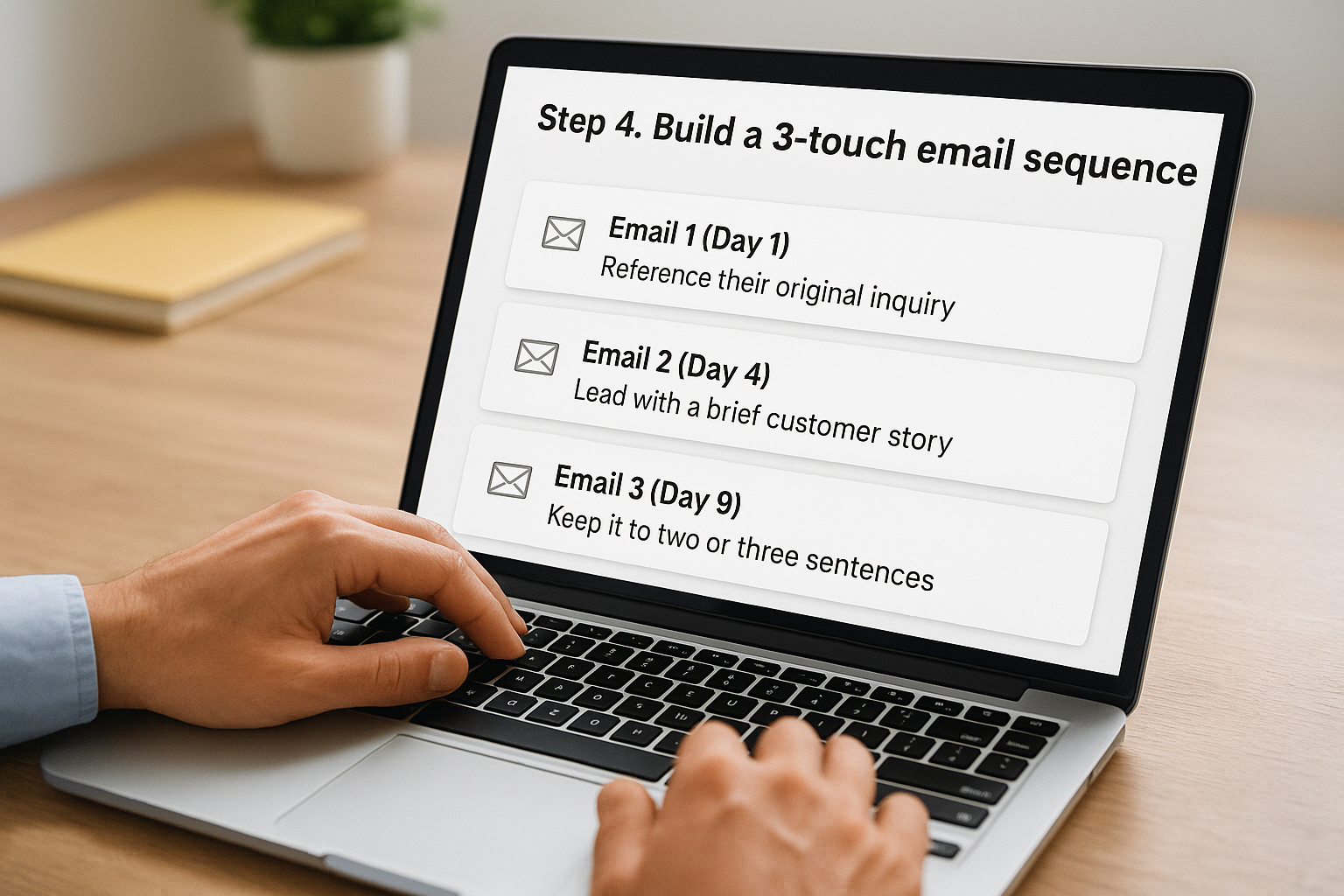
Here is a simple 3-touch template structure:
- Email 1 (Day 1): Reference their original inquiry by name, share one new development relevant to their situation, and end with a single low-friction question.
- Email 2 (Day 4): Lead with a brief customer story from a similar company, then connect it to the problem they initially raised.
- Email 3 (Day 9): Keep it to two or three sentences, acknowledge the timing may not be right, and give them a simple way to opt back in when they are ready.
Step 5. Add a call or SMS touchpoint
Understanding how to nurture cold leads means accepting that email alone rarely closes the loop. Pairing one phone call or SMS with your email sequence increases reply rates by giving leads a second channel to respond through.
Place your call or SMS attempt between emails 2 and 3, not before your first email lands.
Send a short SMS on day 6 that references the email thread. Keep it under 160 characters and end with a direct question, not a pitch.
Steps 6–7. Qualify quickly and set the next step
Once a lead responds, most sales reps make the same mistake: they launch into a full pitch before confirming the lead is worth pursuing. Steps 6 and 7 are about moving fast, confirming fit, and getting a concrete commitment, so you spend your time on the right contacts.
Step 6. Ask one qualifying question
When a cold lead replies, your first move is not to schedule a call or send a proposal. It is to ask a single qualifying question that confirms whether the lead's situation has changed since they went quiet. Keep it short and direct.
Use one of these qualifying prompts depending on where the lead dropped off:
- "Is [original problem they mentioned] still something your team is actively working to solve?"
- "Has your timeline for [goal] shifted since we last spoke?"
- "Are you still the right person to connect with on this, or has that changed?"
One focused question tells you more about a lead's current intent than a five-minute discovery call with someone who is not ready to move.
Step 7. Set the next step before the conversation goes cold again
Once you confirm the lead still fits, do not leave the conversation open-ended. Propose a specific next action with a concrete time attached: a 15-minute call on a specific day, a short demo on a set date, or a follow-up in 30 days if the timing is not right yet. Understanding how to nurture cold leads comes down to this: every interaction should end with a clear, agreed-upon next step that keeps the lead moving forward rather than drifting back into silence.
Wrap up and next steps
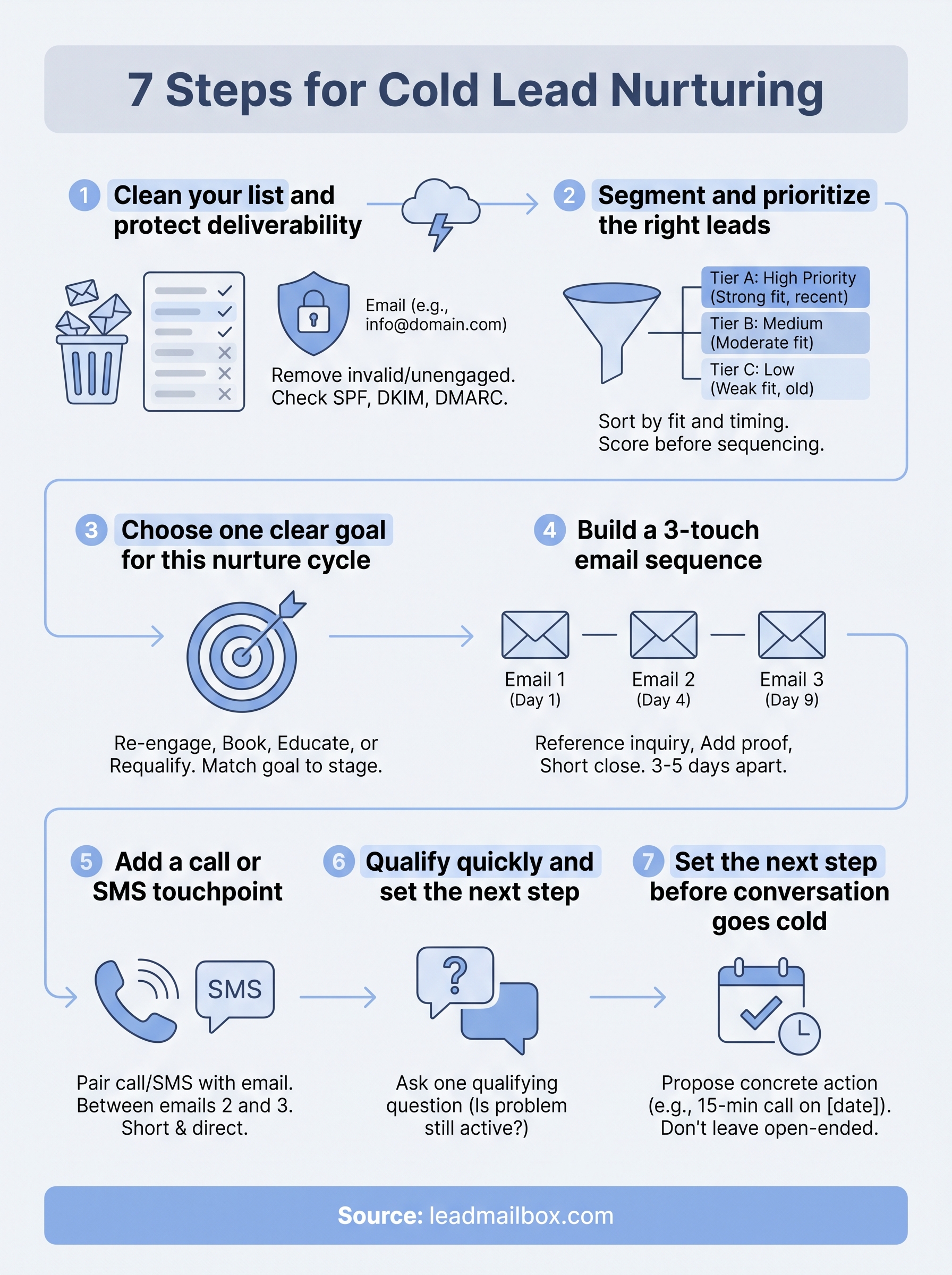
Cold leads are not lost revenue. They are delayed opportunities that need the right structure to move forward. You now have a clear, seven-step process for how to nurture cold leads: clean your list, segment by fit and timing, set one goal per cycle, run a focused multichannel sequence, and qualify fast before committing to a firm next step.
Put these steps into practice one segment at a time rather than trying to reactivate your entire database at once. Start with your Tier A leads, run the sequence, measure what works, then move down the list. The contacts sitting quiet in your CRM right now represent real pipeline, and a consistent, structured approach is the only thing standing between you and those closed deals.
If you want to run these sequences without juggling multiple tools, LeadMailbox combines telephony, SMS campaigns, email, and AI agents in one platform built for exactly this kind of outreach.