

How To Manage Leads Effectively: A Step-By-Step System
Most sales teams don't have a lead problem, they have a lead management problem. Prospects come in from ads, referral partners, web forms, and purchased lists, but without a clear system to track and follow up, a huge chunk of those leads never get a second touch. Knowing how to manage leads effectively is the difference between a pipeline that converts and one that just collects dust.
The fix isn't complicated, but it does require structure. You need a repeatable process that covers every stage, from the moment a lead enters your system to the point they either become a customer or get recycled for future outreach. Skip a step, and you're leaving money on the table. Wing it, and your team wastes hours chasing dead ends while hot prospects go cold.
That's exactly what this guide breaks down. We'll walk through a step-by-step system for capturing, organizing, nurturing, and converting leads, built on the same principles we've refined over 20+ years at LeadMailbox, helping sales teams turn messy lead flows into organized, revenue-generating pipelines. Whether you're a solo operator or managing a full sales floor, you'll walk away with a process you can put to work immediately.
What effective lead management looks like
Effective lead management isn't about having the most sophisticated software or the largest team. It's about consistency and structure: every lead gets captured in one place, every lead gets qualified against clear criteria, and every lead gets followed up in a way that's predictable and repeatable. When your process works, you spend less time asking "what happened to that prospect?" and more time on the conversations that actually close deals.
The four core components
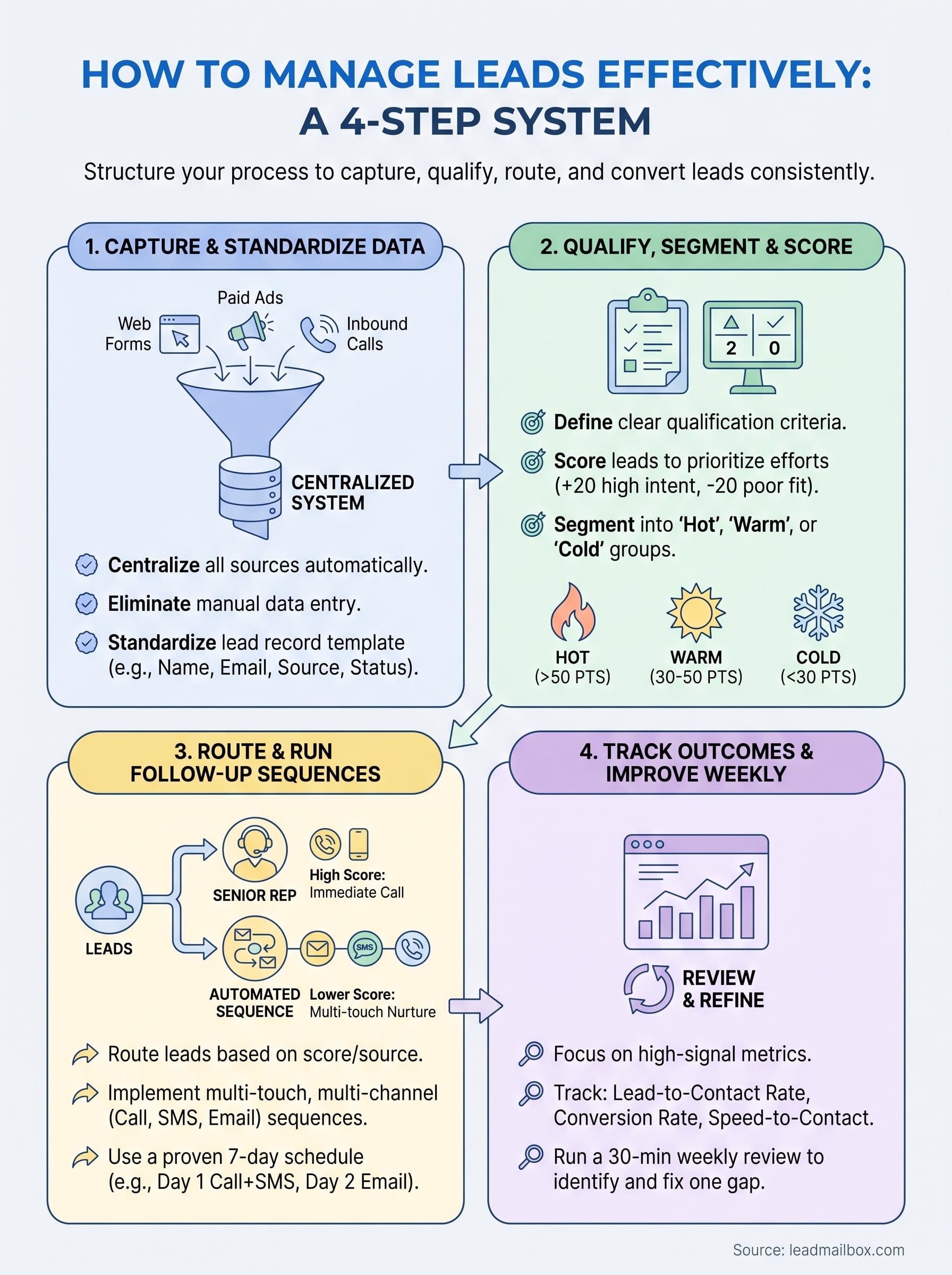
A solid lead management system has four moving parts that work together in sequence. Capture pulls leads from every source into one centralized location. Qualification filters and scores leads so your team focuses effort on the right prospects first. Follow-up ensures no lead sits untouched past a defined window. Tracking gives you the data to improve the system over time. Each component depends on the ones before it, which is why skipping steps always creates downstream problems.

When these four components run in sequence, your team operates on a system rather than on gut instinct and memory.
Without all four in place, you end up with gaps. Leads fall through. Reps duplicate work on the same prospect. Managers have no clear view of pipeline health. The goal of effective lead management is to close those gaps permanently.
What this looks like versus what most teams do
Most sales teams operate reactively. A lead comes in, someone calls when they remember, and if there's no answer it gets buried under the next batch. Knowing how to manage leads effectively means making a hard shift from reactive to systematic. Here's what that contrast looks like:
| What most teams do | What effective lead management looks like |
|---|---|
| Leads sit in inboxes or spreadsheets | All leads flow into a single centralized system |
| Follow-up happens when someone remembers | Sequences trigger automatically on a defined schedule |
| Qualification is done by feel | Leads are scored against specific criteria |
| No visibility into conversion outcomes | Rates tracked, reviewed, and acted on weekly |
| One outreach channel | Phone, SMS, and email used in coordinated sequences |
What a structured pipeline actually gives you
When you run a structured process, your pipeline becomes something you can forecast. Speed-to-contact is one of the clearest conversion drivers available: research from Harvard Business Review found that contacting a lead within an hour makes you nearly seven times more likely to have a meaningful conversation than waiting even sixty minutes longer. Consistent multi-touch follow-up compounds that advantage across every lead in your system.
Your team stops guessing and starts operating on data. You know how many leads are entering the pipeline, how many are actively worked, and what percentage converts at each stage. That level of visibility is what separates teams that scale from teams that stay stuck running the same manual process month after month.
Step 1. Capture every lead and standardize data
Before you can know how to manage leads effectively, every lead needs to land in one place. If leads are scattered across email inboxes, a spreadsheet on one rep's desktop, a form submission folder, and a text thread, you will always lose some. The first job is to eliminate those separate buckets and route every source into a single, centralized system.
Centralize every lead source
Most businesses pull leads from more than one channel: paid ads, web forms, referral partners, purchased lists, and inbound calls. Each of those sources should feed directly into your lead management platform automatically, not manually. Manual data entry slows your team down and introduces errors that break follow-up sequences. Set up direct integrations wherever possible so that a lead submitted on your website or sent from a lead partner appears in your system within seconds.
A lead that enters your system late or incomplete is already behind before your team even touches it.
Here are the most common lead sources to integrate:
- Web forms (landing pages, contact pages)
- Paid ad platforms
- Third-party lead vendors and partners
- Inbound phone calls (captured via inbound number tracking)
- SMS opt-ins
Standardize your lead record
Once a lead enters your system, every record needs the same fields filled the same way. Inconsistent data makes it impossible to filter, segment, or report accurately. Agree on a standard lead record template and enforce it across all sources through field mapping in your integrations.
A basic standardized lead record should include:
| Field | Example |
|---|---|
| First name | Sarah |
| Last name | Johnson |
| Phone number | (555) 867-5309 |
| Email address | [email protected] |
| Lead source | Facebook Ad - Campaign A |
| Date and time captured | 2026-05-04 09:14 AM |
| Initial status | New |
Clean, consistent data means your team can sort, filter, and act on leads without wasting time fixing records before they can work them.
Step 2. Qualify, segment, and score fast
Not every lead deserves the same attention at the same time. Part of knowing how to manage leads effectively is recognizing that your team's time is finite, and spending equal effort on a lukewarm prospect and a ready-to-buy one is a losing strategy. Qualifying and scoring leads quickly lets your reps prioritize the right conversations and move faster on the opportunities most likely to close.
Define your qualification criteria
Your qualification criteria are the specific attributes that separate a workable lead from one that needs more nurturing or isn't a fit at all. Define these criteria before your team starts working leads, not during. Without a shared standard, every rep qualifies differently, which produces inconsistent results and makes your pipeline impossible to forecast.
A basic B2C lead qualification checklist might cover:
- Budget or buying intent (did they request a quote, or just browse?)
- Timeline (are they looking now, or in six months?)
- Contact quality (is the phone number and email valid?)
- Lead source (which source historically converts at the highest rate?)
- Geographic fit (are they in your service area?)
Run each new lead against this checklist as it enters your pipeline and assign a status: hot, warm, or cold.
Score leads to prioritize your team's time
Lead scoring turns your qualification criteria into a numerical ranking that tells your reps exactly who to call first. Assign point values to each attribute based on how strongly it predicts conversion. Here's a simple scoring template to start from:
| Attribute | Condition | Points |
|---|---|---|
| Lead source | High-converting source | +20 |
| Timeline | Ready to buy now | +25 |
| Responded to first contact | Yes | +30 |
| Contact info verified | Yes | +15 |
| Outside service area | Yes | -20 |
A lead with a score above 50 should get a same-day call; anything below 30 goes into a longer nurture sequence.
Segment your leads by score bracket so your system routes and sequences them differently. High-scoring leads get your fastest, most direct outreach. Lower-scoring leads get placed into automated nurture sequences that keep your brand visible without burning rep time.
Step 3. Route leads and run follow-up sequences
Once your leads are scored and segmented, routing them correctly is what keeps the right people working the right leads. Routing means automatically assigning each lead to a specific rep or sequence based on the rules you define, so nothing sits unassigned. This is a step that most teams skip, and it's exactly where qualified leads go cold while waiting for someone to manually pick them up.
Route leads based on score and source
Your routing rules should reflect how you've scored and segmented leads. A high-scoring lead from a proven source gets assigned to your best closer and triggers an immediate call task. A lower-scoring lead from a cold list gets dropped into a longer automated sequence. Set these rules once inside your lead management platform, and the system handles assignment every time a new lead enters.
A simple routing rule set might look like this:
| Lead score | Lead source | Route to |
|---|---|---|
| 60+ | High-converting partner | Senior rep, call within 5 min |
| 30-59 | Web form | Any available rep, call same day |
| Under 30 | Cold list | Automated nurture sequence |
The faster a scored lead reaches the right rep, the higher your chances of making contact before that prospect reaches a competitor.
Build a multi-touch follow-up sequence
Knowing how to manage leads effectively means accepting that most leads won't respond to a single outreach. A multi-touch sequence combines calls, SMS, and email over a defined window to maximize contact rate without requiring your reps to manually track every follow-up. Here's a proven 7-day sequence template to start from:

| Day | Action | Channel |
|---|---|---|
| Day 1 | Intro outreach | Call + SMS |
| Day 2 | Follow-up if no response | |
| Day 3 | Second call attempt | Call |
| Day 5 | Value-add message | SMS |
| Day 7 | Final follow-up | Email + Call |
Each touchpoint in the sequence should use a different angle or message so you're not sending the same thing five times. Reps handle responses; the sequence handles the timing and reminders automatically.
Step 4. Track outcomes and improve weekly
Tracking is what separates teams that improve from teams that repeat the same mistakes. Once your leads are captured, scored, routed, and followed up, you need data on what's actually working so you can cut what isn't and do more of what is. Knowing how to manage leads effectively long-term requires a weekly review habit built into your process, not just an end-of-quarter gut check.
The metrics that matter most
Not every number in your platform deserves attention. Focus on a small set of high-signal metrics that tell you where leads are converting and where they're dropping off. Tracking too many numbers at once dilutes your focus and slows down decision-making.
Here are the core metrics to pull every week:
| Metric | What it tells you |
|---|---|
| Lead-to-contact rate | How many leads your team actually reaches |
| Contact-to-qualified rate | How effective your qualification is |
| Speed-to-first-contact | How fast leads get their first outreach |
| Sequence completion rate | How many leads run through the full follow-up |
| Lead source conversion rate | Which sources produce the most closed deals |
If your lead-to-contact rate drops below 50%, your routing rules or follow-up speed need immediate adjustment.
Run a weekly pipeline review
A weekly pipeline review doesn't need to be a long meeting. It needs to be a consistent, structured 30-minute session where you look at last week's numbers, identify the biggest gap, and make one concrete change. Use this repeatable template every week:
- Pull your five core metrics from the previous seven days
- Compare against last week to spot movement up or down
- Identify the single weakest metric in the funnel
- Diagnose the cause - is it a routing issue, a sequence issue, or a data quality issue?
- Make one specific change to address it before the next review
Fixing one thing per week compounds fast. Over a quarter, twelve targeted adjustments to your pipeline add up to a system that performs significantly better than the one you started with.
Next steps
You now have a complete, step-by-step system for how to manage leads effectively: capture every lead into one place, qualify and score fast, route to the right rep, run multi-touch sequences, and review your numbers every week. Each step builds on the one before it, so the fastest way to see results is to start at Step 1 and implement in order rather than jumping to the middle.
Start this week by auditing your current setup. Pick the single biggest gap in your process right now, whether that's scattered lead sources, no scoring criteria, or inconsistent follow-up, and fix that one thing first. One improvement per week adds up quickly.
If you want a platform that handles the heavy lifting across all four steps, LeadMailbox brings lead aggregation, scoring, automated sequences, and reporting into one system so your team can focus on closing, not managing tools.