

How To Manage Inbound Leads: Qualify, Route, Follow Up Fast
You spent good money getting that lead through the door. A prospect filled out your form, called your number, or responded to your ad, and now the clock starts ticking. Knowing how to manage inbound leads matters because most of those prospects won't wait around. Research consistently shows that response time is the single biggest factor in whether an inbound lead converts or ghosts you entirely.
The problem isn't usually a lack of leads. It's what happens after they arrive. Without a clear system for qualifying, routing, and following up, leads pile up in spreadsheets, get assigned to the wrong rep, or simply fall through the cracks. Every hour of delay cuts your odds of making contact, and closing the deal drops with it.
This guide breaks down a practical, start-to-finish process for handling inbound leads the right way. You'll learn how to score and qualify them quickly, route them to the right person, and follow up before competitors do. These are the same workflows that LeadMailbox was built to support, from lead aggregation across multiple sources to instant call and SMS tools that eliminate the gap between lead arrival and first contact. Let's get into it.
What inbound lead management covers
Inbound lead management is the full process of handling leads who come to you, not the ones you pursue. When someone fills out a web form, calls your business number, responds to a paid ad, or starts a chat on your site, they've raised their hand. Knowing how to manage inbound leads means having a system ready before they arrive, not improvising after the fact. Without that system, even a healthy volume of leads turns into a pile of missed revenue.
The difference between inbound and outbound lead workflows
Inbound and outbound leads behave differently, and your process needs to reflect that. Outbound leads are people you contacted first; they didn't ask to hear from you, so the engagement bar is higher and the timeline is slower. Inbound leads already showed intent by taking an action, which means they're warmer, but that warmth fades fast. The window between a lead arriving and that person moving on, losing interest, or calling a competitor is usually measured in minutes.
The faster you respond to an inbound lead, the more likely that person still remembers exactly why they reached out and is willing to have a real conversation.
Because inbound leads arrive with some level of interest, your process should prioritize speed and relevance over volume. You don't need to contact every lead the same way; you need to reach the right lead with the right message as quickly as possible.
The core stages of an inbound lead workflow
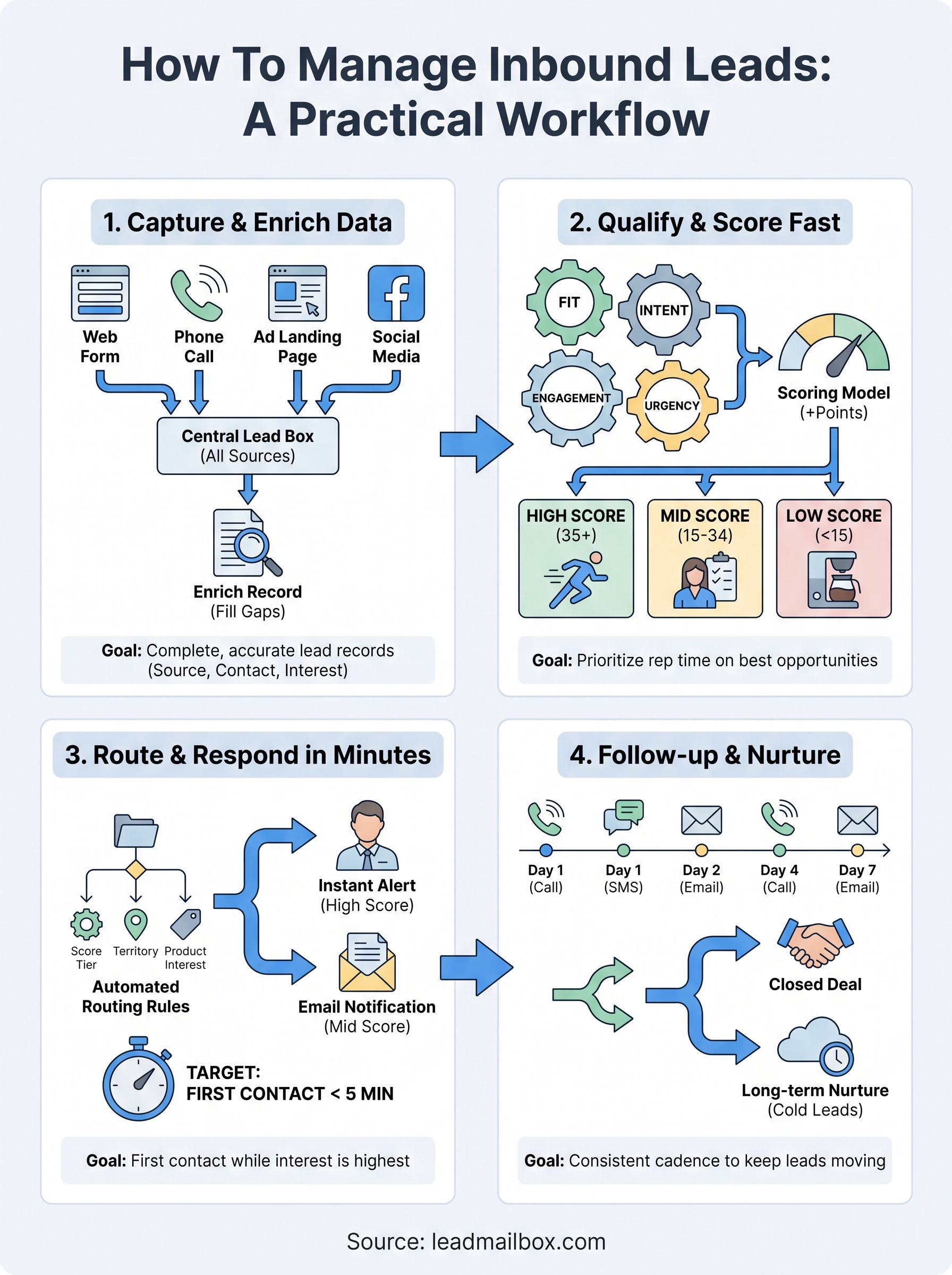
A complete inbound lead process covers four connected stages: capture and enrichment, qualification and scoring, routing and initial response, and follow-up and nurturing. Each stage feeds the next. If you capture a lead but don't enrich the data, you can't qualify accurately. If you qualify well but route slowly or to the wrong rep, the intent cools before anyone picks up the phone. Strong first contact followed by inconsistent follow-up means deals that should have closed don't.

Here's how each stage maps to a specific goal:
| Stage | What you're doing | Goal |
|---|---|---|
| Capture and enrich | Pull in lead data from all sources and fill gaps | Complete, accurate lead records |
| Qualify and score | Evaluate fit and readiness to buy | Focus rep time on leads most likely to convert |
| Route and respond | Get leads to the right rep fast | First contact within minutes of arrival |
| Follow up and nurture | Stay in touch across multiple touchpoints | Keep leads moving toward a decision |
Where most teams lose leads
Most lead loss doesn't happen because the leads are bad. It happens because the process breaks down between stages. Leads arrive from multiple sources like paid search, organic traffic, referrals, and inbound calls, and without a single system aggregating them, reps work from incomplete or duplicate records. Manual handoffs slow everything down, and without clear routing rules, a lead can sit in a queue for hours before anyone takes action.
The follow-up stage is another common failure point. Many teams handle the first call or email reasonably well but have no structured plan for what happens when there's no response. A lead who doesn't answer on the first attempt isn't a dead lead; they need a defined sequence of contacts before you write them off. Understanding these four stages, and where your current process falls short, is the foundation for building a system that actually converts.
Step 1. Capture and enrich every lead
The moment a lead arrives, you need complete, accurate data in one place. Whether that lead came from a web form, an inbound call, a paid ad landing page, or a referral partner, every source feeds into the same process. Fragmented data is the first place leads die, because reps can't follow up effectively when they're missing context or working from duplicate records.
Consolidate leads from every source
Most businesses run leads through three to six different acquisition channels at any given time. Web forms, phone calls, chat tools, and third-party lead vendors all produce data in different formats, and without a central system pulling it together, you end up with reps checking multiple platforms manually. Your goal is a single lead inbox where every new lead lands regardless of source.
Common inbound lead sources to connect to your central system:
- Web forms (contact, demo request, quote request)
- Inbound phone calls
- Paid search landing pages
- Social media lead ads
- Third-party lead vendors and partner networks
- Live chat or chatbot completions
Enrich the record before routing
Raw lead data is rarely enough to route or qualify accurately. A name, email, and phone number tell you little about fit or intent. Before you send that lead to a rep, run basic enrichment to fill in the gaps. At minimum, you want to know the lead source, the product they expressed interest in, and any demographic details your form or call captured.
The more context a rep has before picking up the phone, the more relevant and confident that first conversation will be.
Use a standard intake template so every lead record follows the same structure. Here's a minimal example:
| Field | Example value |
|---|---|
| Lead source | Google Ads - Demo Request Form |
| First name | Sarah |
| Last name | Kim |
| Phone | (555) 867-5309 |
| [email protected] | |
| Interest | Power dialer setup |
| Lead date/time | 2026-05-03 10:14 AM |
| Assigned rep | Unassigned |
| Lead score | Pending |
Standardizing this structure is a core part of how to manage inbound leads at scale. When every record looks the same, qualification and routing move faster and depend less on individual reps filling in blanks from memory.
Step 2. Qualify and score in minutes
Once your lead record is complete, the next task is deciding which leads deserve immediate attention. Qualification is not about rejecting people, it's about prioritizing rep time so your best opportunities get the fastest response. A simple, consistent scoring framework is the engine behind how to manage inbound leads at any volume without creating extra work for your team.
Build a scoring framework around four signals
Not every scoring model needs to be complicated. Four signals cover most of what matters for small to mid-sized sales teams: fit, intent, engagement, and urgency. Fit tells you whether the lead matches your target customer profile based on company size, industry, or geography. Intent tells you what action they took and how much buying interest that action implies. Engagement tracks whether they've interacted with your brand before. Urgency captures any timeline they've indicated.
The simpler your scoring model, the more consistently your reps will use it without friction slowing them down.
Assign point values to each signal so every lead gets a numeric score automatically. Here's a basic template to start from:
| Signal | Criteria | Points |
|---|---|---|
| Fit | Matches target industry or company size | +10 |
| Intent | Requested a demo or quote | +15 |
| Intent | Downloaded a resource or filled contact form | +5 |
| Engagement | Returning visitor or prior interaction | +10 |
| Urgency | Stated a timeline of 30 days or less | +15 |
| Urgency | No timeline mentioned | +0 |
Assign a tier and act on it immediately
Once you have a score, translate it into an action tier with a defined next step. High-scoring leads at 35 or more points go to your fastest available rep with an immediate call or text. Mid-tier leads between 15 and 34 points enter an automated nurture sequence while a rep follows up within the same business day. Low-scoring leads under 15 points get added to a long-term drip campaign rather than consuming rep time upfront.
Tying scores to specific actions removes daily guesswork from your team's workflow. Rather than asking a rep to judge each lead individually, the system routes the action based on the score, and reps spend their energy on conversations instead of prioritization. Review and adjust your point values monthly as you gather data on which scores actually correlate with closed deals.
Step 3. Route and respond fast
Scoring tells you which leads are worth prioritizing. Routing determines who contacts them and how. If you nail qualification but still let a lead sit for two hours before anyone reaches out, you've lost the advantage that inbound intent gives you. Speed of response is one of the most controllable levers in how to manage inbound leads, and routing is where you either protect it or waste it.
Set routing rules before leads arrive
Routing decisions should happen automatically, not in a morning standup. Build your rules in advance based on factors like lead score tier, geographic territory, product interest, or rep availability. When a lead hits a specific threshold, the system assigns it immediately without waiting for a manager to make a call. This removes human delay from the handoff entirely.
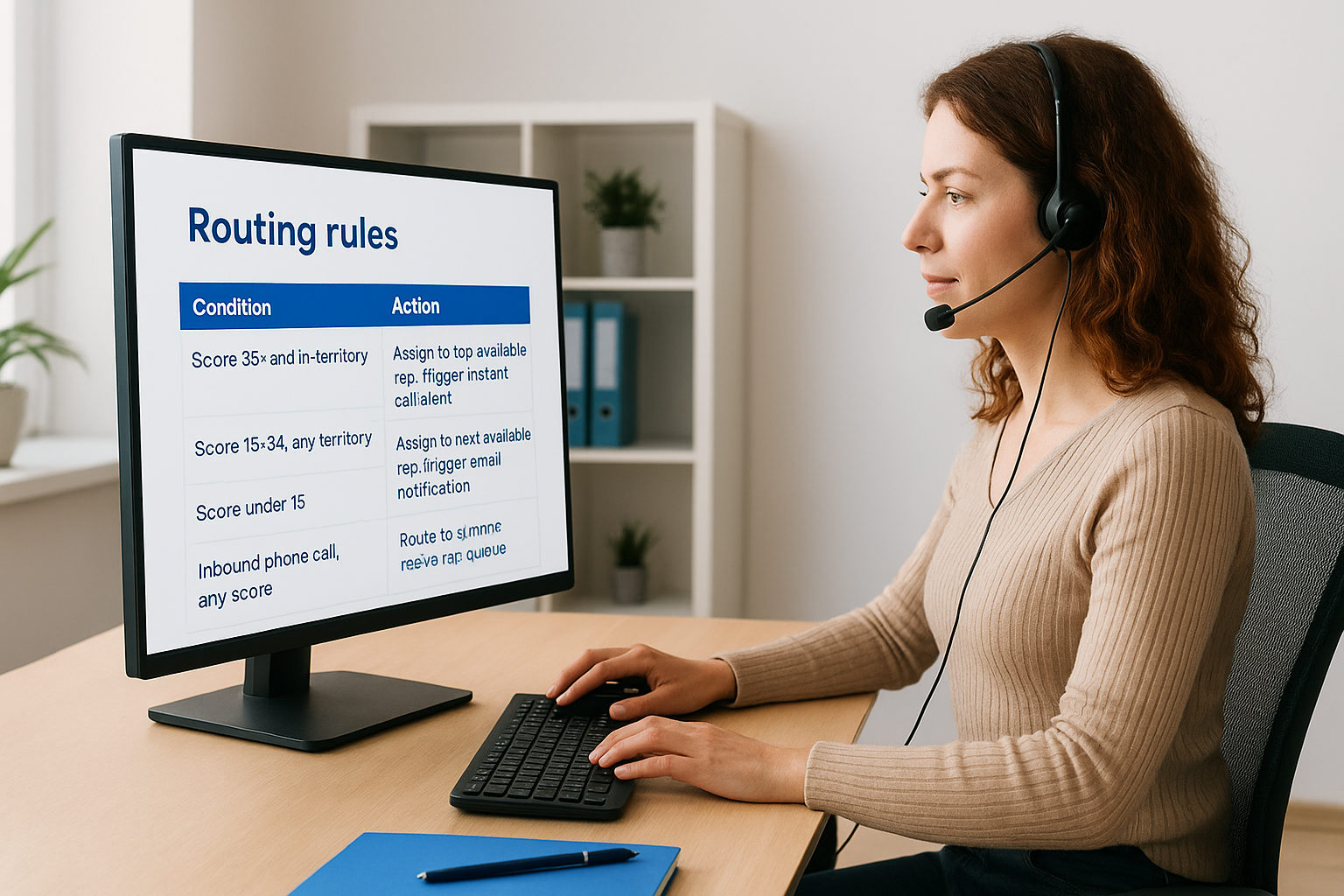
A simple routing rule set might look like this:
| Condition | Action |
|---|---|
| Score 35+ and in-territory | Assign to top available rep, trigger instant call alert |
| Score 15-34, any territory | Assign to next available rep, trigger email notification |
| Score under 15 | Add to nurture sequence, no immediate rep assignment |
| Inbound phone call, any score | Route to first available rep via call queue |
Define these rules once, then audit them monthly as your team grows or your lead mix changes.
Make first contact within five minutes
The five-minute window is not a figure of speech. Studies published by Harvard Business Review found that reps who followed up within five minutes were nearly 100 times more likely to make contact than those who waited 30 minutes. Closing that gap consistently requires tools that notify reps the moment a lead arrives and make it easy to call or text immediately.
If your rep has to log into three systems before making first contact, your routing process is slower than it needs to be.
Your first outreach should match how the lead came in. If someone called, call back. If they filled out a form, a quick personal call paired with a text confirmation works better than a generic email. Keep the first message short and reference what they actually asked about. That specificity signals you were paying attention, and it opens the conversation instead of starting with a pitch.
Step 4. Follow up with a simple cadence
Most leads don't convert on the first contact attempt. That's not a failure; it's normal sales behavior. The gap between a lead arriving and a deal closing is filled by consistent, structured follow-up that keeps you present without becoming a burden. Knowing how to manage inbound leads over a multi-day sequence is what separates teams with predictable conversion rates from those relying on luck.
Build a five-touch sequence
Your follow-up cadence should cover the first five to seven business days after a lead arrives. Each touchpoint uses a different channel or message angle so you're not sending the same email three times in a row. Mixing calls, texts, and emails across the sequence increases the chance of reaching the lead through their preferred channel, and it signals persistence without being repetitive.
A structured sequence removes the burden of deciding what to do next; your reps just execute the next step.
Here's a starting template for a five-touch inbound follow-up cadence:
| Day | Channel | Action |
|---|---|---|
| Day 1 (within 5 min) | Phone call | Introduce yourself, reference what they asked about |
| Day 1 (1 hour later) | SMS | Short text confirming you called, include your name and a one-line reason to call back |
| Day 2 | Brief email with one relevant point about your product or service, no more than three sentences | |
| Day 4 | Phone call | Second call attempt, leave a voicemail if no answer |
| Day 7 | Final follow-up with a clear, low-pressure next step such as booking a 15-minute call |
Keep every message short and specific. Reference the original lead source or the product they asked about so each touchpoint feels personal, not automated. Templates help you move fast, but personalize the first line of every email and the opening of every call with something specific to that lead.
Know when to stop
After five to seven touches with no response, move the lead to a long-term nurture list rather than continuing active outreach. A monthly check-in email or a quarterly call is enough to stay on their radar without burning rep time. Some leads go cold because the timing was wrong, not because the fit was bad. Maintaining a light, long-term presence means you're the first name they think of when their situation changes.
Wrap up and keep leads from slipping
The entire process of how to manage inbound leads comes down to four connected steps: capture every lead in one place, score them quickly, route and respond within minutes, then follow up with a structured cadence. None of these steps work in isolation. A fast response means nothing if the lead record is incomplete. A strong first call goes nowhere without a follow-up sequence behind it. Build the full system, and leads stop slipping through the gaps.
Your biggest risk is not a lack of leads; it's a process that loses them after they arrive. Start with whichever step is weakest in your current workflow and fix that first. Once each stage connects cleanly to the next, your conversion rate improves without increasing your lead spend. If you want a platform that handles all four stages in one place, see what LeadMailbox can do for your team.