

10 Ways To Improve Lead Conversion Rate (With Examples)
Most businesses spend heavily on lead generation but lose the majority of those leads before they ever become customers. The average conversion rate across industries hovers between 2% and 5%, which means up to 98% of your leads go nowhere. If you want to know how to improve lead conversion rate, the answer rarely involves spending more on ads, it's about fixing what happens after the lead comes in. That gap between lead capture and closed deal is where revenue is won or lost.
The good news: even small, targeted improvements to your follow-up speed, lead qualification, and outreach strategy can produce outsized results. A single percentage point increase in conversion can translate to thousands in additional revenue, without adding a dollar to your acquisition budget. Knowing what to fix matters just as much as knowing what to do, and the strategies that move the needle are more practical than you might think. Measurement and benchmarks give you the baseline; execution closes the gap.
At LeadMailbox, we've spent over 20 years helping sales teams organize leads from multiple sources and convert them faster using integrated calling, SMS, email, and AI-powered outreach, all from one platform. This article pulls from that experience. Below, you'll find 10 proven ways to increase your lead conversion rate, complete with examples you can apply to your own pipeline right away.
1. Centralize lead capture and follow-up in LeadMailbox
One of the most common reasons sales teams lose leads isn't a lack of effort, it's a lack of coordination. When leads come in from multiple sources but land in different spreadsheets, inboxes, or tools, follow-up becomes inconsistent and slow. Centralizing your lead capture and follow-up in a single platform eliminates the gaps between lead intake and outreach, and that's one of the most direct ways to improve lead conversion rate.
Why this improves conversion rate
When your team can see every lead, its source, and its full history in one place, they spend less time searching and more time selling. Fragmented systems create delays, missed follow-ups, and duplicate outreach, all of which push prospects away. A centralized platform keeps your pipeline clean and your team accountable to a clear process.
A unified lead management system removes the coordination tax your team pays every time a lead moves between tools.
How to set up your lead sources and routing
Start by listing every source that generates leads for your business, whether that's web forms, paid ads, phone inquiries, or lead partner integrations. Connect each source to LeadMailbox so every new lead routes automatically to the right rep or team based on rules you define, such as geography, product interest, or lead score. This removes manual handoffs and cuts intake time to seconds.
How to use calling, SMS, and email without losing context
LeadMailbox gives your team click-to-call, power dialing, SMS campaigns, and email outreach all inside the same lead record. When a rep calls a lead, leaves a voicemail, and sends a follow-up text, the next person who touches that lead sees the full history immediately. No context is lost between channels, which means your outreach stays relevant and your leads never get hit with repeated introductions.
Example workflow for a small sales team
A five-person insurance team connected three lead sources to LeadMailbox. New leads triggered an instant SMS from a rep within 90 seconds, followed by a call attempt within five minutes. Leads who didn't respond entered an automated email sequence. Within 30 days, their contact rate rose by 28%.
Metrics to track
Track contact rate, first response time, and source-level conversion rate to understand which channels produce the best results. These three numbers tell you where to invest more and where to cut.
2. Define your funnel stages and your conversion math
You can't improve what you haven't defined. Before you adjust your process or test new tactics, you need a clear picture of your funnel stages and a consistent formula to measure conversion at each step. Without this foundation, you're optimizing blind.
Choose what "conversion" means for your team
"Conversion" means different things to different teams, a booked call, a signed contract, or a completed purchase. Pick one primary definition that your whole team agrees on, then stick to it. Changing the definition mid-quarter will make your data useless and your results impossible to compare.
Set stage definitions that sales and marketing share
Misalignment between sales and marketing is one of the most common reasons lead conversion rate stalls. Define each funnel stage in writing, so a lead moving from one stage to the next follows the same criteria every time. When both teams use the same language, handoffs get cleaner and accountability increases.
Shared stage definitions are the single fastest way to stop leads from falling through the cracks between teams.
Calculate lead conversion rate and stage-to-stage rates
Your overall lead conversion rate is simple: divide the number of closed deals by the total number of leads, then multiply by 100. But stage-to-stage rates tell you where you're losing people. Track each transition separately so you can find the exact step that needs attention.
Example definitions for MQL, SQL, and opportunity
| Stage | Definition |
|---|---|
| MQL | Lead meets target criteria and has engaged with content or an ad |
| SQL | Lead has been contacted and confirmed interest and budget fit |
| Opportunity | A next step is scheduled and a proposal is in progress |
Metrics to track
Monitor stage conversion rates monthly and compare them against your baseline. Watch for drops at a specific stage rather than just tracking your overall number, that's where your fix lives.
3. Improve speed to lead with alerts and instant outreach
Speed is one of the most underused levers when you want to know how to improve lead conversion rate. Studies show that responding to a new lead within five minutes makes you up to 100 times more likely to make contact than waiting 30 minutes. The window closes fast, and your competitors are often calling the same leads you are.
Why response time changes outcomes
When a lead submits a form or calls your number, their intent is at its peak at that exact moment. Every minute you wait, their attention shifts, and the chance of a meaningful conversation drops sharply. Faster contact creates better conversations because the lead still remembers why they reached out.
The leads that convert are usually the ones that got a response before they moved on to someone else.
Set response time SLAs by channel and lead source
Define a maximum response time for every channel, such as two minutes for inbound calls, five minutes for web form submissions, and one hour for email inquiries. Set different SLAs based on lead source quality so your team prioritizes high-intent leads first and lets no urgent contact go cold.
Use click-to-call, power dialing, and inbound callbacks
LeadMailbox gives your reps click-to-call and power dialing to reach new leads instantly without manual number entry. Inbound callback tools connect callers to a live rep in seconds, keeping high-intent prospects from hanging up and calling a competitor.
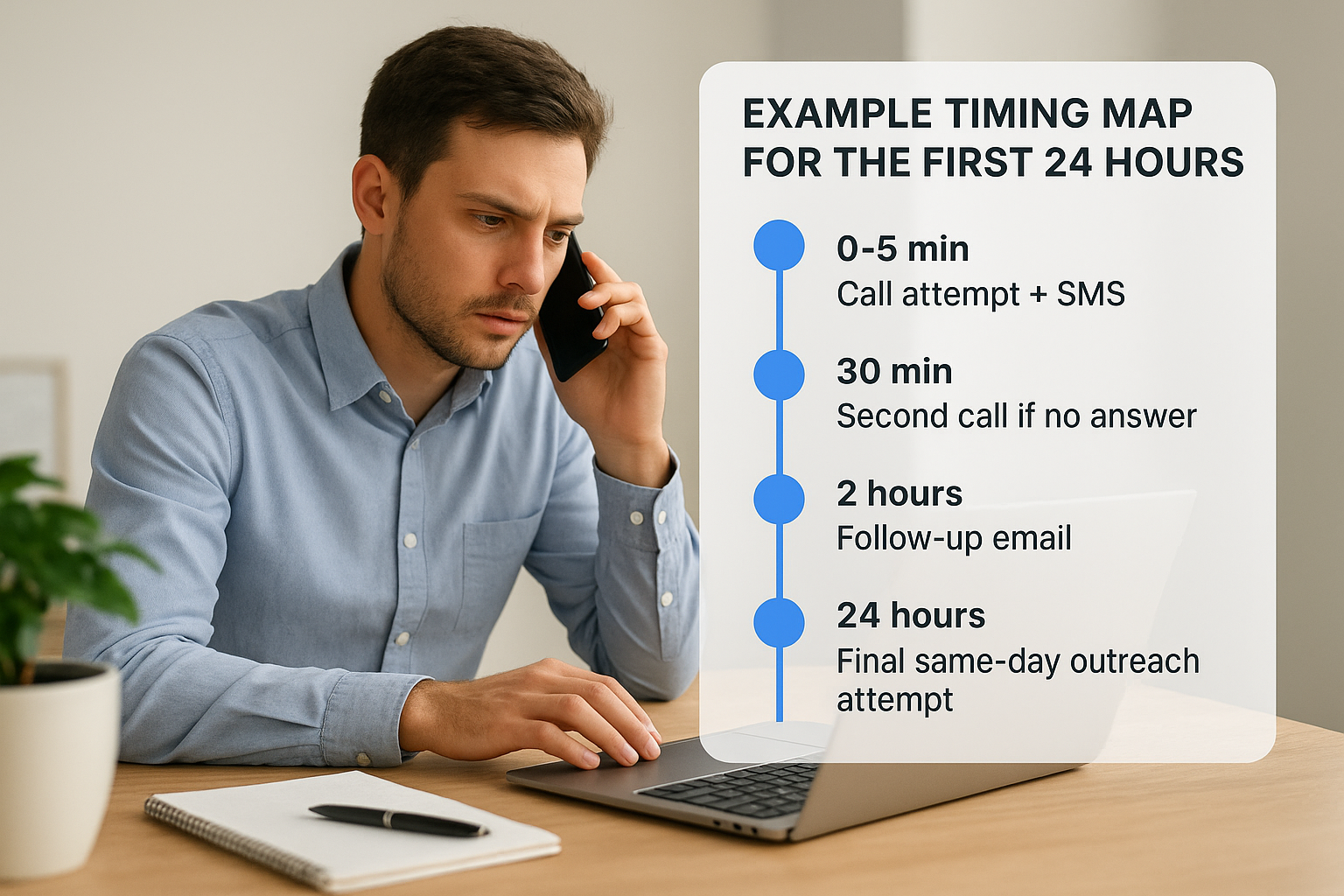
Example timing map for the first 24 hours
| Time After Lead Arrives | Action |
|---|---|
| 0-5 minutes | Call attempt + SMS |
| 30 minutes | Second call if no answer |
| 2 hours | Follow-up email |
| 24 hours | Final same-day outreach attempt |
Metrics to track
Track average first response time and contact rate by hour to see exactly where delays hurt you most. These two numbers will show you whether your speed problem is a process issue or a staffing issue.
4. Qualify leads with simple rules and consistent questions
Not every lead deserves equal time from your team. Lead qualification filters out poor fits early so your reps focus their energy on contacts who can actually buy. A consistent qualification process is one of the clearest answers to how to improve lead conversion rate without adding more leads to the top of your funnel.
Build a qualification checklist your team will use
Give every rep a short set of non-negotiable criteria to confirm on each first contact. Keep it to four or five questions so reps use it on every call without skipping steps.
- Budget: Can they afford your offer?
- Authority: Do they make the final decision?
- Need: Does your solution fit their specific problem?
- Timeline: When do they plan to act?
Disqualify fast and document why
When a lead fails your criteria, remove them from the active pipeline immediately and record the reason. This protects your team's time and builds a data set that reveals patterns in your lead sources over time.
Disqualifying a bad lead quickly is as valuable as closing a good one.
Route high-intent leads to the right rep
Match qualified leads to reps by product line, geography, or deal size. When the right rep handles the conversation from the start, close rates go up because no context is lost in the handoff.
Set routing rules that run automatically so no high-intent lead sits waiting for manual assignment.
Example questions for B2B and service businesses
These three standardized questions give your team a repeatable starting point across both B2B and service-based sales conversations:
| Question | What it reveals |
|---|---|
| What is your timeline? | Urgency |
| Who approves the budget? | Decision authority |
| What have you tried before? | Fit and intent |
Metrics to track
Watch your disqualification rate by lead source each week. A rising rate from one source signals a targeting or intake problem worth addressing before it drains more budget.
Also track your SQL conversion rate to see how often qualified leads advance to a scheduled next step.
5. Score and segment leads so reps focus on the best fit
Not all leads carry the same potential, and treating them equally is one of the fastest ways to waste rep time and hurt results. Lead scoring and segmentation give your team a ranked, organized view of the pipeline so effort flows toward the contacts most likely to convert. This directly impacts how to improve lead conversion rate because reps stop chasing dead weight and start closing real opportunities.
What to score: fit, intent, and urgency
Score every lead across three dimensions: fit (do they match your target profile), intent (have they taken meaningful action like requesting a demo), and urgency (do they have a defined timeline). Assign numeric values to each signal so the final score reflects actual buying readiness, not just activity volume.
A lead with high fit but low intent needs nurturing; a lead with high intent but low fit needs to be disqualified quickly.
Segment by source, persona, and requested offer
Group your leads by where they came from, who they are, and what they asked about. A lead from a paid ad requesting a price comparison behaves differently than a referral asking for a product walkthrough. Segmentation lets you send relevant messaging instead of generic follow-up that gets ignored.
Set different plays for hot, warm, and nurture leads
Assign a specific outreach sequence to each segment. Hot leads get immediate calls, warm leads enter a multi-touch cadence, and nurture leads receive scheduled check-ins until their timing improves.
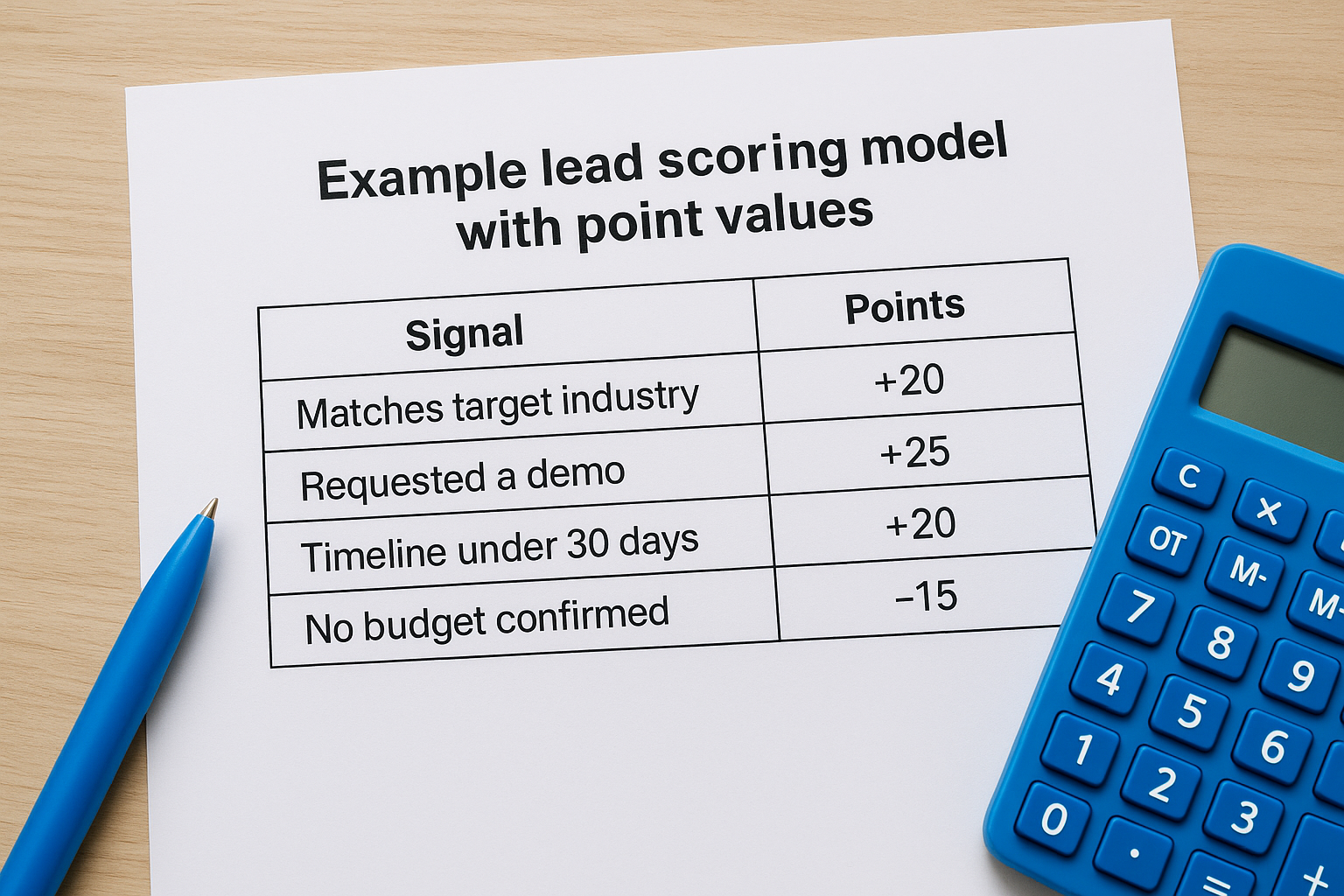
Example lead scoring model with point values
| Signal | Points |
|---|---|
| Matches target industry | +20 |
| Requested a demo | +25 |
| Timeline under 30 days | +20 |
| No budget confirmed | -15 |
Metrics to track
Watch your score-to-close rate by segment to validate that your scoring model actually predicts outcomes. Adjust point values quarterly based on which signals consistently lead to closed deals.
6. Use a multi-touch cadence across phone, SMS, and email
Most leads don't convert on the first contact. Reaching out once and waiting is one of the most common reasons pipelines stall. A structured multi-touch cadence across phone, SMS, and email keeps your name in front of prospects without overwhelming them, and it's one of the most effective answers for how to improve lead conversion rate.
Build a cadence that matches your sales cycle
Shorter sales cycles need faster, more compressed sequences. Longer cycles need spaced-out touches that maintain presence without creating friction. Map your cadence length to your average time-to-close so you're not dropping leads too early or over-contacting them.
Rotate channels based on engagement signals
If a lead opens your email but doesn't reply, follow up by SMS or phone rather than sending another email. Match your next channel to where the prospect showed activity. Engagement signals tell you where attention lives, so follow them.
The channel that gets ignored first is the one you should pause, not repeat.
Write messages that earn a reply, not a delete
Every message needs a clear reason to exist. Reference the prospect's specific interest, offer something useful, and ask one direct question. Keep SMS under 160 characters and email subject lines under 50 characters to improve open rates.
Example 10-touch cadence over 14 days
Use this sequence as a starting template and adjust timing based on your lead source and average sales cycle length.
| Day | Action |
|---|---|
| 1 | Call + SMS |
| 2 | |
| 4 | Call |
| 6 | SMS |
| 8 | |
| 10 | Call + email |
| 14 | Final SMS |
Metrics to track
Watch reply rate by channel and touch number to find where your cadence loses momentum. Track cadence completion rate to see how often reps finish the full sequence versus dropping out early.
7. Improve your calls with structure and tighter next steps
A well-run call is one of the most direct ways to know how to improve lead conversion rate. Without structure, calls drift, reps miss key questions, and prospects hang up without a clear reason to move forward. A repeatable call framework keeps every conversation on track and increases the chance that each call ends with a defined next step.
Open strong and confirm the reason for the call
Start every call by stating your purpose clearly and confirming the prospect still has a few minutes to talk. Reference the specific reason they reached out so the conversation feels relevant from the first sentence, not generic.
Ask better discovery questions and summarize needs
Ask open-ended questions that reveal the prospect's actual situation, not questions that lead them toward a scripted answer. After they respond, repeat back what you heard in your own words to confirm understanding and build trust.
Summarizing a prospect's needs out loud is one of the fastest ways to show you were actually listening.
Handle common objections without arguing
When a prospect pushes back, acknowledge their concern first before responding. Arguing creates resistance; agreeing with the concern and redirecting keeps the conversation moving. Write down your three most common objections and prepare a response for each before your next call block.
End every call with a scheduled next step
Never end a call without a specific date and time locked in for the follow-up. A vague promise to send information is not a next step, and it rarely leads to one.
Metrics to track
Track call-to-next-step rate and average talk time per stage to find where calls lose momentum. A drop in either number signals a breakdown in your call structure worth fixing.
8. Remove friction from your landing pages and lead forms
Your landing pages and forms are the gateway to your pipeline, and unnecessary friction at this stage kills conversions before a rep ever gets involved. If you want to know how to improve lead conversion rate, fixing what happens on the page itself is a high-leverage place to start.
Match the page message to the traffic source
When someone clicks an ad about a specific offer, they expect to land on a page that matches that exact offer. If the headline or body copy shifts the topic even slightly, visitors leave. Align your page headline directly with the ad or link that brought them there, and your completion rate will improve without changing anything else.
Reduce form fields and increase completion rates
Every additional field you ask someone to fill out reduces the chance they finish. Limit your form to the information you actually need to start a conversation. Name, phone number, and one qualifying question is often enough to open a productive first contact.
The best form is the one that collects exactly what you need and nothing more.
Use clear CTAs and a single primary action
Give your page one clear call to action and remove competing links or secondary offers that split attention. Use specific, action-oriented language like "Get your free quote" instead of vague labels like "Submit."
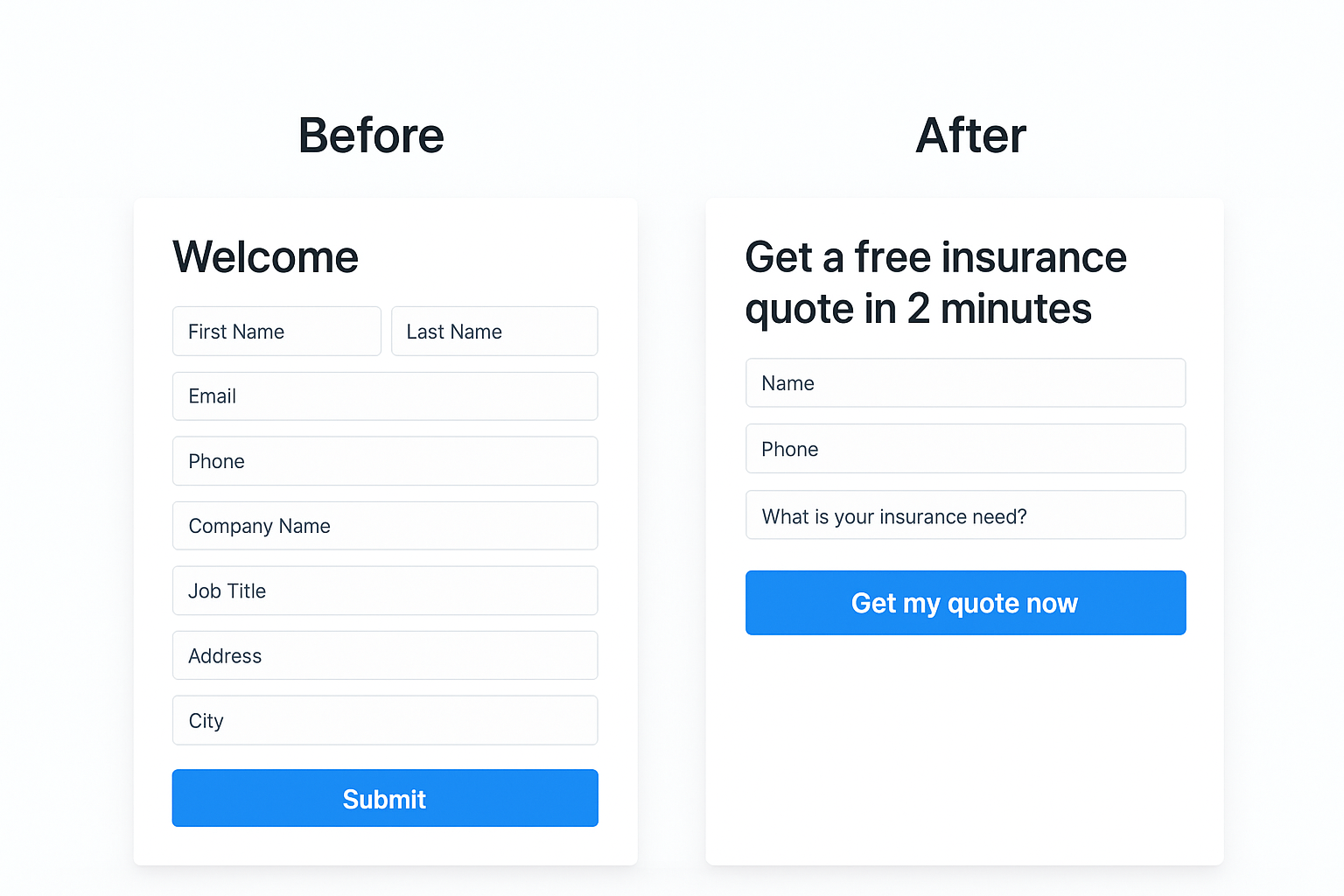
Example before-and-after form and CTA changes
| Element | Before | After |
|---|---|---|
| Form fields | 8 fields | 3 fields |
| CTA text | "Submit" | "Get my quote now" |
| Page headline | "Welcome" | "Get a free insurance quote in 2 minutes" |
Metrics to track
Watch your form completion rate and bounce rate by traffic source to pinpoint which pages leak the most potential leads.
9. Nurture leads who are not ready with targeted follow-ups
Not every lead converts on the first contact, and that's normal. The leads you nurture today become the deals you close next quarter, so abandoning them early leaves real revenue on the table. Understanding how to improve lead conversion rate means treating "not now" as a temporary status, not a closed door.
Identify "not now" versus "not a fit"
These two groups need completely different treatment. A "not now" lead meets your target criteria but isn't ready to move yet due to timing or budget cycles. A "not a fit" lead never matched your criteria in the first place. Disqualify the latter immediately and route the former into a nurture track.
Misrouting "not now" leads into your discard pile is one of the most expensive mistakes a sales team makes.
Send helpful reminders tied to their original interest
Your nurture messages should reference the specific offer or problem that brought the lead in originally. Sending a generic check-in email gets ignored; sending a relevant resource tied to their exact situation keeps you credible and present without being pushy.
Re-qualify at the right time and recycle to sales
Set a scheduled re-qualification trigger, such as 30 or 60 days after the initial contact, to check whether the lead's situation has changed. If their timeline has moved up, route them back to an active rep immediately with full context intact.
Example nurture tracks for price shoppers and researchers
| Segment | Track Focus |
|---|---|
| Price shoppers | ROI examples and flexible pricing reminders |
| Researchers | Educational content and product comparisons |
Metrics to track
Watch your nurture-to-SQL conversion rate and re-qualification rate monthly to confirm your tracks are moving leads forward rather than just filling an inbox.
10. Audit drop-offs and run small experiments every month
Knowing how to improve lead conversion rate over time requires more than applying tactics once. Your funnel will shift as lead sources change, reps turn over, and market conditions evolve, so monthly audits and small experiments keep you ahead of the decay.
Find the step that leaks the most conversions
Pull your stage-to-stage conversion rates at the start of each month and look for the single biggest drop. That step is your priority, not the one with the lowest number overall, but the one with the largest gap between volume in and volume out.
Diagnose the cause: offer, channel, timing, or messaging
Once you find the leak, narrow it down to one root cause before you act. A drop in contact rate points to a timing or channel issue. A drop from SQL to opportunity usually signals a messaging or discovery problem. Guessing without diagnosis leads to fixes that don't stick.
The wrong fix applied confidently still produces wrong results.
Test one change at a time and document results
Change only one variable per experiment so you can isolate what actually moved the number. Keep a simple log with the change made, the dates, and the before-and-after metric. Two weeks of data is enough for most sales teams to see a directional result.
Example monthly conversion improvement checklist
- Review stage-to-stage rates and flag the biggest drop
- Identify the likely cause from your call notes and CRM data
- Run one test for two weeks and record the outcome
- Share findings with the full team before the next month begins
Metrics to track
Monitor your overall conversion rate trend and stage-specific rates month over month. A consistent improvement of even one percentage point per quarter compounds into significant revenue gains over a full year.
Put it into practice
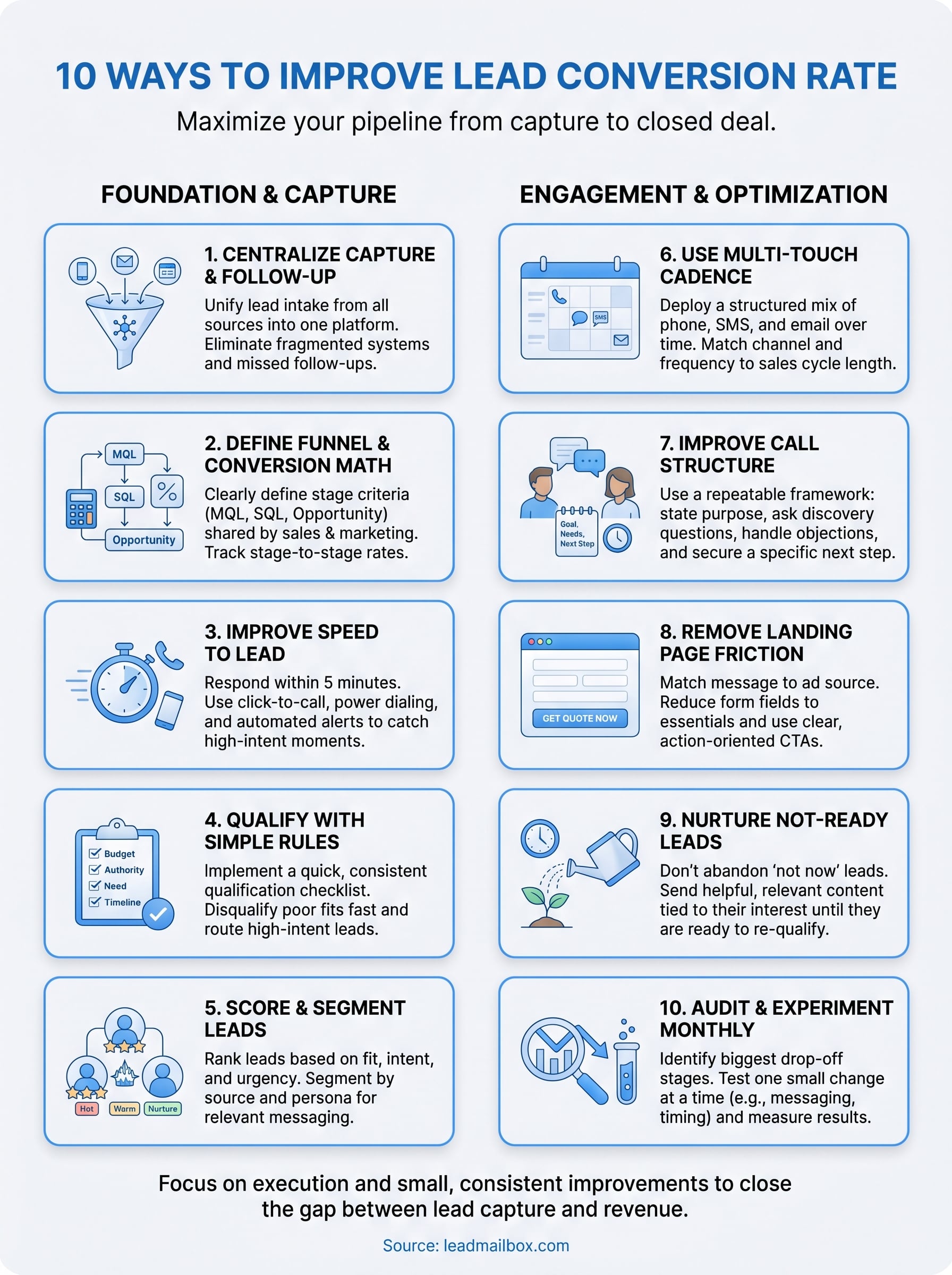
Every strategy in this article answers the question of how to improve lead conversion rate through execution, not theory. You don't need to apply all ten at once. Pick the two or three that address your biggest current leak and build from there. Small, consistent improvements compound fast when you measure them honestly and act on what the data shows.
Your leads are already coming in. The gap between what you capture and what you close is where this work happens. A clear funnel definition, faster follow-up, better qualification, and a structured outreach cadence will move that number in the right direction faster than any increase in ad spend. Start with what you can control today, and add the next layer once you see results.
If you want a platform built to support every tactic on this list, explore LeadMailbox and see how it fits your team's workflow.