

How To Build A Sales Pipeline: Stages, Steps & Examples
Most sales teams don't have a lead problem, they have a process problem. Leads come in from multiple sources, reps follow up when they remember, and deals slip through the cracks without anyone noticing. Knowing how to build a sales pipeline gives your team a repeatable structure that turns scattered activity into predictable revenue. Without one, you're guessing. With one, you're selling.
A sales pipeline maps every step a prospect takes from first contact to closed deal. It tells you where each lead stands, what action comes next, and where your process is breaking down. It's not a forecast or a wish list, it's an operational tool that keeps your team focused on the right leads at the right time.
This guide walks you through the full process of building a sales pipeline from scratch. You'll learn the core stages every pipeline needs, how to define them for your specific sales cycle, and how to manage the pipeline once it's running. We've also included real examples and practical steps you can apply immediately. At LeadMailbox, we've spent over 20 years helping sales teams organize leads from multiple sources, automate outreach, and move prospects through every stage of the pipeline, so the advice here comes directly from what we've seen work in the field.
Sales pipeline basics: pipeline vs funnel vs process
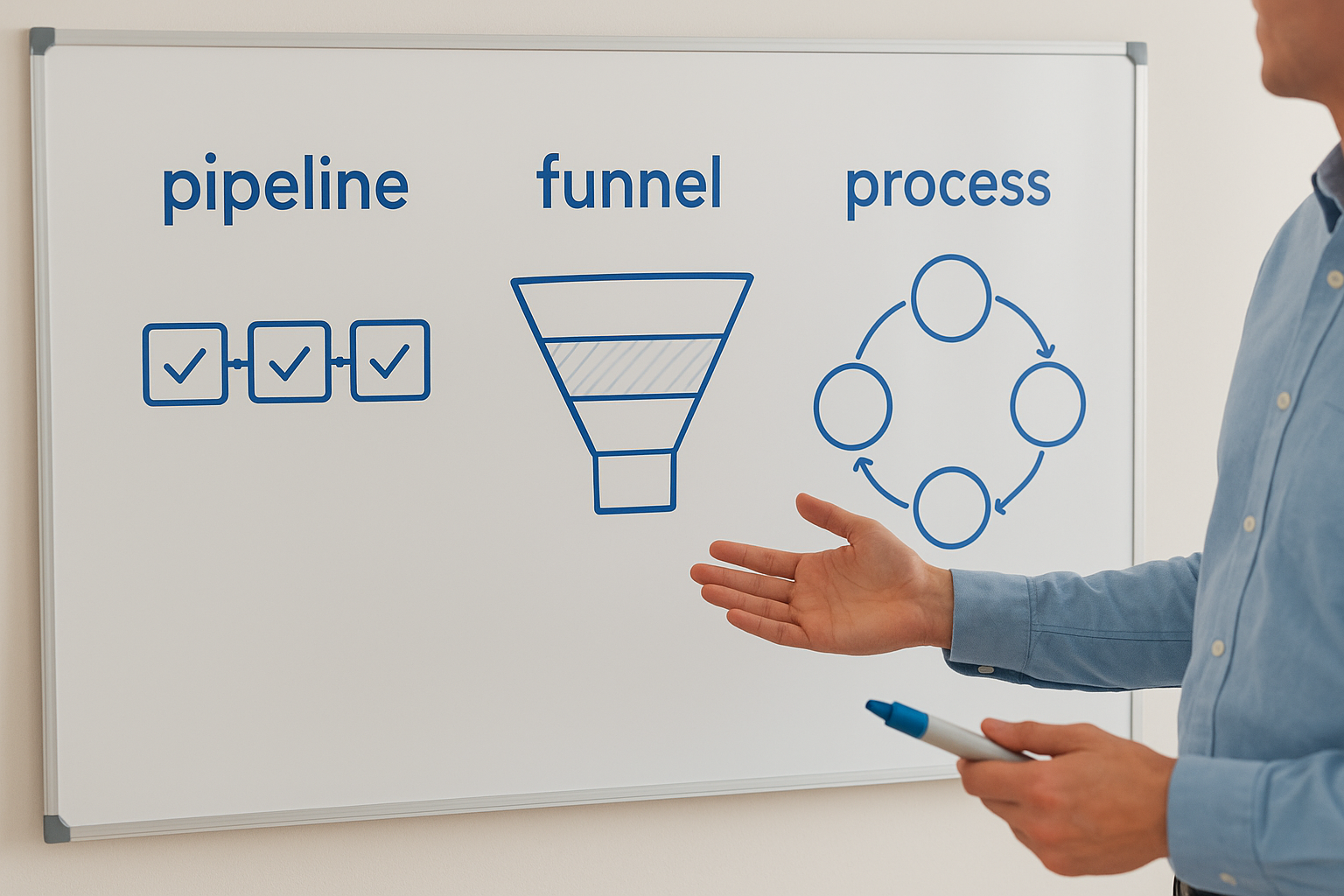
These three terms show up constantly in sales conversations, and most people use them interchangeably. That's a mistake, because each one describes a different layer of the same revenue system. Getting clear on what each term means helps you build a more focused operation and have cleaner conversations with your team about where problems actually live.
What a sales pipeline is
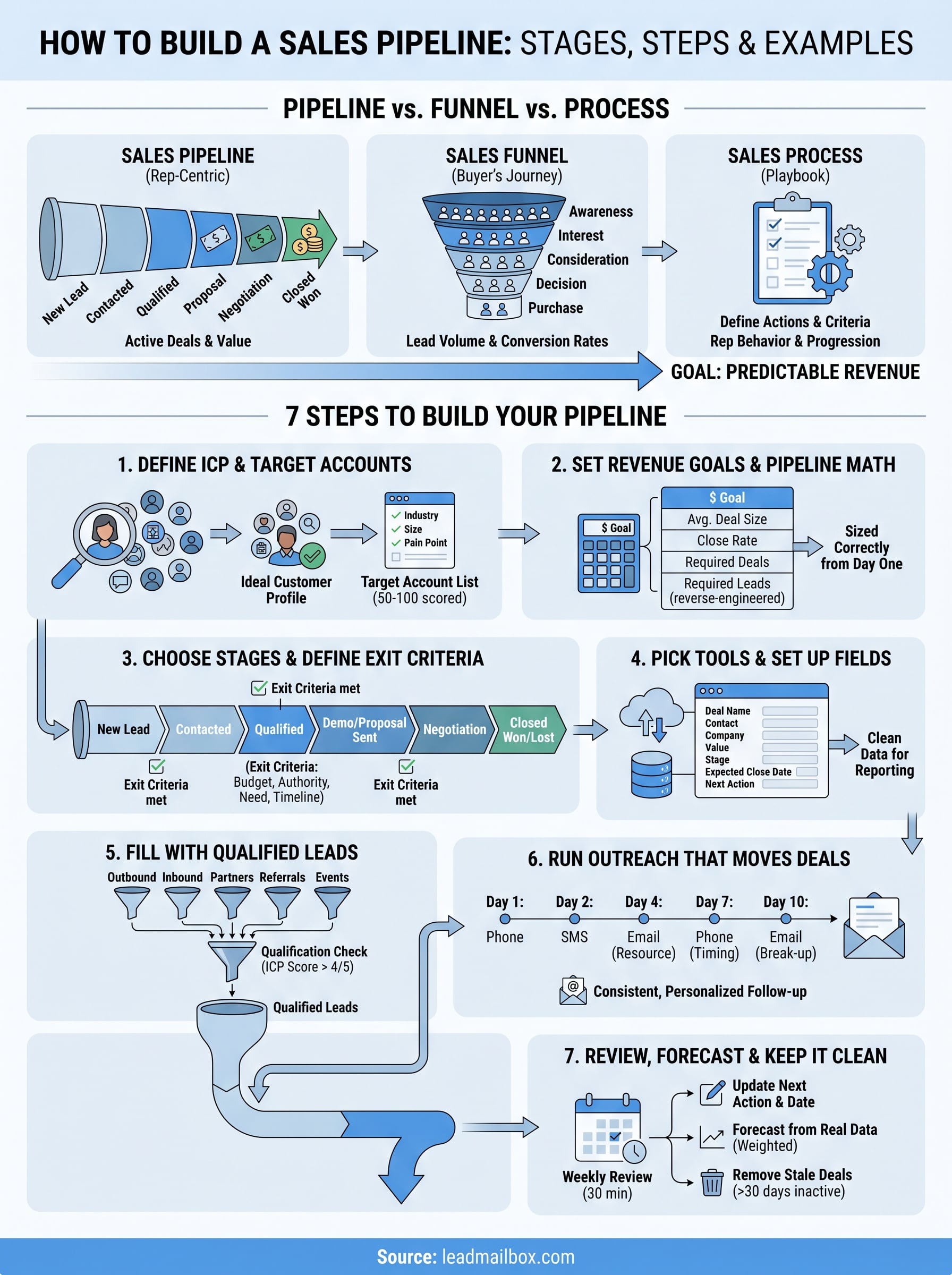
A sales pipeline is a visual representation of your active deals, organized by stage. Each stage reflects a specific action your sales rep has taken or needs to take next. When you look at your pipeline, you see how many deals exist, where each one sits, and what value each deal carries at that moment in time.
Think of it as a snapshot of your current opportunities. If you're trying to understand how to build a sales pipeline that actually works, start here: the pipeline is rep-centric and deal-centric. It answers the question "What is happening right now with the deals we're working?" Pipelines typically track fields like deal value, contact name, company, current stage, expected close date, and next required action. Those fields are what make the pipeline a working tool rather than a static list.
A well-maintained pipeline tells you exactly where revenue will come from and where it might stall before it hits your forecast.
How the sales funnel differs
The sales funnel describes the buyer's journey, not the rep's activity. It's a marketing concept that tracks how a large pool of prospects narrows down to a smaller group of paying customers. The top of the funnel holds everyone who's aware of your product. The bottom holds the ones who bought, and everything in between represents drop-off you need to reduce.
Funnels are typically broader and more volume-focused than pipelines. Marketers use funnels to measure conversion rates between stages like awareness, interest, consideration, and decision. Sales reps rarely work inside a funnel view day-to-day. The funnel informs how many leads you need to generate, while the pipeline tracks what you do with those leads once they arrive.
How the sales process connects everything
The sales process is the playbook that defines what reps actually do at each stage. It's a set of steps, actions, and criteria that govern how a deal moves forward. Where the pipeline shows you the stages, the sales process tells you what must happen to move from one stage to the next.
A strong sales process answers three questions for each stage: What action triggers entry into this stage? What does the rep need to accomplish here? What criteria must be met before the deal advances? Without that structure, stages become labels on a list rather than meaningful checkpoints, and your pipeline data stops reflecting reality.
Here's how the three concepts work together:
| Concept | Owned by | Measures | Primary question |
|---|---|---|---|
| Sales funnel | Marketing | Lead volume and conversion rates | How many people are we reaching and converting? |
| Sales pipeline | Sales | Active deals and deal value | What deals are we working and where do they stand? |
| Sales process | Sales ops / leadership | Rep behavior and stage progression | What are reps doing to move deals forward? |
Understanding all three gives you a complete picture of your revenue operation. The funnel feeds the pipeline. The process governs the pipeline. When any one of the three breaks down, you feel it across all of them, which is why building your pipeline without defining the other two is a setup for confusion down the road.
Step 1. Define your ICP and target accounts
Your pipeline is only as strong as the leads you put into it. Before you map stages or pick tools, you need to know exactly who you're selling to. When you understand how to build a sales pipeline that actually converts, the work starts with defining your Ideal Customer Profile (ICP), not with chasing every lead that comes through the door.
Build your ICP profile
An ICP is a detailed description of the type of company (or individual, for B2C) that gets the most value from your product and is most likely to buy. It's not a wish list. It's a profile built from your best existing customers and the patterns they share. Look at the customers who closed fastest, stayed longest, and complained the least. Those are your ICP.
Your ICP should eliminate as many wrong-fit prospects as possible before they ever enter your pipeline.
To build yours, pull data on your top 10 to 20 customers and identify what they share across these dimensions:
- Firmographic: Industry, company size, annual revenue, geography
- Situational: Growth stage, tech stack, primary pain points, budget range
- Behavioral: How they found you, how long the sales cycle was, what objections they raised
Once you spot those patterns, write them into a one-page ICP document your whole team can reference. Use this template to get started:
| ICP Field | Your Answer |
|---|---|
| Industry | |
| Company size (employees) | |
| Annual revenue range | |
| Geography | |
| Primary pain point | |
| Budget range | |
| Decision maker title | |
| Typical sales cycle length |
Translate your ICP into a target account list
With your ICP defined, the next step is turning it into a concrete list of companies you actively want to sell to. This is your target account list, and it gives your reps a focused pool of prospects rather than an open field. Start with 50 to 100 accounts that match your ICP criteria, then score each one by how closely it fits.
Scoring doesn't need to be complicated. Assign each account a fit score from 1 to 3 based on how well it matches your ICP. Accounts that score a 3 across every category get your reps' first attention and best outreach. Accounts that score lower either move into a nurture sequence or get removed entirely. This keeps your pipeline clean from the start rather than full of long-shot deals that stall and distort your forecasts.
Step 2. Set revenue goals and pipeline math
Before you add a single stage to your pipeline, you need to know what you're building toward. Most sales teams jump straight to organizing deals without first answering a basic question: how much revenue do you need this pipeline to produce? Setting a clear revenue target before you map your stages forces every activity and every forecast to connect back to a number that actually matters.
Start with your revenue target
Your pipeline math begins with your monthly or quarterly revenue goal. Take that number and break it into the specific inputs your pipeline needs to hit it. You need to know your average deal size and your average close rate. Those two numbers are the foundation of every calculation that follows.
For example, if your goal is $50,000 in revenue this month and your average deal size is $2,500, you need to close 20 deals. That's your target, and everything above it in the pipeline gets reverse-engineered from there. Skipping this step means you're managing activity without any idea whether that activity is enough to hit your number.
Work backward through your pipeline
Once you know how many deals you need to close, work backward through each stage to figure out how many leads need to enter the pipeline to produce that result. This is the part most teams skip, and it's exactly why their pipelines run dry in the third week of every month.
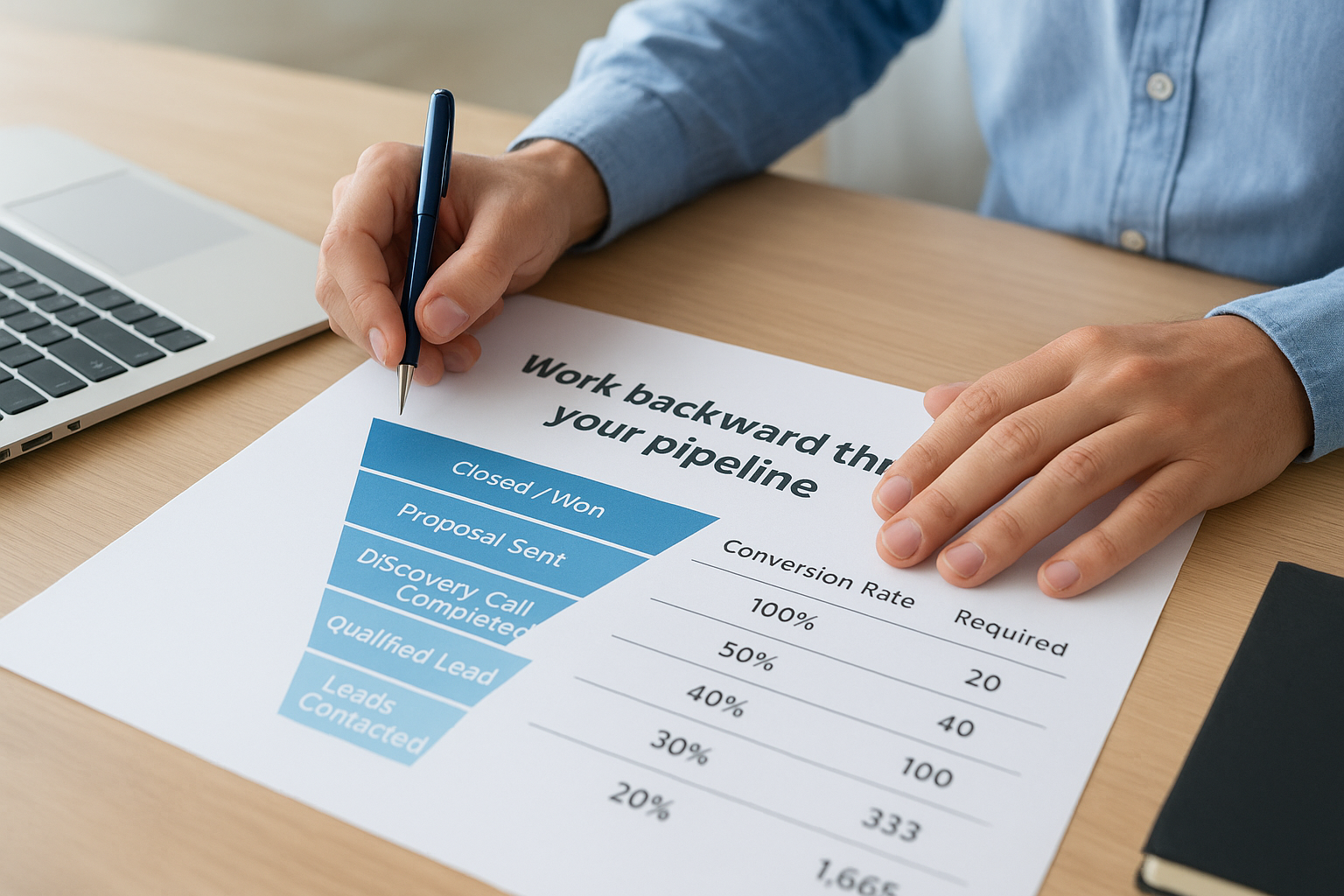
The math doesn't lie. If your pipeline doesn't carry enough volume at the top, no amount of follow-up will save your month.
Running this calculation is a core part of understanding how to build a sales pipeline that hits targets consistently. Use this template to run your own numbers before you build anything else:
| Stage | Conversion Rate | Required Volume |
|---|---|---|
| Closed / Won | 100% | 20 deals |
| Proposal Sent | 50% | 40 deals |
| Discovery Call Completed | 40% | 100 deals |
| Qualified Lead | 30% | 333 leads |
| Leads Contacted | 20% | 1,665 leads |
Adjust the conversion rates in this table to reflect your actual historical data, not industry benchmarks. If you don't have that history yet, use conservative estimates and refine the numbers after your first 60 to 90 days of tracking. The goal is a pipeline sized correctly from day one, so you're not scrambling to fill gaps after your month is already behind.
Step 3. Choose stages and define exit criteria
Choosing the right stages is where the structure of your pipeline becomes real. Most teams copy a generic template they found online and wonder why their pipeline data never reflects reality. The stages you choose need to match your actual sales motion, not someone else's. A five-step enterprise SaaS pipeline looks nothing like a three-step transactional sales process, and forcing the wrong model onto your team creates confusion at every level. Get this step right, and everything downstream becomes sharper.
Pick the right stages for your sales cycle
Your stages should represent the key decision points in your sales process, not every individual task your rep performs. Each stage marks a meaningful shift in the buyer's position, something that tells you the deal has genuinely progressed rather than just sat idle for another week. As a starting point, most small to mid-sized sales teams work well with five to seven stages.

Here is a standard pipeline structure you can adapt directly:
| Stage | What it means |
|---|---|
| New Lead | Contact has entered the pipeline but has not been reached |
| Contacted | Rep has made initial contact and confirmed basic interest |
| Qualified | Lead meets ICP criteria and has confirmed budget, authority, need, and timeline |
| Demo / Proposal Sent | Rep has presented the solution or delivered a formal proposal |
| Negotiation | Both sides are working through pricing or contract terms |
| Closed Won | Deal is signed and revenue is recognized |
| Closed Lost | Deal ended without a sale; reason is logged for review |
Trim or expand this list based on your average sales cycle length. If your deals close in two calls, you don't need seven stages. If your cycle runs three months, you may need to break qualification into multiple checkpoints to maintain visibility.
Write exit criteria for every stage
Exit criteria are the specific conditions a deal must meet before it advances to the next stage. Without them, reps move deals forward based on optimism rather than evidence, and your pipeline fills up with stalled opportunities that distort every forecast you run. Defining these conditions is one of the most important details in understanding how to build a sales pipeline that produces reliable numbers.
If any deal can advance without meeting a real condition, your pipeline data is fiction.
Write exit criteria as observable, verifiable facts, not feelings or gut instincts. Use this template for each stage:
- Stage name: Qualified
- Entry action: Rep has completed a discovery call
- Exit criteria: Contact has confirmed budget range, named a decision maker, and agreed to a follow-up meeting with a set date
Apply that format to every stage in your pipeline before you add a single deal.
Step 4. Pick your tools and set up fields
Your pipeline stages are defined and your math is done. Now you need a tool that holds everything together and fields that capture the data your team actually needs to manage deals day to day. Choosing the wrong tool, or skipping field setup entirely, means your pipeline lives in notebooks and memory instead of a system, and that's exactly where deals start to slip.
Choose the right tool for your team size
Most teams overthink this decision. The right choice depends on your team size, deal volume, and how your leads arrive. A solo rep managing 20 active deals has very different needs than a team of 10 handling hundreds of inbound leads from multiple sources each week. Before you commit to any platform, check whether it handles your existing lead sources natively, supports the communication channels your reps already use, and gives you a clear pipeline view without requiring technical configuration to get started.
The best tool is the one your reps will actually use every day, not the one with the longest feature list.
Use this framework to narrow your options before you evaluate anything:
| Team size | Deal volume | What to prioritize |
|---|---|---|
| 1-3 reps | Under 100 active deals | Simple pipeline views, fast data entry, email integration |
| 4-15 reps | 100-500 active deals | Custom fields, activity tracking, basic reporting |
| 15+ reps | 500+ active deals | Role-based access, advanced forecasting, workflow automation |
Set up your pipeline fields
Once you have a tool selected, the next task is configuring the exact fields that belong on every deal record. This is one of the most overlooked parts of learning how to build a sales pipeline that produces clean, reliable data. Fields drive your reporting, and poorly configured fields produce reports that mislead everyone from frontline reps to leadership.
Start with this core field set and add others only when your process clearly requires them:
| Field | Type | Purpose |
|---|---|---|
| Deal name | Text | Identifies the opportunity |
| Contact name | Text | Primary point of contact |
| Company | Text | Account the deal belongs to |
| Deal value | Currency | Estimated revenue from this deal |
| Current stage | Dropdown | Where the deal sits right now |
| Expected close date | Date | When you expect to win or lose |
| Lead source | Dropdown | Where the lead originated |
| Next action | Text | What the rep does next |
| Last activity date | Date | When the rep last touched the deal |
Keep your field list short and purposeful. Every field you add is a field your reps need to fill in consistently. Unused fields become empty fields, and empty fields make your pipeline data useless for forecasting, coaching, or spotting patterns in your sales cycle.
Step 5. Fill the pipeline with qualified leads
A pipeline with well-defined stages and clean fields does nothing if you're not feeding it with the right leads. Filling your pipeline is not about generating as many contacts as possible. It's about pulling in leads that match your ICP and have a realistic chance of converting, so the deals you work are worth the time you spend on them.
Use multiple lead sources in parallel
Relying on a single source of leads is one of the fastest ways to run your pipeline dry mid-quarter. The strongest pipelines pull from at least three to four channels simultaneously, so a slowdown in one area doesn't kill the rest of your process. Knowing how to build a sales pipeline that stays consistently full requires treating lead generation as an ongoing system, not a one-time project.
Diversifying your lead sources means a single channel drying up won't crater your monthly pipeline volume.
Your lead sources should map directly to your ICP. If your best customers come from inbound referrals and targeted outbound prospecting, those two channels should anchor your pipeline-filling strategy. Add a third channel like lead partner networks or content-driven inbound to give your team reliable top-of-funnel volume throughout the month.
Here are the most reliable lead sources for small to mid-sized sales teams:
- Outbound prospecting: Direct outreach to target accounts from your ICP list
- Inbound inquiries: Form submissions, demo requests, and contact page leads
- Lead partner networks: Third-party sources that deliver contacts matching your target criteria
- Referrals: Existing customers who introduce you to new prospects
- Events and webinars: Live interactions that generate warm contacts with confirmed interest
Score and qualify before leads enter the pipeline
Not every lead belongs in your pipeline. Unqualified contacts slow your reps down and inflate your deal count without adding real revenue potential. Before a contact gets a pipeline stage assigned, run it through a quick qualification check against your ICP criteria.
Use this lead scoring template to filter contacts before they enter your pipeline:
| Qualification Check | Yes / No |
|---|---|
| Matches ICP industry | |
| Falls within company size range | |
| Has confirmed budget or spending authority | |
| Has an identified need for your solution | |
| Can make or influence the buying decision |
A lead that answers yes to at least four of the five checks is worth a pipeline stage. Anything below that threshold goes into a nurture sequence until it qualifies properly. This filter keeps your pipeline clean and your reps focused on deals that can actually close.
Step 6. Run outreach that moves deals forward
Having qualified leads in your pipeline is only half the job. The other half is consistent outreach that advances each deal rather than just checking in to ask if a prospect has had a chance to think it over. Most deals don't die because of a bad product or wrong pricing. They die because a rep went quiet at a critical moment and a competitor filled the gap. Outreach is what keeps your pipeline moving.
Build a follow-up sequence for each stage
Every stage in your pipeline should have a defined follow-up sequence attached to it. That means a specific number of touches, a set cadence, and a channel mix. Reps who operate without a sequence rely on memory and instinct, which means some prospects get five calls in two days while others wait two weeks with no contact at all. Knowing how to build a sales pipeline that converts requires standardizing what happens between stages, not just at them.

The rep who follows up most consistently wins more deals than the rep who follows up most cleverly.
Use this template as your base sequence for any stage where a deal has gone quiet:
| Touch | Timing | Channel | Goal |
|---|---|---|---|
| 1 | Day 1 | Phone call | Re-establish contact and confirm interest |
| 2 | Day 2 | SMS | Short, direct prompt with a specific question |
| 3 | Day 4 | Provide a useful resource tied to their pain point | |
| 4 | Day 7 | Phone call | Ask directly if the timing still works |
| 5 | Day 10 | Break-up message that prompts a clear yes or no |
Adjust the timing based on your average sales cycle length and your historical response data. A one-week deal cycle compresses this sequence significantly. A three-month enterprise cycle spreads it out and may require additional touchpoints between steps three and four.
Personalize your outreach to the deal context
Generic messages get ignored. Every touch you send should reference something specific to that prospect: a detail from your discovery call, a challenge they mentioned, or a recent change at their company. This is not about writing long messages. It's about writing short, relevant ones that prove you paid attention during your last conversation.
Outreach also needs to match the stage the deal is in. A prospect who just received a proposal needs a different message and different urgency than someone who went cold after a discovery call. Align your outreach to the exact moment the deal is at, and your response rates will reflect that precision directly.
Step 7. Review, forecast, and keep it clean
A pipeline that nobody reviews is just a list of outdated contacts. Knowing how to build a sales pipeline is only useful if you treat it as a living operational tool that gets examined and updated on a regular schedule. Without consistent reviews, stale deals accumulate, your forecast drifts from reality, and your reps start gaming the numbers rather than working them.
Run a weekly pipeline review
Set a fixed time each week to review every active deal with your team. This meeting should not be a status report. It should be a working session where you push on the deals that have gone quiet, identify what each rep needs to move their next deal forward, and remove or reassign anything that's clearly dead. Keep the meeting to 30 minutes by focusing only on deals in active stages and anything that hasn't moved in 10 or more days.
Use this review checklist each week to keep the session focused:
| Review Check | Action if Failing |
|---|---|
| Deal has a next action logged | Rep assigns a specific task before the meeting ends |
| Last activity is within 10 days | Rep commits to a same-day follow-up touch |
| Expected close date is current | Rep updates or moves deal to a later period |
| Stage reflects the deal's actual position | Rep corrects the stage based on last conversation |
| Deal value matches the latest proposal | Rep updates the value field immediately |
Forecast from real data
Your forecast should come from actual stage data and close dates, not from what your reps think might happen. Pull your open pipeline by stage, multiply each deal's value by your historical conversion rate for that stage, and sum the results. That number is your weighted forecast. It's more accurate than asking reps to guess which deals will close and far more useful to leadership trying to plan resources or spending.
A forecast built on weighted pipeline data beats gut instinct every time, especially when a month is already half over.
Remove stale deals regularly
Stale deals distort every metric you track. A deal that has sat unmoved for 45 days in your "Qualified" stage is not a qualified deal, it's a placeholder that inflates your pipeline value and makes your conversion rates look worse than they are. Set a hard rule: any deal that hasn't had rep activity in 30 days either gets a final outreach attempt or moves to Closed Lost. Clean data produces better decisions, and better decisions produce better revenue.
Final thoughts
Understanding how to build a sales pipeline takes less time than most teams expect. The real work is running it consistently. The steps in this guide give you a clear ICP, revenue math that drives your targets, defined stages with exit criteria, and a weekly review process that keeps your data honest.
The biggest mistake most teams make is treating the pipeline as a reporting tool rather than a working operational system. Apply the templates here, run your weekly reviews, and keep your data clean. That discipline separates teams that hit their number from teams that wonder where the month went.
If you want a platform that brings your lead sources, outreach tools, and pipeline management into one place, LeadMailbox is built to handle exactly that, so your team can stay focused on closing deals rather than stitching systems together.