

How Does Lead Generation Software Work? Step-By-Step Guide
Most sales teams lose deals not because their product is bad, but because leads slip through the cracks. Someone fills out a form, calls in, or clicks an ad, and then nothing happens fast enough. Understanding how does lead generation software work gives you a clear picture of what's actually going on behind the scenes when a tool captures, organizes, and routes those leads so your team can act on them before they go cold.
At its core, this type of software automates the messy middle ground between "someone showed interest" and "a salesperson picks up the phone." It pulls leads from multiple sources, scores them based on fit, and pushes them into workflows that trigger calls, emails, or texts, without manual data entry or copy-pasting between tabs. The result is a pipeline that moves on its own, with your reps focused on selling instead of sorting spreadsheets.
At LeadMailbox, we've spent over 20 years building exactly this kind of system, one that aggregates leads from hundreds of partners, connects them to built-in calling and messaging tools, and now uses AI agents to handle responses across channels. So this isn't theory for us. This guide breaks down each step of how lead generation software works, from first capture to closed deal, so you know exactly what to look for and how it should perform.
Why lead generation software matters
Every sales team has a version of the same problem. Leads come in from multiple directions - a Facebook ad here, a web form there, a referral from a partner list - and someone has to figure out what to do with all of them, fast. Without a system handling that intake process, response times stretch from minutes into hours, and by then, the prospect has already talked to someone else. That's the core reason lead generation software exists: to close the gap between interest and contact so your team can act before the opportunity cools.
The cost of slow follow-up
Research from Harvard Business Review shows that companies contacting prospects within an hour of receiving an inquiry were seven times more likely to qualify the lead than those that waited just 60 minutes longer. That number should stop you cold. When you understand how does lead generation software work, one of the first things you realize is that speed is the entire game in the early stages of a sales cycle. The software exists to remove every human delay that stands between a new lead and a live conversation.
The first business to make meaningful contact with a new lead wins the conversation in the majority of cases.
Most sales teams lose that race not because their reps are slow, but because the routing and notification systems aren't in place to act automatically. A lead lands in an email inbox, someone has to notice it, copy it into a CRM, assign it to a rep, and hope the rep sees it in time. That chain of manual steps burns the same minutes your competitors are using to make calls.
Manual processes create real revenue gaps
When your team handles lead intake manually, errors compound quickly. A mistyped phone number, a duplicate record, a missed assignment - each one represents a potential deal that never gets a real shot. At low lead volumes, you can manage the noise. But as volume grows, manual processes don't scale, and you end up spending your best reps' time on data hygiene instead of selling.
The financial impact is straightforward. If your team handles 200 leads a month and loses 15% to process failures - slow follow-up, missed contacts, bad data - that's 30 potential customers who never got a proper conversation. Multiply that by your average deal value and the number becomes hard to ignore.
The role of consistency in converting leads
Beyond speed, consistency determines conversion. A lead that receives a structured sequence of touchpoints - an immediate text, a follow-up call, an email with relevant information - converts at a much higher rate than one that gets a single call and nothing else. Lead generation software gives your team a repeatable system that runs the same playbook for every lead, regardless of which rep is on shift or how busy the day gets.
Your best rep might naturally follow up three times before moving on. Your newest hire might give up after one. Software enforces the standard across your entire team, so your pipeline performance doesn't depend on individual habits or memory. That consistency is what separates sales teams that scale from ones that stay stuck managing chaos.
What lead generation software does and does not do
Understanding what this software actually handles versus what it leaves to your team is critical before you invest in one. A lot of buyers get sold on a long feature list and then frustrated when the tool doesn't close deals by itself. Setting realistic expectations upfront helps you build a system that works with your team's strengths rather than one that creates new friction.
What the software handles for you
When you understand how does lead generation software work in practice, the clearest answer is that it automates the mechanical steps between a lead's first action and your rep's first conversation. The software captures data from your lead sources, deduplicates records, scores leads based on rules you set, and triggers outreach sequences across phone, text, and email without anyone touching a keyboard. It also tracks every interaction so your team always knows the current status of each contact.
The software handles repetitive, time-sensitive tasks so your reps can focus on the conversations that actually require a human.
Beyond outreach, modern platforms with AI agents can respond to incoming texts, handle basic inbound calls, and draft email replies, giving leads an immediate response even when your reps are unavailable. That layer of automation keeps your pipeline moving around the clock.
What it cannot do for you
Lead generation software does not replace sales judgment or relationship-building. It can put your rep on the phone with a warm lead in under a minute, but what happens in that conversation is entirely on the person holding the phone. The software cannot read objections, build trust, or negotiate terms, and expecting it to do so sets your team up for disappointment.
It also cannot fix a weak offer or a misaligned target audience. If the leads you're generating aren't a good fit for your product, automation will only surface that problem faster. The software amplifies your existing sales process, for better or worse, so the fundamentals still need to be solid before the technology can do its job.
How lead generation software works step by step
Knowing how does lead generation software work means following a lead from its very first touchpoint through to the moment a rep picks up the phone. The process runs in stages, and each stage feeds directly into the next without anyone needing to move data manually. Understanding the sequence helps you spot where your current setup might be losing momentum.
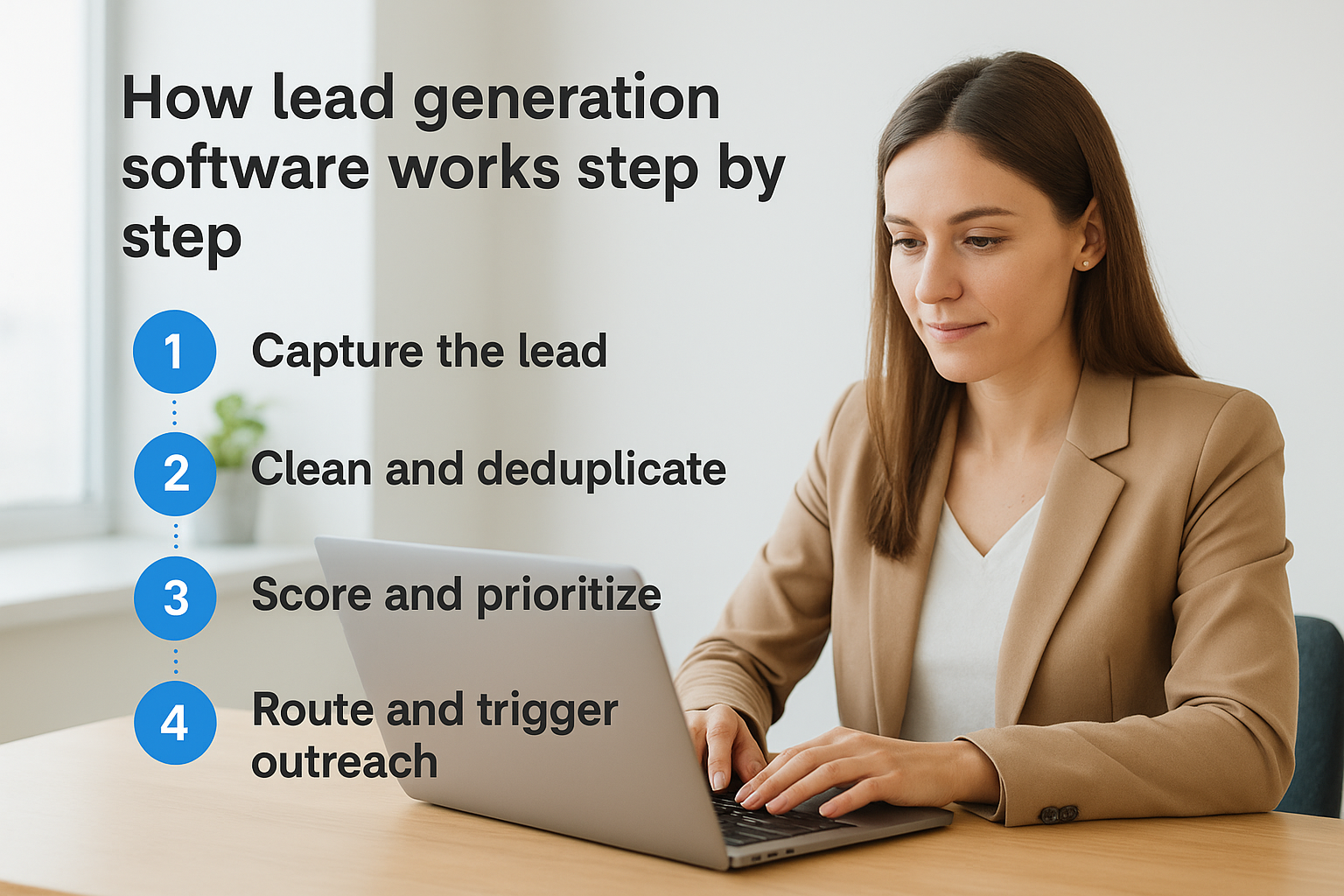
Step 1: Capture the lead
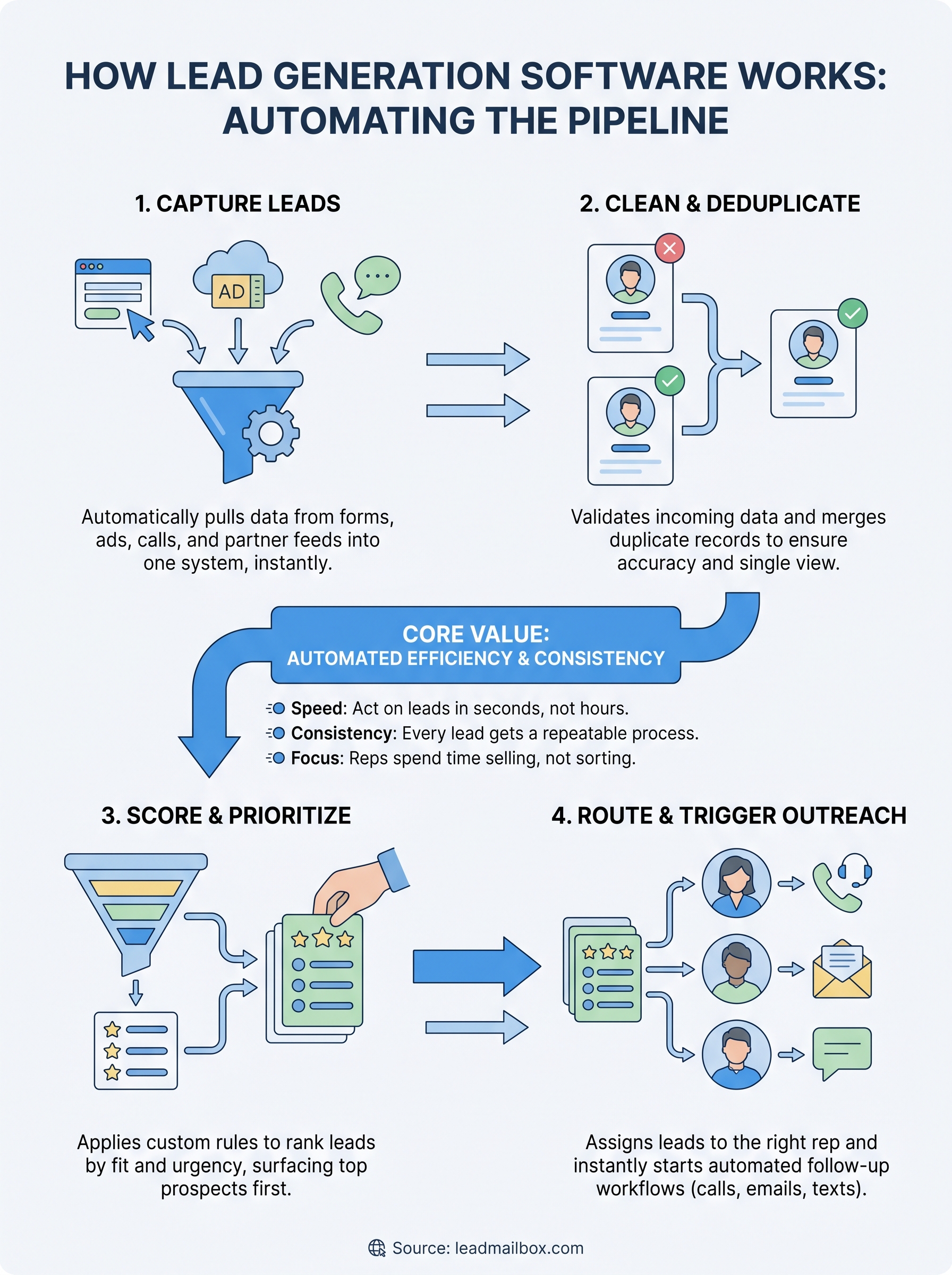
The process starts the moment someone takes an action - a form submission, an inbound call, a click on a paid ad, or a record delivered from a lead partner. The software pulls that data in automatically through integrations or APIs and creates a contact record in your system. Nothing sits in an email inbox waiting for someone to copy and paste it into a spreadsheet.
Step 2: Clean and deduplicate
Before any outreach happens, good software checks for duplicates and validates the incoming data. If the same contact already exists in your system under a different lead source, the platform merges or flags the record rather than creating two separate entries that split your follow-up history. This step protects your data quality at the point of entry, not after the damage is done.
Clean data entering your system costs far less to maintain than scrubbing a corrupted database six months down the line.
Step 3: Score and prioritize
Once the lead is in the system, the platform applies scoring rules you configure to determine how urgent this contact is. A lead that matches your ideal buyer profile and came in through a high-converting source ranks higher than one with incomplete information. Your team sees the highest-priority leads first, so rep time goes to the contacts most likely to convert.
Step 4: Route and trigger outreach
With scoring complete, the software assigns the lead to the right rep based on rules like territory, product line, or round-robin distribution. Simultaneously, it triggers your outreach sequence: an immediate text, a scheduled call task, a follow-up email. The entire handoff from raw lead to active outreach happens in seconds, not hours, and your rep gets a notification the moment the contact is ready for a conversation.
The core features that make it work
When you look at how does lead generation software work under the hood, the answer comes down to a handful of specific features working together. Strip out the marketing language from any platform's sales page and you'll find the same core capabilities driving real results. Knowing what those features are, and why each one matters, helps you evaluate tools based on function rather than branding.
Lead source integrations
Your software is only as useful as the data flowing into it. Lead source integrations connect the platform directly to every channel producing contacts, whether that's a web form, a paid ad network, a third-party lead partner, or an inbound call line. When these integrations work properly, new lead records appear automatically the moment someone takes action, with no manual imports and no waiting on someone to forward a spreadsheet.
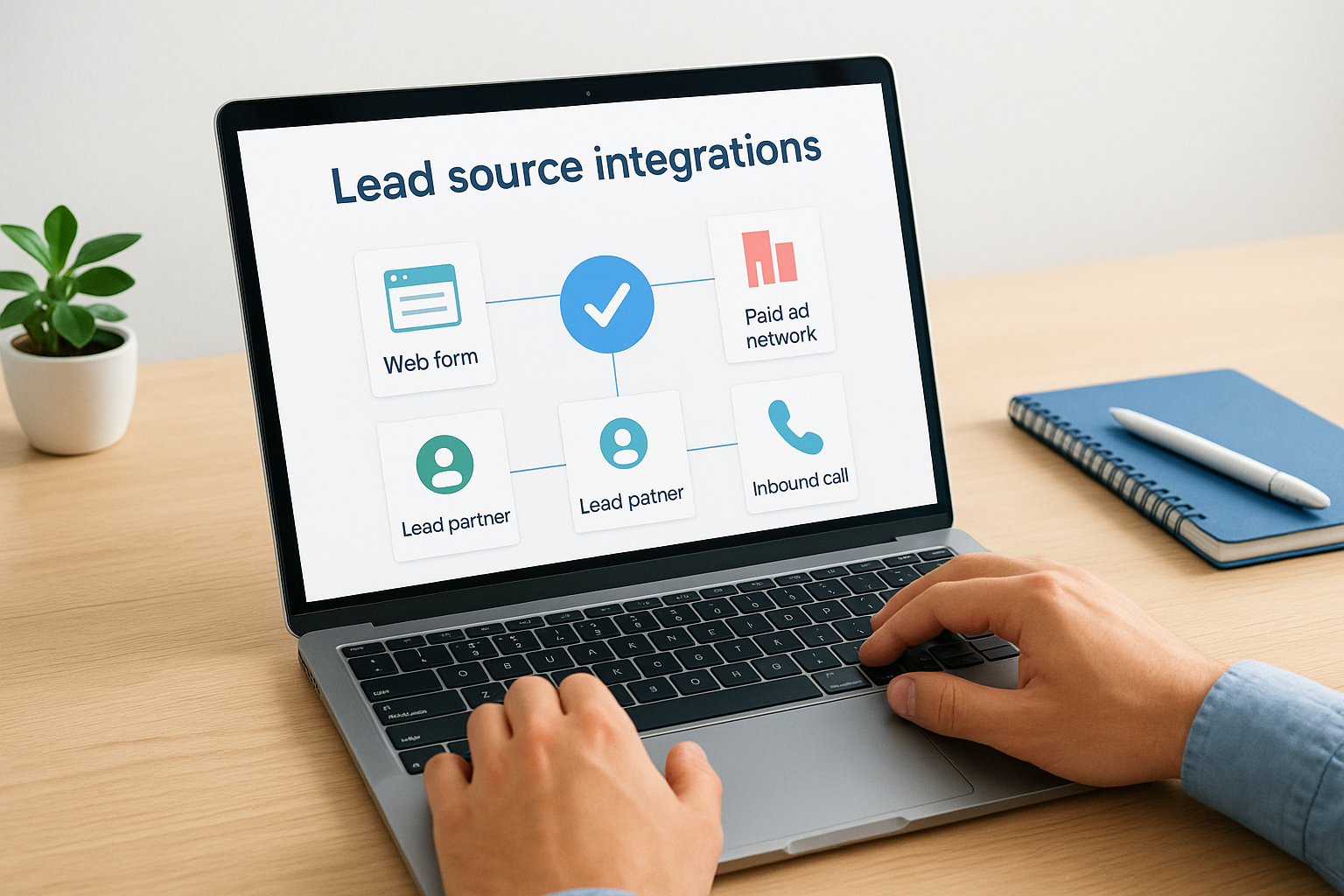
A platform that covers most of your lead sources but misses one forces your team back into manual workarounds, which defeats the entire purpose.
Strong integration coverage also means your data stays consistent across sources. Each record arrives in the same format, with the same fields populated, so your scoring rules and routing logic can run without exceptions or errors.
Automated outreach sequences
Once a lead enters the system, outreach sequences take over immediately. These are pre-built workflows that send texts, schedule calls, and trigger emails in a specific order based on timing rules you define. Your team doesn't have to remember to follow up because the platform handles the cadence automatically for every lead that comes through.
The most capable platforms let you branch sequences based on lead behavior. If a contact replies to a text, the system adjusts the next step. If a call goes unanswered, a follow-up message fires automatically rather than waiting for a rep to notice the missed attempt.
Reporting and pipeline visibility
Managers need to see which leads are active, stalled, or closed at any given moment. Reporting features provide a live view of pipeline health, rep activity, and conversion rates across lead sources. That visibility lets you spot problems early, whether a rep is skipping follow-ups or a particular lead source is producing low-quality contacts that drain time without converting.
Good reporting also tells you which outreach channels are driving the most conversions across your lead base. When you can see that calls outperform emails for a specific lead type, you can adjust your sequences accordingly rather than guessing what's working.
How it captures, qualifies, and routes leads
To see how does lead generation software work at the most granular level, you need to look at three connected stages: capture, qualification, and routing. Each one handles a specific problem in the intake process, and together they eliminate the manual steps that slow most sales teams down.
Capture: pulling data from every source
Capture is where the pipeline starts. When a prospect fills out a form, calls an inbound number, or gets delivered through a lead partner, the software records that contact automatically and creates a structured record in your system. Every field - name, phone number, source, timestamp - gets logged at the moment of entry, so nothing relies on someone remembering to add it later. That immediacy matters because the first few minutes after a lead arrives determine whether your team reaches out before a competitor does.
Qualification: sorting leads by fit
Once the lead is in your system, the platform applies your scoring rules to rank that contact against your criteria. Factors like budget signals, job title, geographic location, or the lead source itself can all contribute to a score that tells your reps how much attention this contact deserves right now. A high-scoring lead gets pushed to the top of the queue for immediate outreach; a lower-scoring lead enters a nurture sequence rather than sitting untouched.
Qualification without a clear scoring framework just shuffles work around. Your criteria need to reflect what your best customers actually looked like before they converted.
Some platforms also use behavioral signals to adjust scores over time. If a lead opens multiple emails or replies to a text, that activity increases their priority automatically without anyone reviewing the record manually.
Routing: getting the right lead to the right rep
Routing assigns each qualified lead to the rep best positioned to work it. You can set rules based on territory, product line, experience level, or simple round-robin distribution, depending on how your team is structured. The moment a lead gets assigned, the platform notifies that rep and triggers the first outreach step in the sequence, whether that's a call task, a text, or an email. No lead waits in a queue for a manager to notice it and hand it off.
How to set up lead generation software the right way
Most setup failures happen before anyone logs into the platform. Businesses rush to connect their lead sources and start sending outreach, then wonder why the system isn't performing. To understand how does lead generation software work at its best, you need to build the foundation in the right order, starting with your process, not the tool. A few hours of planning before configuration saves weeks of cleaning up broken workflows later.
Map your lead sources before you configure anything
Your first task is listing every place a lead can enter your pipeline, web forms, inbound call lines, paid ad channels, lead partner feeds, and anything else generating contacts for your team. Write them all down before you open the platform. When you start configuring integrations without this map, you almost always miss a source, which means some portion of your leads still arrives manually, defeating the entire purpose of automation.
Every lead source you leave out of the system becomes a gap that costs your team time and costs you revenue.
Once you have the full list, prioritize integration by volume. Connect your highest-traffic sources first so the biggest portion of your pipeline starts flowing automatically, then work down the list.
Build your scoring rules around real buyer data
Scoring only works when your criteria match what your actual customers looked like before they converted. Pull your last 12 months of closed deals and look for patterns: which lead sources produced the best customers, which industries converted fastest, which geographic areas performed strongest. Those patterns become your scoring framework, not assumptions about what a good lead should look like.

Set your rules in tiers. High-priority leads should trigger immediate outreach sequences. Lower-priority leads should enter longer nurture tracks rather than hitting the same aggressive follow-up cadence. This prevents your reps from burning time on weak contacts while letting strong ones wait.
Test every workflow before going live
Run test leads through every sequence you've built before connecting your live sources. Check that routing assigns contacts to the right rep, that texts and emails fire at the correct intervals, and that notifications reach your team in real time. Fixing a broken trigger on a test record takes minutes. Fixing one that has been silently failing on real leads for two weeks is a much harder conversation.
Common pitfalls and how to avoid them
Even well-designed platforms fail when the team around them makes predictable setup mistakes. Understanding how does lead generation software work is only half the job. The other half is knowing which habits and shortcuts break the system over time, so you can avoid building those problems into your process from day one.
Overloading the system before your workflows are proven
Many teams connect every lead source, build a dozen sequences, and go live all at once. When something breaks, tracking down the source of the problem takes far longer than it would have if you had launched in phases. Start with your highest-volume lead source and one outreach sequence, confirm that it runs cleanly end-to-end, then layer in additional sources and workflows one at a time.
Launching everything simultaneously turns a simple configuration error into a system-wide failure that is difficult to diagnose and even harder to fix under pressure.
Running a phased rollout also gives your reps time to build familiarity with the platform before the full weight of your pipeline runs through it. Confidence in the tool comes from using it at a manageable scale first.
Treating lead scoring as a one-time setup task
Your scoring rules need regular review, not a one-time configuration. Buyer behavior shifts, lead source quality changes, and the signals that predicted a strong customer six months ago may not hold today. Set a recurring review, once a quarter at minimum, to compare your scoring criteria against actual conversion data and adjust the weights accordingly.
Teams that skip this end up pushing low-quality leads to their best reps while high-fit contacts sit in low-priority queues waiting for outreach that comes too late.
Ignoring rep feedback on what the system delivers
Your reps are the first to notice when routed leads are a poor fit or when a sequence step produces no responses. If you build a feedback loop where reps can flag issues directly, you get early warning signals before small problems become systemic ones. A platform your team actively ignores is worse than no platform at all, because it creates false confidence that your pipeline is running when it is not.
Final takeaways
Understanding how does lead generation software work comes down to recognizing that it solves a timing and consistency problem, not a sales problem. The software captures leads the moment they arrive, cleans and scores them against your criteria, routes them to the right rep, and triggers outreach automatically so no contact waits longer than it should. That chain of steps removes the manual delays that cost sales teams real revenue every day.
The technology only performs as well as the process behind it. Your scoring rules, your workflow structure, and your willingness to revisit both determine whether the platform becomes a genuine pipeline engine or just another tool your team tolerates. Build it right, review it regularly, and let your reps focus on conversations instead of data entry.
If you want a platform that handles every part of this process in one place, explore LeadMailbox and see how it fits your team.