

12 Best Sales Funnel Software Tools for Businesses (2026)
Picking the best sales funnel software can feel like a gamble when every platform claims to be the one that'll transform your pipeline. The truth is, the right tool depends entirely on how you sell, your channels, your team size, your budget, and where your leads actually come from.
Most businesses don't need a bloated all-in-one suite. They need software that captures leads reliably, moves them through stages without manual babysitting, and connects directly to the tools they already use for outreach. That's something we understand well at LeadMailbox, we've spent over 20 years helping sales teams aggregate, manage, and convert leads through integrated calling, SMS, email, and AI-powered communication, all from a single platform.
To help you find the right fit, we evaluated 12 sales funnel software tools across pricing, features, ease of use, and real-world suitability for small and mid-sized teams. Whether you need a full funnel builder or a focused platform that slots into your existing stack, this breakdown covers what actually matters, no filler, no hype.
1. LeadMailbox
LeadMailbox has been in the lead management space since 2004, which makes it one of the longest-running platforms built specifically for sales teams. It focuses on aggregating leads from multiple sources and giving your team the tools to follow up fast, through phone, SMS, email, and AI-powered responses, all from a single dashboard rather than a collection of disconnected tools.

What it is
LeadMailbox is a unified lead management and sales enablement platform built for teams that handle high volumes of incoming leads. It combines CRM-style pipeline management with a full telephony suite and multi-channel outreach capabilities. You get a system designed from the ground up for converting leads into customers, not a general marketing tool that added CRM features as an afterthought.
Best for
LeadMailbox is best suited for small to mid-sized sales teams that pull leads from multiple sources and need a reliable, affordable system to manage and convert them without paying enterprise prices. It fits particularly well with teams that depend on phone-based outreach, including those running power dialers, managing inbound call flows, or combining phone contact with SMS and email sequences.
If your team spends significant time calling and texting leads, having calling, SMS, and AI tools under one subscription is far more practical than managing three separate platforms with separate billing.
Key funnel and sales features
LeadMailbox covers the core stages of a sales funnel from lead capture through to active outreach and follow-up. Here's what you get:
- Click-to-call, power dialer, and insta-call for rapid outbound contact
- Inbound number management so your team never misses an incoming lead
- AI agents that respond to incoming texts, handle calls, and draft emails automatically
- SMS and email campaign tools with personalized messaging support
- Lead pipeline tracking across all active lead sources in one view
Integrations and setup
The platform connects with hundreds of lead partners, which makes it practical if your business acquires leads from third-party providers or runs multiple lead generation campaigns simultaneously. Setup is straightforward, and the month-to-month pricing model removes the risk of locking into a long contract before you know the platform fits your workflow.
Pricing notes and trade-offs
LeadMailbox is priced as a cost-effective alternative to enterprise CRM platforms, and that positioning holds up. The month-to-month structure keeps your commitment low while you evaluate results. The honest trade-off is that LeadMailbox prioritizes lead management and conversion workflows over visual funnel building, so if page-by-page funnel design is your main need, it works best alongside a dedicated landing page tool. For sales teams looking for the best sales funnel software that connects multi-channel outreach in one place, it covers the operational side very well.
2. ClickFunnels
ClickFunnels built its reputation by making visual funnel building accessible to people without development skills. Since launching in 2014, it has become one of the more recognizable names when people search for the best sales funnel software, particularly among entrepreneurs and course creators who want to build and launch funnels quickly.
What it is
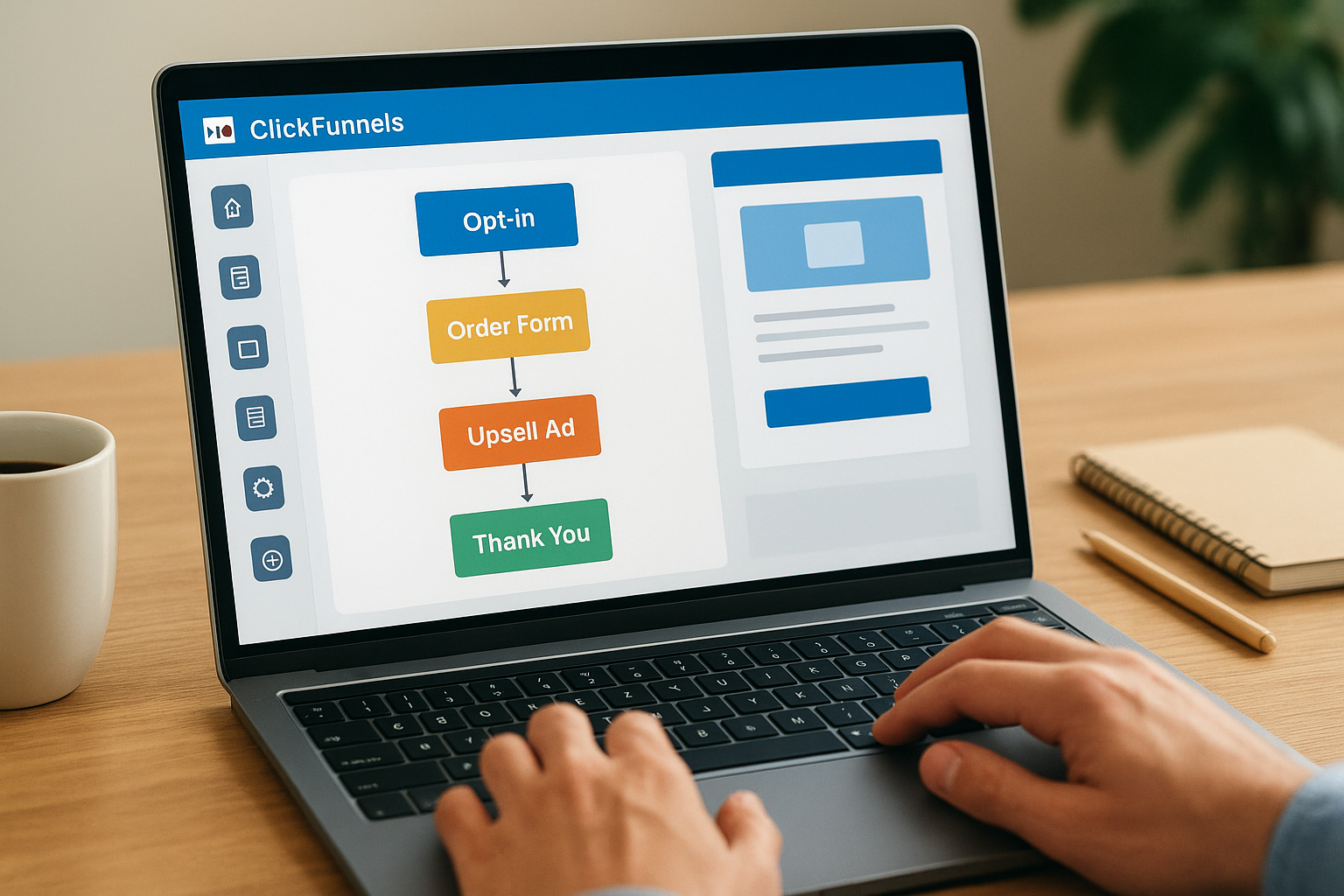
ClickFunnels is a drag-and-drop funnel builder focused on creating multi-step sales flows, including opt-in pages, order forms, upsell sequences, and thank-you pages. The platform is designed to connect each stage of a buying journey in a visual, linear structure that even non-technical users can manage and modify without writing code.
Best for
ClickFunnels fits best for digital product sellers, coaches, and course creators who need to launch structured sales pages fast. If your business model revolves around selling one or a few offers through a defined sequence, the platform is built around exactly that use case.
It works less well for teams managing high-volume inbound leads from multiple sources, where a dedicated lead management system handles the operational side better.
Key funnel and sales features
- Pre-built funnel templates for webinars, product launches, lead generation, and tripwire offers
- One-click upsells and order bump features built into checkout flows
- A/B testing for landing pages and funnel steps
- Membership site functionality for gated content delivery
Integrations and setup
ClickFunnels connects with major email marketing and payment platforms including Stripe and PayPal, plus Zapier for broader integration options. Setup time is low if you use their templates.
Pricing notes and trade-offs
Plans start around $97 per month, which is reasonable for solo operators but adds up quickly for growing teams. The platform's strength is funnel building, not lead tracking or telephony, so sales teams handling phone-based outreach will need additional tools alongside it.
3. GoHighLevel
GoHighLevel launched in 2018 targeting marketing agencies specifically, offering a white-label platform they could rebrand and resell to clients. It has since expanded its user base to include small businesses and independent sales professionals looking for an all-in-one alternative to stacking separate CRM, funnel, and communication tools.
What it is
GoHighLevel is a comprehensive marketing and CRM platform that combines funnel building, pipeline management, email and SMS automation, and reputation management in one system. It positions itself as a replacement for multiple tools rather than a focused solution for one specific job.
Best for
GoHighLevel fits best for marketing agencies managing multiple client accounts who need white-labeling and a broad toolset under one roof. Businesses that want to run funnels, automated follow-up sequences, and appointment booking without pulling in separate software will also find it useful.
If you run an agency billing clients for marketing services, the ability to rebrand the platform entirely and offer it as your own product is a genuine advantage.
Key funnel and sales features
- Drag-and-drop funnel and website builder with template options
- Pipeline management with visual deal stages
- Two-way SMS and email automation for lead nurturing sequences
- Appointment scheduling and calendar integration built in
- Reputation management tools for review requests and monitoring
Integrations and setup
GoHighLevel connects with Stripe for payments, major calendar platforms, and supports Zapier for extending its integrations. The setup process is more involved than simpler tools, and new users typically spend time during onboarding configuring workflows and automations before the platform runs smoothly.
Pricing notes and trade-offs
Plans start around $97 per month, with agency accounts running higher. If you are evaluating the best sales funnel software purely for direct sales team use rather than client management, some features feel aimed at agencies rather than in-house teams, which can create unnecessary complexity.
4. HubSpot
HubSpot is one of the most widely recognized names in CRM and marketing automation, and it has grown from an inbound marketing tool into a broad platform covering sales pipelines, email workflows, landing pages, and customer service. Its scale and brand recognition make it a frequent consideration when businesses evaluate the best sales funnel software at the mid-market level.

What it is
HubSpot is a multi-hub platform built around a central CRM. Its Sales Hub and Marketing Hub together cover pipeline management, deal tracking, automated email sequences, and landing page creation. The free CRM tier gives you a starting point, while paid hubs layer on more advanced automation and reporting.
Best for
HubSpot fits best for growing companies with dedicated marketing and sales teams that need tight alignment between marketing campaigns and sales pipeline activity. It suits organizations that want a single source of contact and deal data across departments.
If your team is scaling and you need detailed reporting on how leads move from first touch to closed deal, HubSpot's native analytics make that visibility straightforward.
Key funnel and sales features
- Deal pipeline management with customizable stages and task automation
- Email sequences for automated follow-up tied directly to CRM contacts
- Landing page and form builder for lead capture connected to the CRM
- Lead scoring based on engagement and contact properties
Integrations and setup
HubSpot connects with hundreds of third-party tools through its App Marketplace and supports native integrations with Gmail, Outlook, Slack, and Salesforce. Setup is manageable for small teams, though configuring advanced workflows takes time.
Pricing notes and trade-offs
The free CRM is genuinely useful, but paid tiers escalate quickly, with Sales Hub Professional running several hundred dollars per month. For smaller teams, the cost can outpace the value unless you are actively using multiple hubs together.
5. ActiveCampaign
ActiveCampaign has built a strong reputation in email marketing and marketing automation since its founding in 2003. It has expanded well beyond basic email into a platform that covers CRM, automation workflows, and lead nurturing sequences that can function as the connective tissue of a sales funnel.
What it is
ActiveCampaign is a customer experience automation platform that combines email marketing, behavioral tracking, CRM functionality, and sales automation in one system. Its core strength is the automation builder, which lets you trigger actions based on contact behavior, deal stage changes, or custom events across your funnel.
Best for
ActiveCampaign works best for small to mid-sized businesses that rely heavily on email-driven nurturing and want detailed automation without the price tag of enterprise platforms. If your funnel depends on sequenced communication that adapts based on how contacts engage, this platform handles that logic well.
Teams that sell complex products with longer decision cycles get the most out of ActiveCampaign's conditional automation logic.
Key funnel and sales features
- Visual automation builder with branching logic based on contact actions
- CRM with deal tracking and pipeline stage management
- Lead scoring tied to email engagement and site activity
- SMS messaging available as an add-on
- Site tracking to monitor contact behavior after they leave your emails
Integrations and setup
ActiveCampaign connects with over 900 third-party apps, including Shopify, WordPress, Salesforce, and Zapier. Setup takes more time than simpler tools because configuring automation sequences properly requires planning your funnel logic in advance.
Pricing notes and trade-offs
Plans start around $15 per month for basic email automation, but the CRM and advanced features require higher tiers. For teams evaluating the best sales funnel software that prioritizes automation depth over visual page building, ActiveCampaign delivers strong value per dollar at the mid-tier level.
6. Keap
Keap (formerly Infusionsoft) has been around since 2001, making it one of the oldest platforms in the small business CRM and marketing automation space. It combines contact management, automated follow-up sequences, and payment processing in a single system aimed at small business owners who want to cut down on manual work across their sales process.
What it is
Originally launched as Infusionsoft, this platform is a CRM and automation tool built for small businesses that need to capture leads, trigger follow-up sequences, and close sales without relying on separate tools for each step. It covers pipeline management, email and SMS automation, and invoicing under one subscription.
Best for
Small business owners and solo operators who want automated follow-up running without dedicated marketing staff will find Keap fits their situation well. If your business captures leads through forms and needs reliable, triggered responses followed by nurture sequences, the platform is built around exactly that workflow.
It suits service businesses particularly well, where following up quickly with an inquiry can determine whether you win or lose the client.
Key funnel and sales features
- Automated lead capture and follow-up triggered by form submissions
- Pipeline management with customizable deal stage tracking
- Email and SMS automation for multi-step nurture sequences
- Appointment scheduling built directly into the platform
- E-commerce and invoicing tools for direct sales and billing
Integrations and setup
Keap connects with Zapier, QuickBooks, and major calendar platforms for workflow extension. Setup includes guided onboarding, though configuring automation sequences to match your specific sales process takes some upfront planning before the platform runs smoothly.
Pricing notes and trade-offs
Plans start around $299 per month, which is a noticeable jump when comparing the best sales funnel software options on a limited budget. The price reflects its feature breadth, but smaller teams frequently pay for capabilities they rarely use.
7. GetResponse
GetResponse started as an email marketing platform in 1998 and has evolved into a broader tool that covers automation, landing pages, and basic funnel building. It occupies a practical middle ground between simple email tools and more complex all-in-one platforms, making it a frequent contender when teams compare the best sales funnel software at an accessible price point.
What it is
GetResponse is a marketing automation and email platform that added a dedicated funnel builder called "Conversion Funnel" to its core email capabilities. The funnel feature lets you string together landing pages, opt-in forms, automated email sequences, and checkout pages without switching between separate tools for each piece.
Best for
GetResponse fits best for small businesses and solo marketers who run email-heavy campaigns and want basic funnel functionality bundled into the same subscription. If your sales process leans on nurturing contacts through email before sending them to a purchase page, the platform handles that sequence without requiring additional software.
For teams that already run active email lists, the ability to build funnels directly inside your email tool removes a meaningful layer of integration complexity.
Key funnel and sales features
- Conversion Funnel builder for connecting opt-in pages, emails, and sales pages in sequence
- Marketing automation with behavior-triggered email workflows
- Landing page builder with A/B testing options
- Webinar hosting integrated directly into the platform
- E-commerce integration for basic product sales
Integrations and setup
GetResponse connects with Shopify, WordPress, PayPal, Stripe, and Zapier, covering most common stack combinations. Setup is straightforward, and most users can launch a basic funnel within a day.
Pricing notes and trade-offs
Paid plans start around $19 per month, with the Conversion Funnel feature requiring a mid-tier plan. The telephony and advanced lead management capabilities that phone-based sales teams need are not part of the platform, so outbound calling workflows require separate tools.
8. Kartra
Kartra launched in 2018 and positions itself as an all-in-one business platform that covers landing pages, email automation, membership sites, video hosting, and affiliate management in a single subscription. It targets online business owners who want to eliminate the cost and complexity of maintaining separate tools for each part of their sales and delivery process.
What it is
Kartra is a hosted marketing and funnel platform built to manage the entire customer journey, from the first opt-in to post-purchase content delivery. Unlike tools focused purely on funnel building, Kartra includes membership portal functionality and video hosting natively, which makes it practical if your business sells courses or subscription-based content alongside digital products.
Best for
Kartra fits best for digital product creators and course sellers who need both a funnel tool and a content delivery platform without paying for them separately. If your business model involves selling and then delivering content to paying customers, having checkout and membership functionality in one place reduces friction considerably.
Businesses that sell information products will get more out of Kartra's built-in features than teams focused primarily on outbound lead management.
Key funnel and sales features
- Drag-and-drop page builder for landing pages, sales pages, and checkout flows
- Email automation with behavioral triggers and campaign sequencing
- Built-in membership portal for gated content and course delivery
- Video hosting with in-video opt-in forms and call-to-action overlays
- Affiliate management system for running referral programs
Integrations and setup
Kartra connects with Stripe and PayPal for payment processing, plus Zapier for extending integrations with outside tools. Setup takes moderate time, particularly when configuring membership tiers and automated sequences together.
Pricing notes and trade-offs
Plans start around $119 per month, which is a real commitment compared to other options in this roundup of the best sales funnel software. The price reflects its broad feature set, but if your primary need is lead management and outbound outreach rather than content delivery, you will likely pay for capabilities your team never touches.
9. Systeme.io
Systeme.io launched in 2018 and has grown quickly by offering a free plan that includes genuine funnel building functionality, which sets it apart from most platforms that restrict core features behind a paywall. It targets budget-conscious entrepreneurs and small business owners who want an all-in-one setup without committing to a paid subscription before seeing results.
What it is
Systeme.io is a cloud-based marketing platform that combines funnel building, email automation, course hosting, and affiliate management in a single interface. Its approach is straightforward: consolidate the tools a small online business needs into one platform and keep the pricing low enough that even a solo operator can access a full working setup.
Best for
Systeme.io fits best for new and early-stage online businesses that need to launch funnels and start capturing leads without upfront software costs. If your operation is small and your budget is tight, the free plan gives you a real starting point rather than a stripped-down trial.
For anyone testing the best sales funnel software options for the first time, Systeme.io's free tier removes the financial risk of getting started entirely.
Key funnel and sales features
- Drag-and-drop funnel builder with templates for opt-in, sales, and webinar funnels
- Email automation with campaign sequencing and tagging
- Built-in course and membership site functionality
- Affiliate program management included at all plan levels
Integrations and setup
Systeme.io supports Stripe and PayPal for payment processing and connects to Zapier for broader integration needs. The setup process is notably fast compared to more complex platforms, and most users can launch a basic funnel within a few hours.
Pricing notes and trade-offs
The free plan supports up to 2,000 contacts and three sales funnels, which is a legitimate option for early-stage businesses. Paid plans start around $27 per month. The trade-off is depth: telephony, advanced lead management, and phone-based outreach are entirely absent, so sales teams that depend on outbound calling need separate tools.
10. Instapage
Instapage built its reputation specifically around landing page optimization and conversion, separating itself from broader funnel builders by going deep on the page-level experience rather than wide across an entire marketing stack. It targets teams that run paid advertising campaigns and need high-converting landing pages that match ad messaging precisely.

What it is
Instapage is a dedicated landing page platform designed to maximize conversion rates for paid traffic. It offers a drag-and-drop builder with pixel-level design control, post-click personalization, and robust A/B testing tools. If your team runs ads and wants every click to land on a tightly optimized, relevant page, Instapage focuses on that specific outcome more than any other tool in this list.
Best for
Instapage fits best for marketing teams running paid search or social campaigns who need landing pages that match ad copy at scale. It suits businesses with dedicated budgets for paid traffic where improving conversion rates by even a few percentage points has a measurable revenue impact.
If you evaluate the best sales funnel software purely by cost-per-conversion on paid traffic, Instapage's optimization tools can justify its higher price point.
Key funnel and sales features
- AdMap feature that visualizes the connection between individual ads and landing pages
- Personalization tools for showing different content to different audience segments
- Heatmaps and A/B testing built into the platform
- Collaboration tools for design and marketing teams to work on pages together
Integrations and setup
Instapage connects with Google Ads, HubSpot, Salesforce, Marketo, and Zapier, making it straightforward to slot into an existing ad and CRM workflow. Setup time is low for experienced marketers.
Pricing notes and trade-offs
Plans start around $199 per month, which makes Instapage one of the more expensive options here. The platform does one thing exceptionally well, but teams without significant paid traffic budgets will struggle to see a return on that cost.
11. Leadpages
Leadpages has focused on landing page creation and lead capture since 2012, building a platform that helps small businesses turn web traffic into leads without requiring design or development skills. It occupies a specific lane in the best sales funnel software conversation: straightforward page building at a price point that smaller teams can actually sustain.
What it is
Leadpages is a hosted landing page and lead generation platform that lets you build pages, pop-ups, and alert bars using a drag-and-drop editor. The platform prioritizes speed and simplicity over deep customization, which means you can get a working lead capture page live in a short amount of time without touching code.
Best for
Leadpages fits best for small businesses and solo operators who need clean, functional landing pages to support email list growth, webinars, or basic product promotions. Teams without dedicated designers who still want professional-looking pages that convert are the core audience.
If your priority is getting a lead capture page running fast without a large monthly bill, Leadpages delivers on that specific need reliably.
Key funnel and sales features
- Drag-and-drop page builder with conversion-focused templates sorted by conversion rate data
- Pop-ups and alert bars for capturing leads across your existing site
- A/B testing for comparing page variations
- Built-in checkout pages for selling simple digital products or services
Integrations and setup
Leadpages connects with major email marketing platforms, Stripe for payments, and Zapier for extending into broader workflows. Setup is fast, and most users can publish a page on the same day they sign up.
Pricing notes and trade-offs
Plans start around $49 per month, making Leadpages one of the more affordable dedicated page builders here. The platform does not include telephony, CRM functionality, or lead management workflows, so sales teams handling active outbound pipelines need additional tools.
12. CartFlows
CartFlows is a WordPress-native funnel builder that takes a different approach from every other platform on this list. Instead of operating as a standalone SaaS tool, it lives inside your existing WordPress site, turning WooCommerce into a multi-step sales funnel engine without requiring you to migrate your content or product catalog elsewhere.
What it is
CartFlows is a WordPress plugin that adds funnel building functionality on top of WooCommerce. It lets you create custom checkout pages, order bumps, and upsell sequences that replace WooCommerce's default checkout with something designed specifically to maximize revenue per transaction. If you already run a WordPress site with WooCommerce active, CartFlows slots into your existing setup rather than replacing it.
Best for
CartFlows fits best for WordPress store owners who want to add sales funnel logic to their existing WooCommerce operation without switching platforms. If you have an established product catalog and want to add one-click upsells and custom checkout flows without rebuilding your store elsewhere, this is the most practical path.
For teams evaluating the best sales funnel software that integrates with an existing WordPress site, CartFlows removes the need to move your products to a separate funnel tool entirely.
Key funnel and sales features
- Order bump functionality that adds relevant offers at checkout with a single click
- One-click upsell and downsell pages triggered immediately after purchase
- Custom checkout templates that replace the default WooCommerce checkout flow
- A/B testing for funnel steps to compare conversion rates between variations
Integrations and setup
CartFlows works with major WordPress page builders including Elementor, Divi, and Gutenberg, and connects directly to WooCommerce for product management. Setup requires an active WordPress and WooCommerce installation before the plugin adds any value.
Pricing notes and trade-offs
CartFlows offers a free version with basic checkout customization, and the pro version starts around $99 per year. The trade-off is clear: this tool only works inside WordPress with WooCommerce, so non-WordPress businesses have no practical use for it regardless of the feature set.
Final takeaways
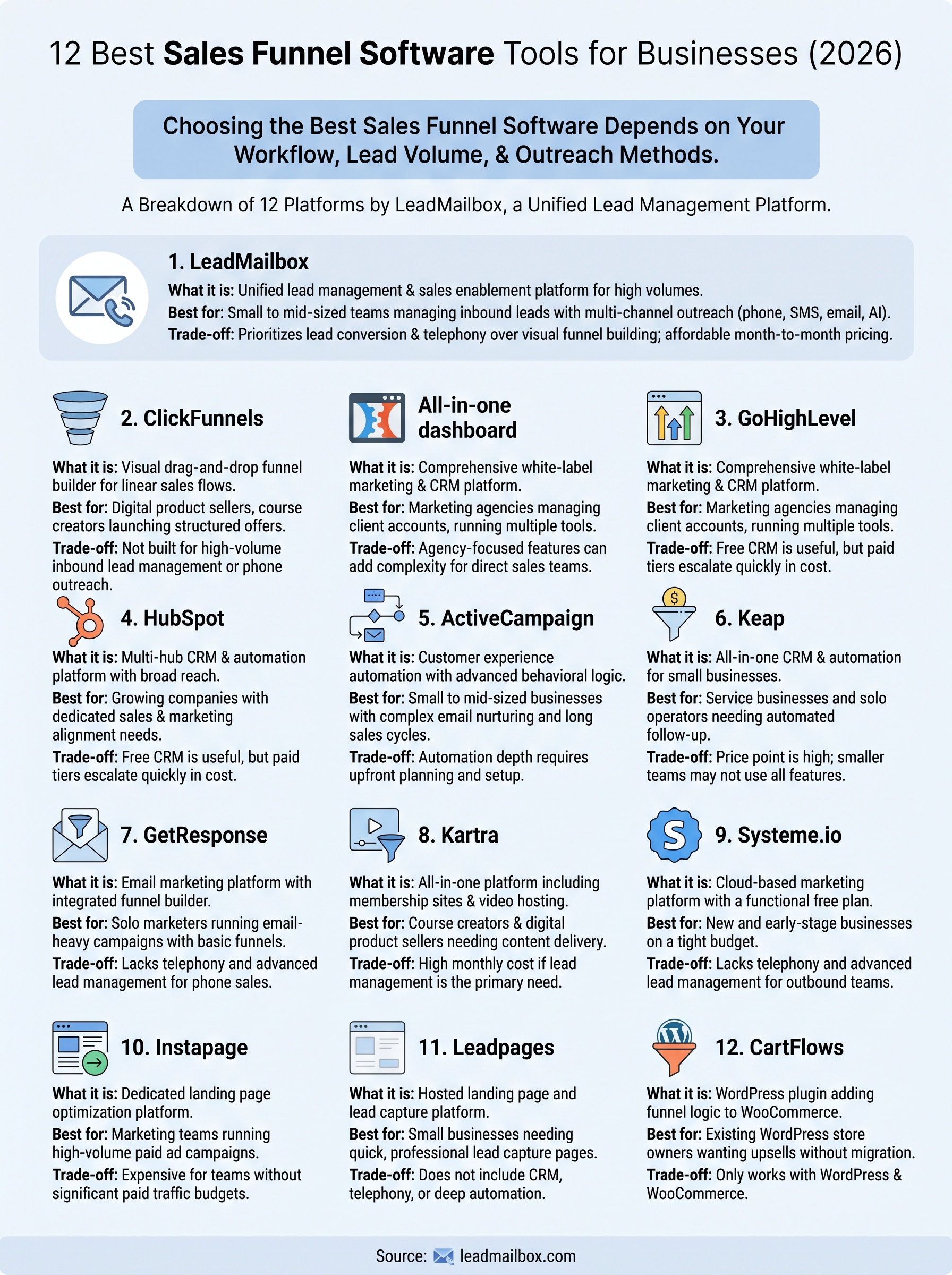
No single tool wins across every category, and the best sales funnel software for your business depends on what you actually need to do with it. Visual funnel builders like ClickFunnels and Systeme.io suit digital product sellers well. Platforms like HubSpot and ActiveCampaign fit teams that need detailed automation and CRM tracking. WordPress operators get the most out of CartFlows without leaving their existing setup.
For sales teams that manage high volumes of leads from multiple sources and depend on phone, SMS, and email outreach working together, the picture looks different. You need a platform built around lead conversion, not just page design. That's exactly where LeadMailbox fits. It covers calling, AI-powered follow-up, and multi-channel outreach in one system at a price that doesn't scale against you. If that matches how your team sells, explore what LeadMailbox can do for your pipeline.