

Best CRM for Insurance Agents: 5 Top Picks (2026)
Insurance agents juggle policy renewals, prospect follow-ups, and client onboarding, often all at once. Without a system to keep that pipeline organized, deals slip through the cracks. That's exactly why finding the best CRM for insurance agents matters: the right platform turns scattered contacts and sticky notes into a repeatable sales process that actually scales.
But not every CRM is built for how insurance agents work. Some are bloated enterprise tools with features you'll never touch. Others lack the communication tools, calling, texting, email, that drive real conversions. At LeadMailbox, we've spent 20+ years helping sales teams manage leads and close deals through an all-in-one platform with built-in telephony, SMS, email, and AI agents. So we know what separates a useful CRM from an expensive contact list.
Below, we break down five CRM platforms worth considering in 2026, what each one does well, and where they fall short.
1. LeadMailbox
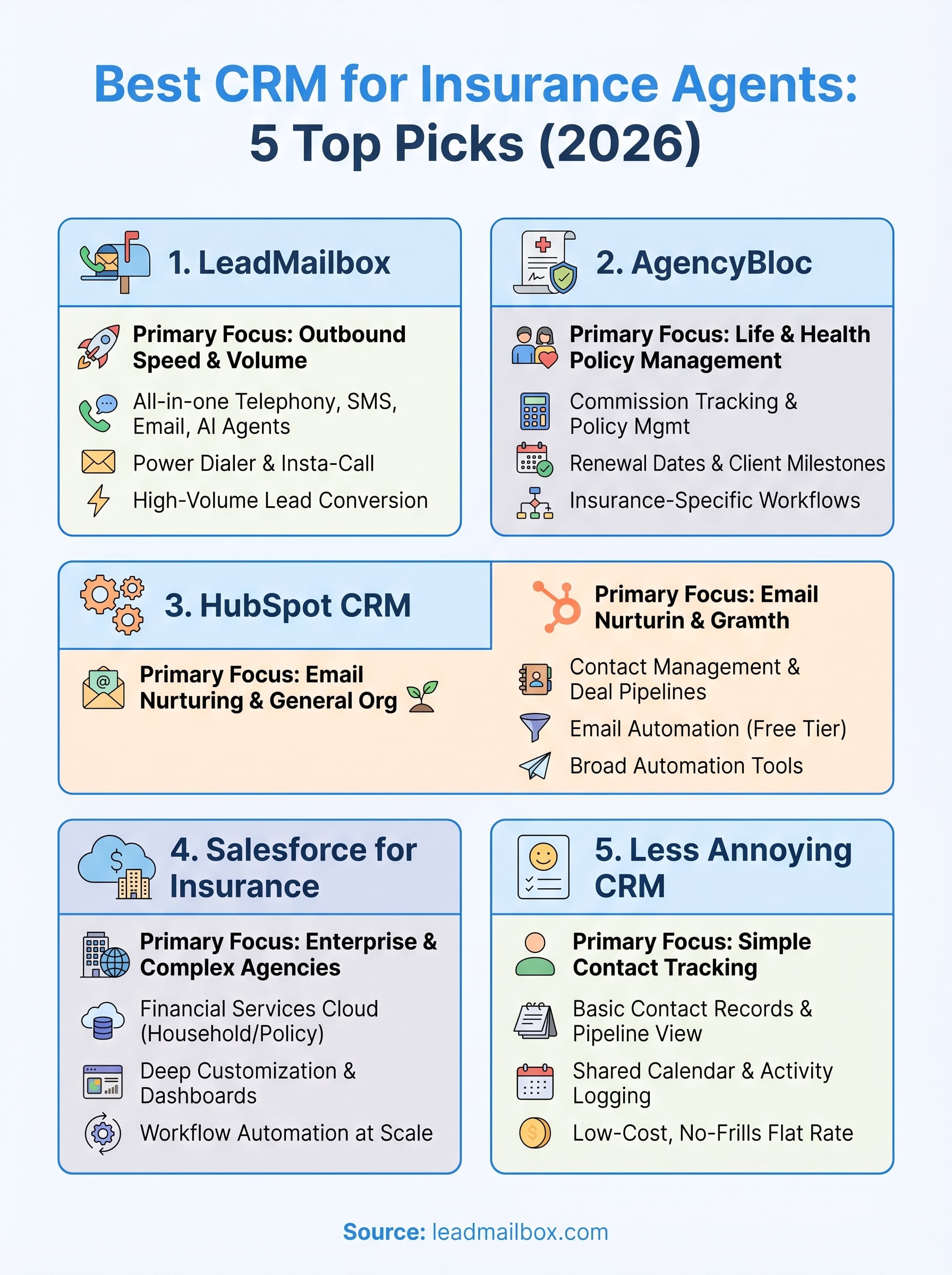
LeadMailbox is an all-in-one lead management and sales enablement platform built for sales teams that need speed and volume. For insurance agents, it combines telephony, SMS, email, and AI agents in a single subscription, cutting out the cost and complexity of managing separate tools for each channel.

Best fit
This platform fits independent insurance agents and small to mid-sized agencies that pull leads from multiple sources and need one place to work them. If your day revolves around fast outreach, follow-up texts, and drip email campaigns, LeadMailbox handles all three natively. It works especially well for:
- Agents managing high lead volume from multiple lead partners
- Teams that rely heavily on phone-based prospecting
- Businesses that want AI-assisted follow-up without hiring extra staff
Key features for insurance workflows
Your team gets a power dialer and click-to-call to reach prospects before interest fades. The insta-call feature connects inbound leads to a live agent in seconds, which directly affects conversion rates in insurance. AI agents handle incoming texts, calls, and emails, freeing your reps to focus on high-value conversations instead of administrative back-and-forth.
Speed-to-lead is critical in insurance sales. LeadMailbox's insta-call feature removes the gap between a new inquiry and a live conversation.
Limitations to know
LeadMailbox is optimized for lead conversion and outbound sales, not policy administration. If you need built-in commission tracking or compliance documentation, you will likely need a supplementary tool alongside it. The platform prioritizes pipeline activity and communication, not agency back-office management.
Pricing
Pricing follows a month-to-month subscription model with no long-term contracts locking you in. Plans scale with your team size and usage, so you are not paying for seats you do not use. Visit leadmailbox.com for current plan details and to request a demo.
2. AgencyBloc
AgencyBloc is a vertical CRM built specifically for life and health insurance agencies. Unlike general-purpose tools adapted for insurance, this platform was designed from the ground up around insurance-specific workflows, including policy tracking, renewal management, and commission processing.
Best fit
AgencyBloc fits independent agents and small agencies that focus primarily on life and health insurance lines. If your book of business centers on managing ongoing policy relationships rather than high-volume outbound prospecting, this platform aligns well with how you work day to day.
Key features for insurance workflows
The platform handles commission tracking and policy management natively, which removes the need for manual spreadsheets. Automated workflows tied to renewal dates and client milestones help you stay ahead of lapse risks. For agents evaluating the best CRM for insurance agents in the life and health space, AgencyBloc covers the back-office side that sales-focused tools typically skip.
If commission accuracy and policy compliance are daily priorities, AgencyBloc's built-in tracking features address those needs directly.
Limitations to know
AgencyBloc is narrow in scope. Agents selling P&C, commercial lines, or specialty products will find the feature set restricting. It also lacks the built-in telephony and multi-channel outreach tools that outbound-focused agencies rely on.
Pricing
AgencyBloc offers tiered monthly plans based on the size of your agency and policy volume. Exact pricing requires a direct quote from their sales team.
3. HubSpot CRM
HubSpot CRM is a widely-used general-purpose platform that many agents consider when evaluating the best CRM for insurance agents. Its free tier and broad automation tools make it a common starting point for smaller teams.
Best fit
This platform fits individual agents and small teams that focus on email-based nurturing and content-driven lead generation rather than high-volume phone prospecting. It works well if you need an organized contact database and basic pipeline visibility without significant upfront costs.
Key features for insurance workflows
The platform includes contact management, deal pipelines, and email automation out of the box. You can set up automated follow-up sequences tied to prospect behavior, keeping renewal outreach and new lead follow-up on schedule with minimal manual effort.
HubSpot's free plan covers essential CRM features, making it a low-risk starting point before committing to a paid tool.
Limitations to know
Without built-in telephony or insurance-specific features like commission tracking and policy management, HubSpot requires extra tools to cover a full insurance workflow. Costs also climb quickly in paid tiers, and most teams end up relying on third-party integrations to close the gaps.
Pricing
HubSpot offers a free core CRM plan. Paid options start at $15 per user per month and scale as you add sales and marketing hubs.
4. Salesforce for Insurance
Salesforce is the largest CRM platform on the market, and it has built dedicated tools for financial services, including insurance. Its Financial Services Cloud gives agents a structured environment for managing relationships, tracking policies, and automating sales activity across large teams.

Best fit
Salesforce works best for mid-to-large insurance agencies and enterprise teams with dedicated IT resources and budget to match. If your agency manages a complex book of business across multiple lines, the platform's customization depth is hard to beat.
Key features for insurance workflows
The Financial Services Cloud includes household and policy tracking, referral management, and pre-built dashboards designed around insurance sales cycles. Workflow automation handles routine follow-ups and pipeline stage updates, which reduces manual work at scale for teams evaluating the best CRM for insurance agents.
Salesforce's depth makes it one of the most configurable options available, but that flexibility comes with a steep setup investment.
Limitations to know
Salesforce is expensive and complex to implement. Smaller agencies often need a dedicated admin or consultant just to get the platform running the way they need it.
Pricing
Plans start at $300 per user per month for Financial Services Cloud, with implementation costs often adding significantly to the total.
5. Less Annoying CRM
Less Annoying CRM is a simple, low-cost contact management tool built for small businesses that find most CRM platforms overwhelming. It focuses on core contact tracking and pipeline visibility at a flat monthly rate with no complicated tiers to sort through.
Best fit
This platform suits solo agents and very small teams that need basic organization without the cost or complexity of a full-featured tool. If your main priority is keeping client contact details and follow-up tasks in one place, Less Annoying CRM handles that without extra friction.
Key features for insurance workflows
You get contact records, a simple pipeline view, and a shared calendar to track where each prospect stands. Basic activity logging keeps your follow-up schedule visible, which helps you avoid missed renewal calls or forgotten client outreach.
For agents just starting to organize their book of business, Less Annoying CRM offers a low-friction entry into structured contact management.
Limitations to know
The platform has no built-in telephony, automation, or insurance-specific features like policy tracking or commission management. When evaluating the best CRM for insurance agents who need to scale outreach, this tool falls short. High lead volume will push most agencies past what it can handle.
Pricing
Less Annoying CRM charges a flat $15 per user per month with no upsells or premium tiers.
Next Steps
Choosing the best CRM for insurance agents comes down to where your biggest gap is right now. If you need back-office tools like commission tracking and policy management, AgencyBloc or Salesforce make more sense. If your priority is converting leads faster through calls, texts, and automated follow-up, you need a platform built around outreach, not administration.
LeadMailbox is built for that second group. It combines telephony, SMS, email, and AI agents in one subscription, so your team spends more time talking to prospects and less time switching between tools. The month-to-month pricing means you can test it without locking into a contract.
If you manage high lead volume and need every inquiry to reach a live agent fast, see how LeadMailbox handles insurance lead management and request a demo to walk through the features your team would actually use.