

12 Affordable CRM Software for Small Business in 2026
Most small businesses don't need a CRM that costs $150 per user per month. They need something that works, fits their budget, and doesn't require a dedicated admin to set up. The problem is that searching for affordable CRM software for small business returns hundreds of options, and half of them bury their true costs behind 'contact sales' buttons and feature-gated pricing tiers that make comparison a headache.
We built LeadMailbox to solve exactly this problem, a lead management and sales enablement platform with straightforward month-to-month pricing, built-in telephony, AI agents, and campaign tools that replace the need to stitch together multiple apps. We've been doing this since 2004, so we know what small sales teams actually need versus what sounds good on a features page.
That said, every business is different. So we put together this list of 12 CRM platforms that won't drain your budget in 2026, including our own. Below, you'll find an honest breakdown of features, pricing, and trade-offs so you can pick the right tool for how your team actually sells.
1. LeadMailbox
LeadMailbox is a lead management and sales enablement platform built specifically for sales teams that need more than a basic contact list. Unlike generic CRMs that tack on communication features as an afterthought, LeadMailbox puts lead conversion at the center of everything, from the moment a lead comes in to the moment they sign.

Best for
LeadMailbox is the right fit for small to mid-sized businesses that rely on high-volume lead intake and phone-based outreach. If your team is actively calling leads, running SMS campaigns, and pulling contacts from multiple lead sources, this platform keeps all of that in one place instead of spreading it across three or four separate tools. It's especially useful for industries like insurance, real estate, home services, and financial services where speed-to-lead and consistent follow-up directly affect close rates.
Key features that matter for small teams
The telephony suite is one of LeadMailbox's strongest differentiators. You get click-to-call, a power dialer, insta-call, and inbound number management built directly into the platform, with no third-party integration required. Beyond calls, you can run SMS and email campaigns with personalization built in, so your outreach doesn't read like a form letter.
LeadMailbox also includes AI agents that handle real-time tasks your team doesn't have bandwidth for: responding to incoming texts, answering calls, and drafting emails. For a small team wearing multiple hats, that kind of automation covers gaps without adding headcount.
When you're evaluating affordable CRM software for small business, the ability to replace three or four separate subscriptions with one platform is where the real cost savings show up.
Integrations and add-ons
LeadMailbox connects with hundreds of lead partners, which makes it practical if you're buying leads from outside sources and need them to flow directly into your pipeline. The platform is designed around aggregating leads from multiple channels simultaneously, so your team sees everything in one dashboard rather than logging into separate portals throughout the day.
Pricing and plan notes
LeadMailbox uses a month-to-month subscription model, meaning you're not locked into an annual contract. That flexibility matters for small businesses managing tight cash flow or scaling up and down with seasonal demand. Pricing is transparent with no hidden feature tiers forcing you to upgrade just to access tools your team needs on day one.
Watch-outs
LeadMailbox is purpose-built for sales and lead conversion, so if you need deep project management features or complex multi-step marketing automation workflows, you may find the toolset narrower than platforms like HubSpot. It's also worth noting that the platform's value scales with call volume and lead volume, so a very early-stage business with minimal lead flow may not take full advantage of everything included in the subscription.
2. HubSpot CRM
HubSpot CRM is one of the most recognized names in the space, and its free tier draws a lot of small businesses in. The platform covers contact management, deal tracking, email logging, and basic reporting without charging you upfront, which makes it a common starting point for teams new to CRM software.
Best for
HubSpot works well for small businesses that prioritize inbound marketing alongside sales. If your team is generating leads through content, forms, or paid ads and needs a CRM that connects directly to those channels, HubSpot's ecosystem is built around that workflow. It's also a solid fit for teams that want a free tool to get organized before committing to a paid platform.
Key features that matter for small teams
The free plan includes contact and company records, deal pipelines, email tracking, and a meeting scheduler without a time limit. You also get a live chat widget and basic chatbot tools, which help small teams respond to site visitors without adding staff. Reporting dashboards are included but limited on the free tier, so you can track pipeline activity without needing to build custom reports from scratch.
If you're evaluating affordable CRM software for small business, HubSpot's free tier is a legitimate starting point, but factor in where your costs land once you need features beyond the basics.
Integrations and add-ons
HubSpot connects with over 1,500 apps through its marketplace, including Gmail, Outlook, Slack, and most major marketing platforms. The native integrations are generally straightforward to set up, which matters for small teams without dedicated IT support.
Pricing and plan notes
The free CRM is genuinely free with no expiration. Paid Sales Hub plans start at $20 per user per month (Starter), but costs climb quickly once you add multiple users or need advanced automation.
Watch-outs
HubSpot's pricing scales steeply as your team grows or your needs expand beyond the free plan. Many of the features that actually move the needle for sales teams, like sequences and advanced automation, sit behind the Professional tier, which starts at $100 per user per month.
3. Zoho CRM
Zoho CRM is a feature-rich platform that punches well above its price point. It covers the full sales cycle from lead capture to deal close, with enough customization options to fit teams that have specific workflow requirements without paying enterprise prices.
Best for
Zoho CRM is a strong fit for small businesses that want customizable pipelines and detailed reporting on a limited budget. Teams that manage both inbound and outbound sales, and need flexibility in how they track deals and contacts, will find the platform adaptable enough to match their process rather than forcing their process to fit the tool.
Key features that matter for small teams
The platform includes lead management, contact scoring, workflow automation, and sales forecasting on its paid tiers. Zoho also offers an AI assistant called Zia, which surfaces deal predictions and anomaly alerts, giving small teams data-driven insights they would normally need a dedicated analyst to generate.
If you are searching for affordable crm software for small business that covers automation without jumping to enterprise pricing, Zoho CRM's mid-tier plans offer solid value relative to what you pay.
Integrations and add-ons
Zoho CRM connects with the broader Zoho ecosystem, which includes tools for email marketing, helpdesk, accounting, and HR. Outside of that suite, the platform integrates with Google Workspace, Microsoft 365, Slack, and Mailchimp, among others, so your existing stack likely connects without much friction.
Pricing and plan notes
The free plan supports up to three users and covers basic CRM functions. Paid plans start at $14 per user per month (Standard), with the Professional tier at $23 per user per month unlocking workflow automation and inventory management.
Watch-outs
Zoho's interface can feel overwhelming for first-time CRM users because the volume of settings and modules takes time to navigate. Smaller teams without someone dedicated to setup may find the initial configuration slow, especially if they need to customize pipelines and fields before they can start working leads.
4. Bigin by Zoho
Bigin is Zoho's stripped-down CRM built specifically for small businesses that find full-featured CRMs overwhelming. Where Zoho CRM offers deep customization and a broad feature set, Bigin focuses on keeping things simple: pipelines, contacts, and communication without the extra layers you don't need yet.
Best for
Bigin is designed for very small teams and solo operators who need a structured way to manage leads and follow-ups without configuring a complex system. If you run a small service business with a handful of deals in motion at any given time, Bigin gives you a clean pipeline view and basic communication tools without the learning curve of a full CRM.
Key features that matter for small teams
Bigin includes pipeline management, contact records, email integration, and basic workflow automation at a price point that stays accessible for micro-businesses. You also get a built-in telephony feature that lets you log calls directly from the platform, which saves time on manual data entry when you're working through a short call list.
For teams evaluating affordable CRM software for small business, Bigin offers a practical entry point before committing to a more complex platform.
Integrations and add-ons
Bigin connects with Google Workspace, Microsoft 365, and Zapier, covering most of the tools a small team already uses. It also integrates with Zoho's own product suite, so if your business grows and you need to move up to Zoho CRM or add Zoho Desk for support, the transition stays within the same ecosystem.
Pricing and plan notes
Bigin offers a free plan for single users, which is one of the more generous free tiers in this category. The paid Express plan runs $7 per user per month, making it one of the lowest-cost paid CRM options on this list.
Watch-outs
Bigin's simplicity is its ceiling, not just its strength. If your team grows beyond a handful of users or your pipeline complexity increases, you will likely outgrow Bigin's feature set and need to migrate to a more robust platform, which means another round of setup and data migration.
5. Pipedrive
Pipedrive is a sales-focused CRM built around visual pipeline management. The platform puts deal tracking front and center, so your team spends less time navigating menus and more time moving leads through the funnel.
Best for
Pipedrive works well for small sales teams that run structured, deal-driven pipelines and want a clear visual of where every opportunity sits. If your team manages multiple concurrent deals and needs a simple way to track activity and next steps without getting buried in feature complexity, Pipedrive's layout fits that workflow naturally.
Key features that matter for small teams
The drag-and-drop pipeline view is the core of the product, letting your team update deal stages quickly without extra clicks. Pipedrive also includes activity reminders, email tracking, and a built-in meeting scheduler, which keeps follow-up consistent even when your team is stretched thin. Reporting covers pipeline health, conversion rates, and individual rep performance without requiring custom configuration.
If you're evaluating affordable CRM software for small business specifically for outbound sales, Pipedrive's activity-based selling approach gives your team a clear framework for daily priorities.
Integrations and add-ons
Pipedrive connects with over 400 apps through its marketplace, including Google Workspace, Microsoft 365, Slack, and Zapier. LeadBooster, its lead generation add-on, gives you chatbot and web form tools if you want to capture inbound leads directly from your site.
Pricing and plan notes
Pipedrive has no free plan, but its Essential tier starts at $14 per user per month (billed annually). The Advanced tier at $29 per user per month unlocks email automation and full email sync, which most active sales teams will need.
Watch-outs
Pipedrive has limited built-in marketing tools, so if your team needs SMS campaigns or advanced email marketing, you will need to add separate software. The annual billing requirement for lower pricing also reduces flexibility compared to month-to-month options.
6. Freshsales
Freshsales is a CRM from Freshworks that combines contact management, built-in phone and email, and AI-powered lead scoring in a single platform. It targets sales teams that want meaningful automation without paying enterprise prices.
Best for
Small to mid-sized sales teams that handle consistent lead volume will find Freshsales a practical fit. If your team needs both inbound lead management and outbound calling tools without adding separate software, this platform covers both in one place.
Key features that matter for small teams
The platform includes a built-in phone system with call recording, two-way email sync, and an AI assistant called Freddy that scores leads based on behavior and engagement. Your team gets a clear view of which leads to prioritize without manually sorting through the pipeline.
If you're looking for affordable CRM software for small business that blends phone, email, and AI lead scoring in one tool, Freshsales covers all three without requiring add-ons.
Workflow automation lets you trigger follow-up tasks, emails, and field updates based on deal stage or lead activity, which reduces the manual work your team handles between touchpoints.
Integrations and add-ons
Your integration options cover Google Workspace, Microsoft 365, and Slack, along with the broader Freshworks suite, which includes support and marketing tools. Zapier connectivity extends the platform to hundreds of additional apps if your existing stack includes tools outside the Freshworks ecosystem.
Pricing and plan notes
Freshsales offers a free plan for unlimited users that covers basic contact management and a built-in phone. Paid plans start at $9 per user per month on the Growth tier (billed annually), which adds AI lead scoring and workflow automation.
Watch-outs
The free plan excludes workflow automation, so your team handles follow-ups manually until you upgrade. Reporting on lower tiers is also limited, which makes it harder to track pipeline trends and rep performance without moving to a higher-cost plan.
7. monday CRM
monday CRM is built on the monday.com work OS platform, which means it brings a visual, spreadsheet-style interface to sales pipeline management. Teams that already use monday.com for project work will find the CRM layer fits into their existing workflow without a steep learning curve.

Best for
monday CRM suits small businesses that manage both sales and project delivery in parallel, such as agencies, consultants, and service businesses where a deal closing triggers a client project. If your team already lives in monday.com, adding the CRM keeps everything in one place instead of splitting work across separate tools.
Key features that matter for small teams
The platform gives you customizable pipeline boards, contact management, and activity tracking with a drag-and-drop layout that most teams can configure without IT support. You also get email sync and automated follow-up reminders, which help small teams stay on top of leads without building complex automation sequences from scratch.
If you're comparing affordable CRM software for small business, monday CRM's visual layout is one of the more intuitive options for teams that struggle with traditional CRM interfaces.
Integrations and add-ons
monday CRM connects with Gmail, Outlook, Slack, Zoom, and Zapier, along with a broad app marketplace covering marketing, support, and finance tools. The native monday.com integrations are a key advantage if you already use other boards on the platform for operations or project tracking.
Pricing and plan notes
monday CRM has no permanent free plan, but a 14-day trial is available. Paid plans start at $12 per seat per month (billed annually) on the Basic tier, with the Standard tier at $17 per seat per month adding timeline views and automation.
Watch-outs
The seat-based pricing adds up quickly for teams with more than a few users. monday CRM also lacks built-in telephony, so phone-heavy sales teams will need a separate calling solution.
8. Less Annoying CRM
Less Annoying CRM does exactly what its name suggests. The platform strips out everything a small business does not need and focuses on contact management, pipeline tracking, and follow-up reminders in a clean interface that most teams can learn in an afternoon.
Best for
Small businesses and solo operators with straightforward sales processes are where this platform fits best. If your main need is knowing who to call next and when, Less Annoying CRM delivers that without layers of features your team will never touch.
Key features that matter for small teams
The platform gives you a single, flat pipeline view with customizable fields, task reminders, and a daily agenda email that surfaces your priority follow-ups each morning. Every contact record shows full interaction history, notes, and upcoming tasks in one place, so your team spends less time searching for context before a call.
For teams searching for affordable CRM software for small business without a long setup process, Less Annoying CRM is one of the fastest platforms to get running on day one.
Integrations and add-ons
Less Annoying CRM keeps its integration list intentionally short and focused. You get native connections with Google Calendar and Mailchimp, plus broader connectivity through Zapier. If your stack relies heavily on third-party tools, this platform's limited native integrations may feel restrictive.
Pricing and plan notes
Pricing is flat: $15 per user per month, with no tiers and no annual commitment required. Every user gets full access to all features, which removes the frustration of finding that a key tool sits behind a higher plan.
Watch-outs
Built-in calling, SMS, and email campaign tools are not part of the package, so sales teams with high outbound volume will need separate software to cover those gaps. Reporting is also limited across all plans, making it harder to track pipeline trends or forecast performance as your team scales.
9. OnePageCRM
OnePageCRM is built around a single-action sales methodology where every contact in your pipeline has one clear next action assigned to it. This design forces your team to decide what to do with each lead rather than letting contacts sit idle in a list with no follow-up plan.
Best for
Small businesses and solo sales reps who lose deals to missed follow-ups will get the most out of OnePageCRM. If your team struggles to prioritize a growing contact list and needs a system that removes decision fatigue from daily sales work, this platform's action-stream layout does that job better than a traditional pipeline view.
Key features that matter for small teams
OnePageCRM's action stream sits at the center of the product, surfacing your most urgent contacts at the top of the queue based on the next action date you set. You also get contact management, deal tracking, and email integration that work together to keep your pipeline moving without manual sorting every morning. The platform includes basic email templates and a click-to-call feature that logs calls directly to contact records.
For teams comparing affordable CRM software for small business, OnePageCRM's action-focused design cuts out the pipeline clutter that causes follow-ups to stall.
Integrations and add-ons
OnePageCRM connects with Gmail, Outlook, Mailchimp, and Zapier, covering the tools most small sales teams already use. You also get integrations with Zoom and Skype so your team can log video calls directly to contact records without switching between apps.
Pricing and plan notes
OnePageCRM offers a 21-day free trial with no credit card required. Paid plans start at $9.95 per user per month (billed annually) on the Professional tier, which includes unlimited contacts and deals.
Watch-outs
The platform's narrow focus on the action stream makes it a poor fit for teams that need advanced reporting or multi-channel outreach tools. If your sales process involves SMS campaigns or power dialing, you will need separate software to fill those gaps.
10. EngageBay
EngageBay is an all-in-one platform that combines CRM, marketing automation, and customer support tools at a price point designed for small business budgets. It targets businesses that want to consolidate their sales and marketing stack without paying for separate tools.

Best for
EngageBay fits best for small businesses that handle both marketing and sales in-house and want a single platform to manage the full customer lifecycle. If your team runs email campaigns, tracks deals, and handles support tickets, EngageBay reduces the cost and friction of managing three separate subscriptions.
Key features that matter for small teams
The platform includes contact management, email marketing, deal pipelines, and landing page builders across its plans. You also get lead scoring and behavior-based email sequences, so your team can automate follow-ups based on how leads interact with your messages rather than manually monitoring activity.
If you are looking for affordable CRM software for small business that covers both marketing and sales workflows, EngageBay's combined toolset gives you more functionality per dollar than most single-purpose CRMs.
Appointment scheduling and live chat are built into the platform, which small teams can use to reduce back-and-forth with prospects without adding separate software for booking or site communication.
Integrations and add-ons
EngageBay connects with Gmail, Outlook, Zapier, and Stripe, covering the core tools most small teams already rely on. The Zapier connection extends your options significantly if your stack includes apps outside the native integration list.
Pricing and plan notes
EngageBay offers a free plan for up to 15 users that includes email marketing, CRM, and live chat. Paid plans start at $12.74 per user per month (billed annually) on the Basic tier, which adds more contacts and marketing automation.
Watch-outs
EngageBay's reporting tools are limited on lower tiers, which makes pipeline forecasting difficult without upgrading. The platform's interface also has a learning curve if your team is new to combined CRM and marketing tools.
11. Bitrix24
Bitrix24 is a free-to-start platform that combines CRM, project management, and internal team collaboration tools in a single workspace. For small businesses that want to consolidate sales activity alongside team communication, the platform covers a wide range of functions without requiring multiple separate subscriptions.
Best for
Bitrix24 fits small businesses and growing teams that need both sales pipeline management and internal collaboration in one place. If your team tracks deals, runs projects, and communicates internally, this platform reduces the number of tools you need to manage daily.
Key features that matter for small teams
The platform includes lead and deal management, a built-in phone system, email marketing, and task management across its plans. You also get a website builder and live chat widget, which helps small teams capture leads from their site without adding a separate tool. For teams evaluating affordable CRM software for small business, the combination of sales and collaboration features in one dashboard is a meaningful cost advantage.
Bitrix24's free plan supports unlimited users, which is rare at this price point and makes it a serious option for budget-conscious teams.
Integrations and add-ons
Bitrix24 connects with Google Workspace, Microsoft 365, Mailchimp, and Zapier, along with a marketplace of additional apps. The platform also supports open API access, giving technical teams flexibility to build custom integrations if your stack includes tools outside the standard marketplace.
Pricing and plan notes
The free plan is unlimited in users and covers basic CRM, tasks, and collaboration. Paid plans start at $49 per month for five users (billed annually) on the Basic tier, which adds more storage, marketing tools, and online store features.
Watch-outs
Bitrix24's interface is dense, and new users often report a steep learning curve before the platform feels comfortable. The volume of features can slow your team down during setup, particularly if you only need the CRM functions and have no interest in the project or collaboration layers.
12. Insightly
Insightly is a CRM built with project-oriented businesses in mind. It combines deal tracking with post-sale project management in a single platform, which makes it a practical option for small businesses where winning a client is only the first step in the relationship.
Best for
Insightly works best for small businesses that need to manage both the sales pipeline and client delivery in one place. Consulting firms, agencies, and professional service businesses that transition a closed deal directly into a project will find the dual-purpose design saves them from bouncing between a CRM and a separate project management tool.
Key features that matter for small teams
The platform connects contact and deal records directly to project records, so your team has full context on every client without rebuilding information from scratch after the sale closes. Insightly also includes workflow automation and email templates that reduce repetitive manual tasks during both the sales and delivery phases.
If you are evaluating affordable CRM software for small business and your work does not stop at the close, Insightly's linked sales-to-project structure is one of the more practical approaches on this list.
Integrations and add-ons
Insightly connects with Google Workspace, Microsoft 365, Slack, and QuickBooks, covering the tools most small service businesses already use. Zapier support extends the platform further if your stack includes apps outside the native integration list.
Pricing and plan notes
Insightly offers a free plan for up to two users that covers basic CRM functions. Paid plans start at $29 per user per month on the Plus tier (billed annually), which adds project management features, workflow automation, and more pipeline customization options.
Watch-outs
The free plan is limited to two users, which cuts it out as a starting point for any team beyond a solo operator plus one partner. Insightly also lacks built-in telephony, so high-volume calling teams will need to add a separate phone solution.
Next steps
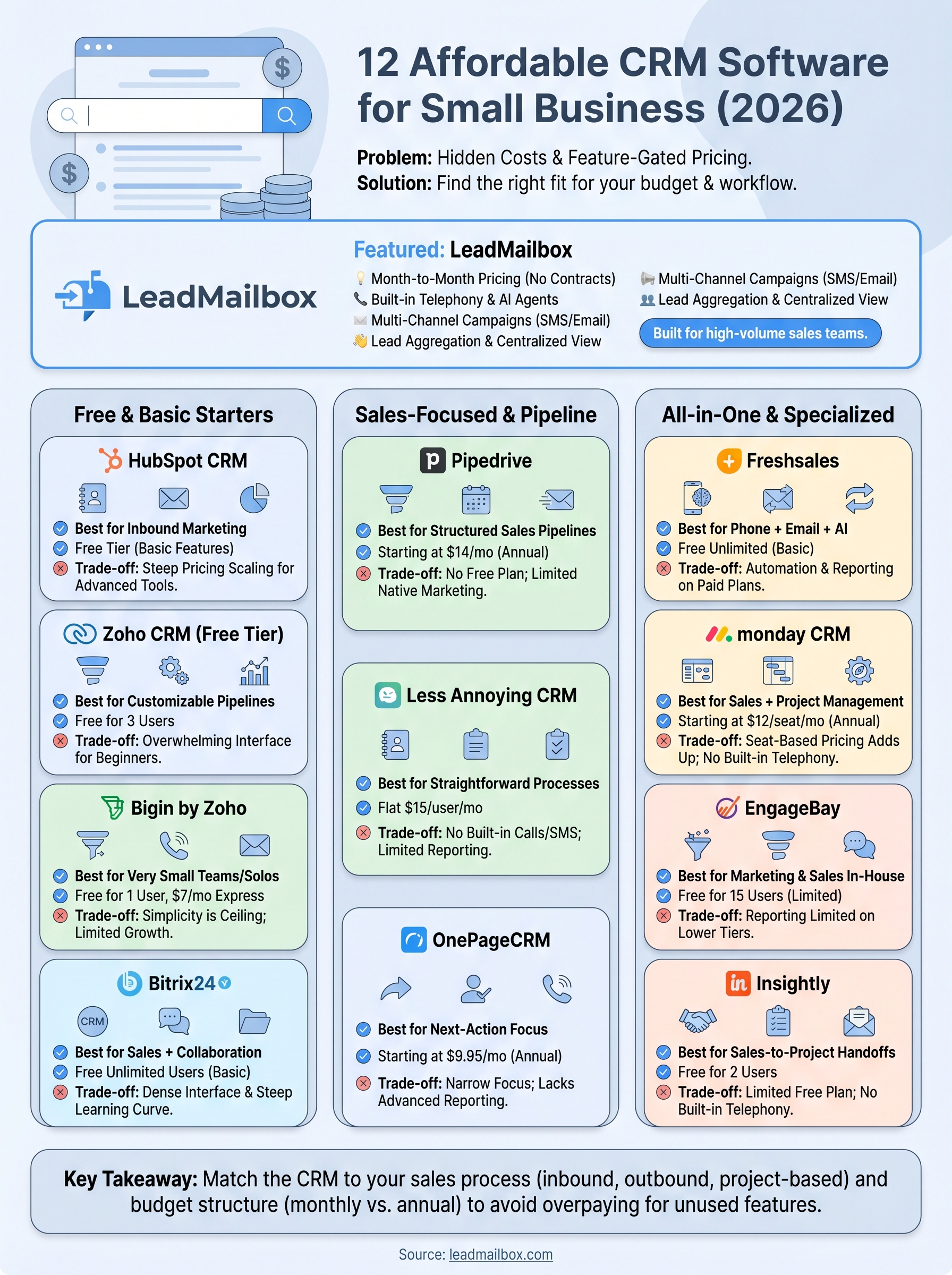
Picking the right affordable CRM software for small business comes down to matching the tool to how your team actually sells. If you run a lean operation with basic pipeline needs, options like Less Annoying CRM or Bigin will cover the essentials without overcomplicating your workflow. If your team handles high call volumes, multi-source leads, and outbound campaigns, you need a platform built around those realities from the ground up, not one that treats them as optional add-ons.
LeadMailbox combines lead aggregation, a full telephony suite, AI agents, and SMS and email campaigns in one platform with month-to-month pricing and no long-term contracts. You get the tools your sales team needs without paying for a system designed for enterprise teams. If that sounds like the right fit, see what LeadMailbox can do for your sales team and start moving leads through your pipeline faster.